


The relationship between anogenital distance, fatherhood, and fertility in adult men
- PMID: 21589916
- PMCID: PMC3092750
- DOI: 10.1371/journal.pone.0018973
The relationship between anogenital distance, fatherhood, and fertility in adult men
Abstract
Background: Anogenital distance (AGD), a sexually dimorphic measure of genital development, is a marker for endocrine disruption in animal studies and may be shorter in infant males with genital anomalies. Given the correlation between anogenital distance and genital development, we sought to determine if anogenital distance varied in fertile compared to infertile adult men.
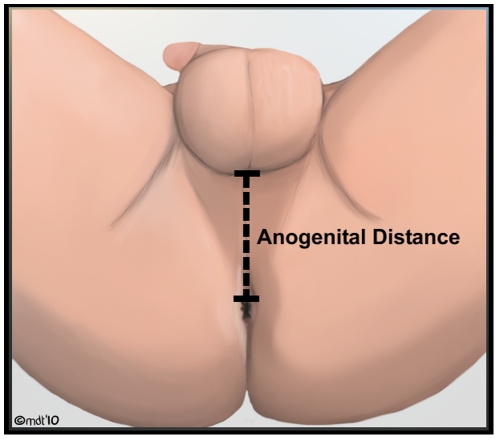
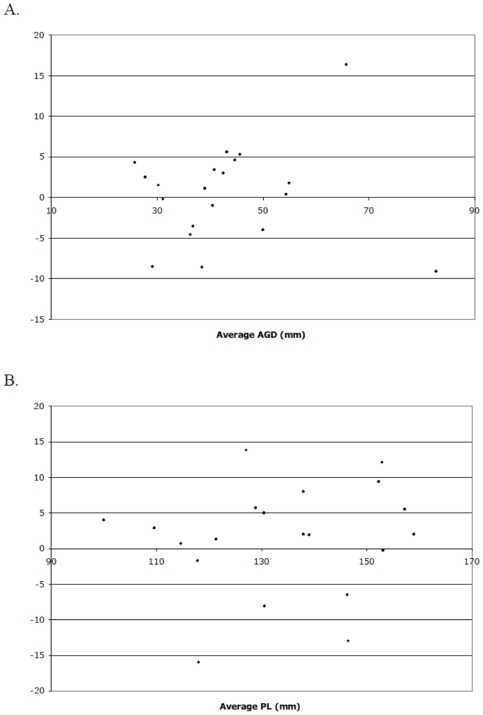
Methods: A cross sectional study of consecutive men being evaluated for infertility and men with proven fertility was recruited from an andrology clinic. Anogenital distance (the distance from the posterior aspect of the scrotum to the anal verge) and penile length (PL) were measured using digital calipers. ANOVA and linear regression were used to determine correlations between AGD, fatherhood status, and semen analysis parameters (sperm density, motility, and total motile sperm count).
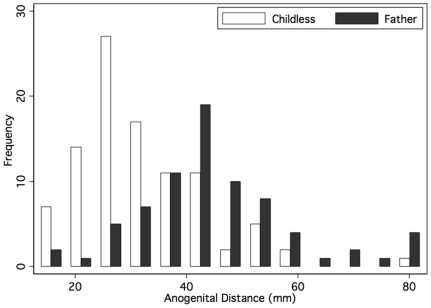
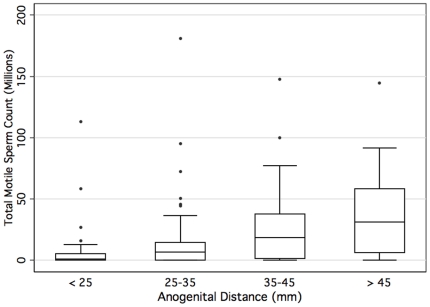
Findings: A total of 117 infertile men (mean age: 35.3±17.4) and 56 fertile men (mean age: 44.8±9.7) were recruited. The infertile men possessed significantly shorter mean AGD and PL compared to the fertile controls (AGD: 31.8 vs 44.6 mm, PL: 107.1 vs 119.5 mm, p<0.01). The difference in AGD persisted even after accounting for ethnic and anthropomorphic differences. In addition to fatherhood, on both unadjusted and adjusted linear regression, AGD was significantly correlated with sperm density and total motile sperm count. After adjusting for demographic and reproductive variables, for each 1 cm increase in a man's AGD, the sperm density increases by 4.3 million sperm per mL (95% CI 0.53, 8.09, p = 0.03) and the total motile sperm count increases by 6.0 million sperm (95% CI 1.34, 10.58, p = 0.01). On adjusted analyses, no correlation was seen between penile length and semen parameters.
Conclusion: A longer anogenital distance is associated with fatherhood and may predict normal male reproductive potential. Thus, AGD may provide a novel metric to assess reproductive potential in men.
Conflict of interest statement
Figures
Comment in
-
Re: The relationship between anogenital distance, fatherhood, and fertility in adult men.J Urol. 2012 Jan;187(1):240. doi: 10.1016/j.juro.2011.08.093. Epub 2011 Nov 25. J Urol. 2012. PMID: 22153461 No abstract available.
References
-
- Davis DL, Gottlieb MB, Stampnitzky JR. Reduced ratio of male to female births in several industrial countries: a sentinel health indicator? JAMA. 1998;279:1018–1023. - PubMed
-
- Skakkebaek NE, Rajpert-De Meyts E, Jorgensen N, Main KM, Leffers H, et al. Testicular cancer trends as ‘whistle blowers’ of testicular developmental problems in populations. Int J Androl. 2007;30:198–204; discussion 204–195. - PubMed
-
- te Velde E, Burdorf A, Nieschlag E, Eijkemans R, Kremer JA, et al. Is human fecundity declining in Western countries? Hum Reprod. 2010;25:1348–1353. - PubMed
-
- Greenham LW, Greenham V. Sexing mouse pups. Lab Anim. 1977;11:181–184. - PubMed
MeSH terms
LinkOut - more resources
Full Text Sources
