. 2011 Aug;123(3):493-508.
doi: 10.1007/s00122-011-1602-z. Epub 2011 May 18.

A genome-wide genetic map of NB-LRR disease resistance loci in potato

Affiliations

A genome-wide genetic map of NB-LRR disease resistance loci in potato

Erin Bakker et al. Theor Appl Genet. 2011 Aug.

Abstract

Like all plants, potato has evolved a surveillance system consisting of a large array of genes encoding for immune receptors that confer resistance to pathogens and pests. The majority of these so-called resistance or R proteins belong to the super-family that harbour a nucleotide binding and a leucine-rich-repeat domain (NB-LRR). Here, sequence information of the conserved NB domain was used to investigate the genome-wide genetic distribution of the NB-LRR resistance gene loci in potato. We analysed the sequences of 288 unique BAC clones selected using filter hybridisation screening of a BAC library of the diploid potato clone RH89-039-16 (S. tuberosum ssp. tuberosum) and a physical map of this BAC library. This resulted in the identification of 738 partial and full-length NB-LRR sequences. Based on homology of these sequences with known resistance genes, 280 and 448 sequences were classified as TIR-NB-LRR (TNL) and CC-NB-LRR (CNL) sequences, respectively. Genetic mapping revealed the presence of 15 TNL and 32 CNL loci. Thirty-six are novel, while three TNL loci and eight CNL loci are syntenic with previously identified functional resistance genes. The genetic map was complemented with 68 universal CAPS markers and 82 disease resistance trait loci described in literature, providing an excellent template for genetic studies and applied research in potato.


Figures
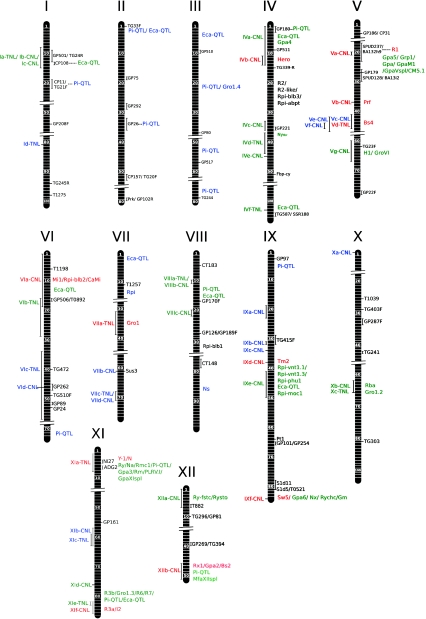
Fig. 1
Fig. 1
Schematic representation of the genome-wide integrated genetic map of RGHs and resistance trait loci in potato. Chromosomes or linkage groups are represented by broad vertical bars with the bin signatures (van Os et al. 2006) separated by white horizontal bars. To the right of each linkage group, genetic markers are indicated in black. Previously described R genes which reside at syntenic loci are indicated in red and previously described R genes for which no syntenic loci is shown are indicated in black. Resistance trait loci that map approximately to an RGH locus are indicated in green and otherwise in blue. Horizontal dashed bars indicate that the marker used to map a previously described resistance trait locus is also mapped in the UHD map. To the left of each linkage group, RGH (TNL and CNL) loci are indicated in red if they are syntenic to previously described R genes, in green if they map approximately at the same location as a resistance trait locus and in blue if they do not. Thin vertical bars represent genetic intervals and thin horizontal bars a genetic map position
Fig. 2
Fig. 2
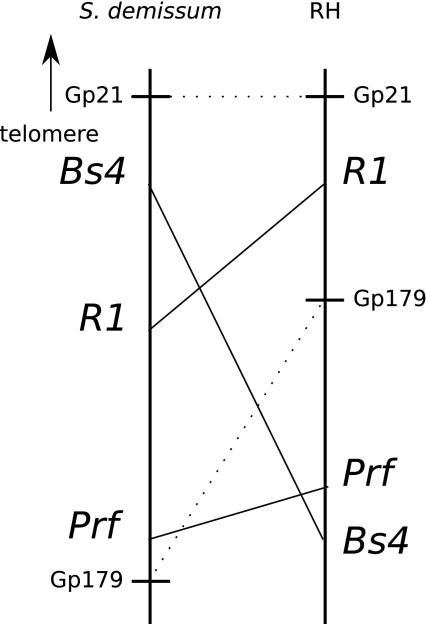
Comparative map representing the short arm of chromosome V of S. demissum and S. tuberosum (RH). The vertical bars represent the genetic maps. Genetic positions of markers Gp21 and Gp179 are indicated with a horizontal bar and their comparison between the two maps with a dashed line. Comparison of the RGH loci syntenic to Bs4, R1 and Prf are indicated with lines. The direction of the telomere is indicated with an arrow

References

    1. Altschul SF, Gish W, Miller W, Myers EW, Lipman DJ. Basic local alignment search tool. J Mol Biol. 1990;215:403–410. - PubMed
    1. Anderson PA, Lawrence GJ, Morrish BC, Ayliffe MA, Finnegan EJ, Ellis JG. Inactivation of the flax rust resistance gene M associated with loss of a repeated unit within the leucine-rich repeat coding region. Plant Cell. 1997;9:641–651. - PMC - PubMed
    1. Ashfield T, Ong LE, Nobuta K, Schneider CM, Innes RW. Convergent evolution of disease resistance gene specificity in two flowering plant families. Plant Cell. 2004;16:309–318. - PMC - PubMed
    1. Bai J, Pennill LA, Ning J, Lee SW, Ramalingam J, Webb CA, Zhao B, Sun Q, Nelson JC, Leach JE, Hulbert SH. Diversity in nucleotide binding site-leucine-rich repeat genes in cereals. Genome Res. 2002;12:1871–1884. - PMC - PubMed
    1. Bakari KA, Marie-Claire K, Bernard C, Jean-Paul D, Didier F, Maria MD, Daniel E, Didier M. A major gene mapped on chromosome XII is the main factor of a quantitatively inherited resistance to Meloidogyne fallax in Solanum sparsipilum. Theor Appl Genet. 2006;112:699–707. - PubMed

Publication types

LinkOut - more resources