


Hippocampal activation correlates with visual confrontation naming: fMRI findings in controls and patients with temporal lobe epilepsy
- PMID: 21592730
- PMCID: PMC3229979
- DOI: 10.1016/j.eplepsyres.2011.04.007
Hippocampal activation correlates with visual confrontation naming: fMRI findings in controls and patients with temporal lobe epilepsy
Abstract
Purpose: In patients with left temporal lobe epilepsy (TLE) due to hippocampal sclerosis (HS) decreased naming ability is common, suggesting a critical role for the medial left temporal lobe in this task. We investigated the integrity of language networks with functional MRI (fMRI) in controls and TLE patients.
Experimental design: We performed an fMRI verbal fluency paradigm in 22 controls and 66 patients with unilateral mesial TLE (37 left HS, 29 right HS). Verbal fluency and naming ability were investigated as part of the standard presurgical neuropsychological assessment. Naming ability was assessed using a visual confrontation naming test.
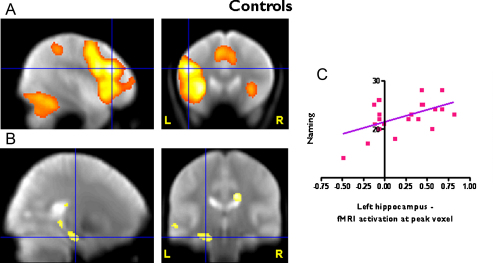
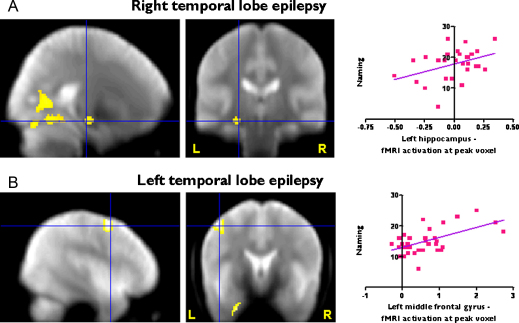
Results: Left TLE patients had significantly lower naming scores than controls and those with right TLE. Right TLE patients performed less well than controls, but better than those with left TLE. Left TLE had significantly lower scores for verbal fluency than controls. In controls and right TLE, left hippocampal activation during the verbal fluency task was significantly correlated with naming, characterised by higher scores in subjects with greater hippocampal fMRI activation. In left TLE no correlation with naming scores was seen in the left hippocampus, but there was a significant correlation in the left middle and inferior frontal gyri, not observed in controls and right TLE. In left and right TLE, out of scanner verbal fluency scores significantly correlated with fMRI activation for verbal fluency in the left middle and inferior frontal gyri.
Conclusion: Good confrontation naming ability depends on the integrity of the hippocampus and the connecting fronto-temporal networks. Functional MRI activation in the left hippocampus during verbal fluency is associated with naming function in healthy controls and patients with right TLE. In left TLE, there was evidence of involvement of the left frontal lobe when naming was more proficient, most likely reflecting a compensatory response due to the ongoing epileptic activity and/or underlying pathology.
Copyright © 2011 Elsevier B.V. All rights reserved.
Figures
References
-
- Bartha L., Brenneis C., Schocke M., Trinka E., Koylu B., Trieb T., Kremser C., Jaschke W., Bauer G., Poewe W., Benke T. Medial temporal lobe activation during semantic language processing: fMRI findings in healthy left- and right-handers. Brain Res. Cogn. Brain Res. 2003;17:339–346. - PubMed
-
- Bartha L., Marien P., Brenneis C., Trieb T., Kremser C., Ortler M., Walser G., Dobesberger J., Embacher N., Gotwald T., Karner E., Koylu B., Bauer G., Trinka E., Benke T. Hippocampal formation involvement in a language-activation task in patients with mesial temporal lobe epilepsy. Epilepsia. 2005;46:1754–1763. - PubMed
-
- Bell B.D., Davies K.G. Anterior temporal lobectomy, hippocampal sclerosis, and memory: recent neuropsychological findings. Neuropsychol. Rev. 1998;8:25–41. - PubMed
-
- Bell B.D., Hermann B.P., Woodard A.R., Jones J.E., Rutecki P.A., Sheth R., Dow C.C., Seidenberg M. Object naming and semantic knowledge in temporal lobe epilepsy. Neuropsychology. 2001;15:434–443. - PubMed
-
- Bell B.D., Seidenberg M., Hermann B.P., Douville K. Visual and auditory naming in patients with left or bilateral temporal lobe epilepsy. Epilepsy Res. 2003;55:29–37. - PubMed
Publication types
MeSH terms
Substances
Grants and funding
LinkOut - more resources
Full Text Sources
