Review
. 2011 Jul;21(7):409-15.
doi: 10.1016/j.tcb.2011.04.003. Epub 2011 May 17.

Formation of mammalian erythrocytes: chromatin condensation and enucleation

Affiliations
Review

Formation of mammalian erythrocytes: chromatin condensation and enucleation

Peng Ji et al. Trends Cell Biol. 2011 Jul.

Abstract

In all vertebrates, the cell nucleus becomes highly condensed and transcriptionally inactive during the final stages of red cell biogenesis. Enucleation, the process by which the nucleus is extruded by budding off from the erythroblast, is unique to mammals. Enucleation has critical physiological and evolutionary significance in that it allows an elevation of hemoglobin levels in the blood and also gives red cells their flexible biconcave shape. Recent experiments reveal that enucleation involves multiple molecular and cellular pathways that include histone deacetylation, actin polymerization, cytokinesis, cell-matrix interactions, specific microRNAs and vesicle trafficking; many evolutionarily conserved proteins and genes have been recruited to participate in this uniquely mammalian process. In this review, we discuss recent advances in mammalian erythroblast chromatin condensation and enucleation, and conclude with our perspectives on future studies.


Figures

Figure 1
Figure 1
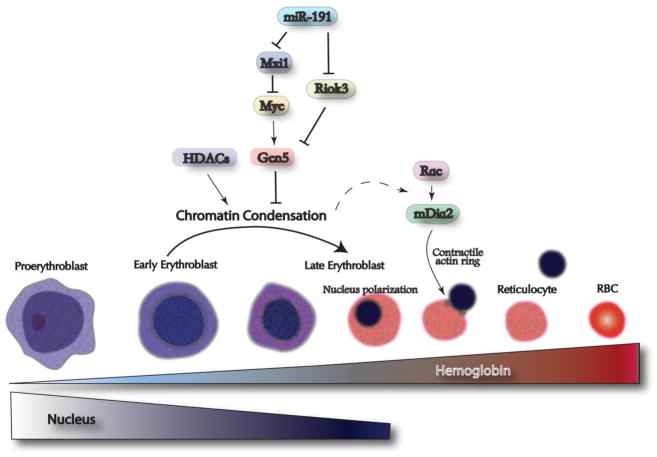
Enucleation of mammalian erythroblast requires multiple molecular and cellular pathways. During mammalian erythroblast differentiation, the chromatin gradually condenses while the hemoglobin concentration gradually increases. Chromatin condensation involves histone deacetylation that is controlled by up-regulation of histone deacetylases (HDACs) and down-regulation of histone acetyltransferases (Gcn5). Gcn5 is directly regulated by c-myc, whose level gradually decreases during erythropoiesis. In addition, miR-191, an erythroid specific microRNA, targets Mxi1 and Riok3 to regulate c-myc and Gcn5, respectively. Subsequently, chromatin condensation may provide unknown signals to activate the Rac-GTPases-mDia2 pathway, which is required for contractile actin ring formation and enucleation.
Figure 2
Figure 2
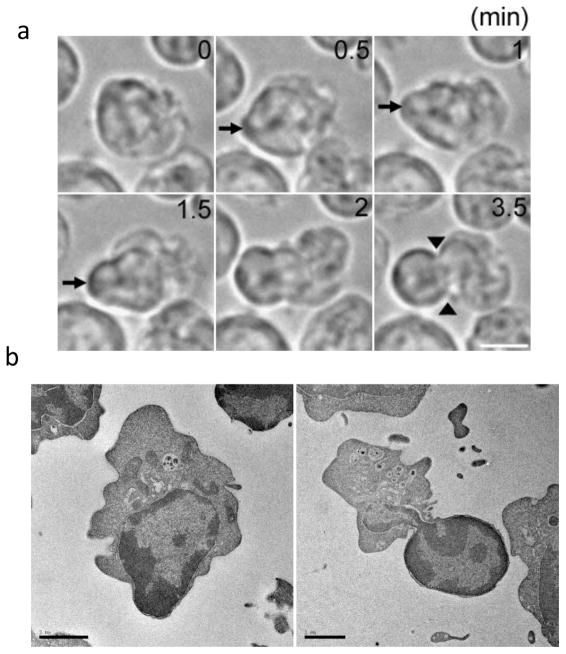
During enucleation the nucleus is rapidly squeezed out from the cell, forming a bleb-like structure. (a) Time-lapse live-cell imaging of late erythroblasts undergoing nuclear extrusion. The nucleus is quickly squeezed out from a limited area of the cortex facing the nucleus, forming the bleb-like structure (arrows). Note that the nucleus becomes largely deformed during enucleation, and that a cytokinetic-like furrow is observed at the neck region of the bleb-like protrusion (arrowheads). Scale bar, 5 μm.(b) Electron microscope images of late erythroblasts undergoing enucleation in an in vitro culture system. Shown are late erythroblasts at early (left) and late (right) stages of nuclear extrusion. These images show deformed nuclei and cytokinesis-like furrows similar to what has been seen in erythroid cells from mice [10], indicating that late erythroblasts in the in vitro culture system reproduce the in vivo situation. The images were taken by T. Ramirez and M. Murata-Hori. Scale bar, 2 μm.

References

    1. Eshghi S, et al. Alpha4beta1 integrin and erythropoietin mediate temporally distinct steps in erythropoiesis: integrins in red cell development. J Cell Biol. 2007;177:871–880. - PMC - PubMed
    1. Zhang J, et al. Role of Ras signaling in erythroid differentiation of mouse fetal liver cells: functional analysis by a flow cytometry-based novel culture system. Blood. 2003;102:3938–3946. - PubMed
    1. Neelin JM, et al. The Histones of Chicken Erythrocyte Nuclei. Can J Biochem Physiol. 1964;42:1743–1752. - PubMed
    1. Hnilica LS. The specificity of histones in chicken erythrocytes. Experientia. 1964;20:13–14. - PubMed
    1. Miki BL, Neelin JM. The histones of rainbow trout erythrocytes include an erythrocyte-specific histone. Can J Biochem. 1975;53:1158–1169. - PubMed

Publication types