


Long-term habituation to food in obese and nonobese women
- PMID: 21593492
- PMCID: PMC3142716
- DOI: 10.3945/ajcn.110.009035
Long-term habituation to food in obese and nonobese women
Abstract
Background: Habituation is a form of learning in which repeated exposure to a stimulus leads to a decrease in responding. Eating involves repeated presentation of the same food stimulus in a meal, and habituation is reliably observed within a meal such that faster rates of habituation are associated with less energy intake. It is possible that repeated presentation of the same food over days will lead to long-term habituation, such that subjects habituate to foods repeated over meals. However, no research on long-term habituation to food in humans has been conducted.
Objective: The current study was designed to assess long-term habituation in 16 obese and 16 nonobese premenopausal women.
Design: Obese and nonobese women (aged 20-50 y) were randomly assigned to receive a macaroni and cheese meal presented 5 times, either daily for 1 wk or once per week for 5 wk.
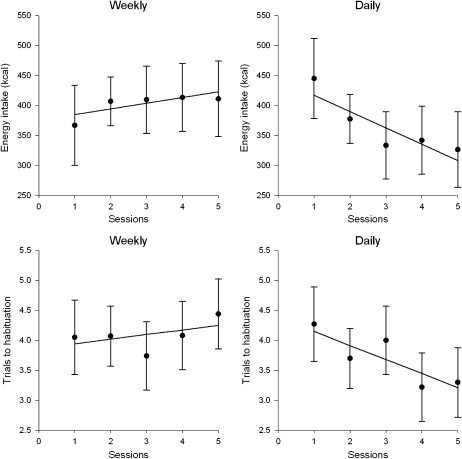
Results: In both obese and nonobese women, daily presentation of food resulted in faster habituation and less energy intake than did once-weekly presentation of food.
Conclusions: Long-term habituation was observed when the same food was presented at daily meals but not when presented once weekly for 5 wk. These results provide the first evidence of long-term habituation to food in women and show that memory of food over daily meals can increase the rate of habituation and reduce energy intake. This trial was registered at clinicaltrials.gov as NCT01208870.
Figures
Comment in
-
Variety and hyperpalatability: are they promoting addictive overeating?Am J Clin Nutr. 2011 Aug;94(2):367-8. doi: 10.3945/ajcn.111.020164. Epub 2011 Jun 29. Am J Clin Nutr. 2011. PMID: 21715513 No abstract available.
-
Variety and overeating: comments on long-term habituation to food.Am J Clin Nutr. 2012 Apr;95(4):981; author reply 982-3. doi: 10.3945/ajcn.111.031617. Am J Clin Nutr. 2012. PMID: 22434599 No abstract available.
References
Publication types
MeSH terms
Associated data
Grants and funding
LinkOut - more resources
Full Text Sources
Medical
