


Micro-balancing innate immunity to Salmonella
- PMID: 21593727
- PMCID: PMC3098492
- DOI: 10.1038/emboj.2011.134
Micro-balancing innate immunity to Salmonella
Abstract
EMBO J 30 10, 1977–1989 (2011); published online April 05 2011
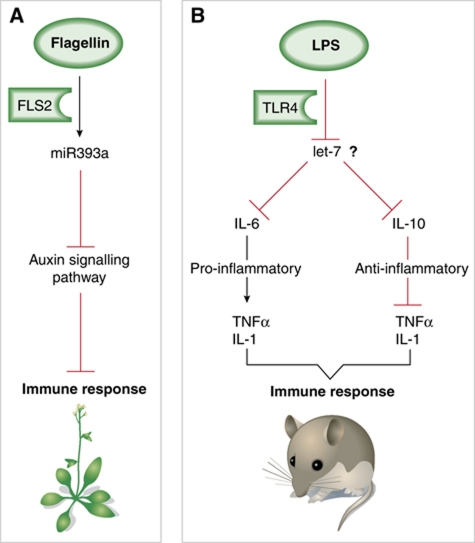
MicroRNAs are 19–24 nt-long RNAs that post-transcriptionally regulate eukaryotic gene expression. Beside their important roles in patterning and development, miRNAs also orchestrate responses to pathogen infections. In this issue of The EMBO Journal, Schulte et al (2011) investigate the miRNA response of mammalian cells to the intracellular bacterium Salmonella. They find that Salmonella triggers highly specific and robust alterations to the expression of a subset of host miRNAs. In macrophages, these alterations notably include the rapid downregulation of let-7 MIRNA gene family members, following extracellular sensing of bacterial lipopolysaccharides (LPS) via Toll-like receptor 4 (TLR4). The authors identify two interleukins (IL-6 and IL-10) as novel targets of Let-7 and suggest that Salmonella infection rapidly relieves IL-6 and IL-10 from negative control by let-7, thereby potentiating the immune response. Intriguingly, while IL-6 is pro-inflammatory, IL-10 prevents the detrimental consequences of systemic inflammation, suggesting that the observed response is tightly balanced and, hence, biologically relevant.
Conflict of interest statement
The author declares that he has no conflict of interest.
Figures
Comment on
-
Analysis of the host microRNA response to Salmonella uncovers the control of major cytokines by the let-7 family.EMBO J. 2011 May 18;30(10):1977-89. doi: 10.1038/emboj.2011.94. Epub 2011 Apr 5. EMBO J. 2011. PMID: 21468030 Free PMC article.
References
-
- Baltimore D, Boldin MP, O’Connell RM, Rao DS, Taganov KD (2008) MicroRNAs: new regulators of immune cell development and function. Nat Immunol 9: 839–845 - PubMed
-
- Biswas SK, Lopez-Collazo E (2009) Endotoxin tolerance: new mechanisms, molecules and clinical significance. Trends Immunol 30: 475–487 - PubMed
Publication types
MeSH terms
Substances
LinkOut - more resources
Full Text Sources
Research Materials
Miscellaneous
