Review
. 2012 Jan;37(1):247-60.
doi: 10.1038/npp.2011.85. Epub 2011 May 18.

Epigenetic treatments for cognitive impairments

Affiliations
Review

Epigenetic treatments for cognitive impairments

Jeremy J Day et al. Neuropsychopharmacology. 2012 Jan.

Abstract

Epigenetic mechanisms integrate signals from diverse intracellular transduction cascades and in turn regulate genetic readout. Accumulating evidence has revealed that these mechanisms are critical components of ongoing physiology and function in the adult nervous system, and are essential for many cognitive processes, including learning and memory. Moreover, a number of psychiatric disorders and syndromes that involve cognitive impairments are associated with altered epigenetic function. In this review, we will examine how epigenetic mechanisms contribute to cognition, consider how changes in these mechanisms may lead to cognitive impairments in a range of disorders and discuss the potential utility of therapeutic treatments that target epigenetic machinery. Finally, we will comment on a number of caveats associated with interpreting epigenetic changes and using epigenetic treatments, and suggest future directions for research in this area that will expand our understanding of the epigenetic changes underlying cognitive disorders.


Figures
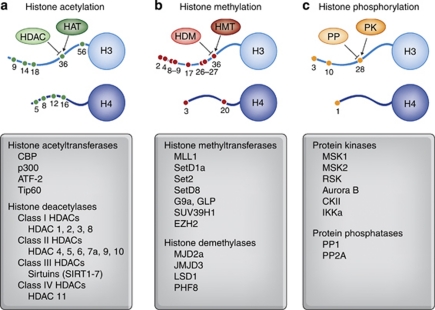
Figure 1
Figure 1
Summary of well-understood histone modifications and histone-modifying enzymes. (a) Histone acetylation at numerous lysine residues on histone tails is catalyzed by histone acetyltransferases (HATs) and removed by histone deacetlyases (HDACs). Histone acetylation is generally a transcriptionally permissive mark. Different HAT and HDAC enzymes are listed below. Importantly, specific HDACs isoforms are differentially expressed across brain structures and appear to uniquely regulate different aspects of cognition. (b) Histone methylation at lysine and arginine residues on histone tails is catalyzed by histone methyltransferases (HMTs) and removed by histone demethylases (HDMs). Histone methylation at different amino acid residues has been linked to both transcriptional activation and transcriptional repression. Methylation can occur in mono-, di-, or even tri-methylated states. Many HDMs and HMTs are specific for modifications at individual amino acids on histone tails or even a specific number of methyl groups. (c) Histone phosphorylation at serine residues is catalyzed by protein kinases (PKs) such as mitogen- and stress-activated protein kinase 1 (MSK1), whereas phosphorylation marks are removed by protein phosphatases such as protein phosphatase 1 (PP1). Histone phosphorylation is generally linked to transcriptional activation.
Figure 2
Figure 2
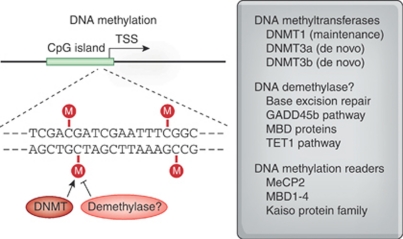
DNA methylation and demethylation. A majority of mammalian gene promoters contain dense clusters of cytosine-guanine dinucleotides called CpG islands, at which methylation can occur to dramatically influence gene transcription. In this example, the CpG island (green bar) overlaps the transcription start site. At CpG dinucleotides, methylation is catalyzed by DNA methyltransferases (DNMTs). De novo DNMTs direct the methylation of unmethylated CpGs, whereas maintenance DNMTs recognize hemi-methylated DNA and methylate the complementary strand. The existence of a direct demethylase is controversial, but a number of different mechanisms have been proposed to regulate removal of the methyl moiety, including excision and replacement of the entire base pair. DNA methylation marks are read by a family of proteins with methyl binding domains (MBD proteins), which includes MeCP2. Each of these targets may represent candidates for therapeutic treatments of disorders characterized by aberrant DNA methylation. See text for additional details.

References

    1. Abel T, Zukin RS. Epigenetic targets of HDAC inhibition in neurodegenerative and psychiatric disorders. Curr Opin Pharmacol. 2008;8:57–64. - PMC - PubMed
    1. Adachi M, Autry AE, Covington HE, III, Monteggia LM. MeCP2-mediated transcription repression in the basolateral amygdala may underlie heightened anxiety in a mouse model of Rett syndrome. J Neurosci. 2009;29:4218–4227. - PMC - PubMed
    1. Adegbola A, Gao H, Sommer S, Browning M. A novel mutation in JARID1C/SMCX in a patient with autism spectrum disorder (ASD) Am J Med Genet A. 2008;146A:505–511. - PubMed
    1. Akbarian S, Huang HS. Epigenetic regulation in human brain-focus on histone lysine methylation. Biol Psychiatry. 2009;65:198–203. - PMC - PubMed
    1. Alarcon JM, Malleret G, Touzani K, Vronskaya S, Ishii S, Kandel ER, et al. Chromatin acetylation, memory, and LTP are impaired in CBP+/− mice: a model for the cognitive deficit in Rubinstein-Taybi syndrome and its amelioration. Neuron. 2004;42:947–959. - PubMed

Publication types

MeSH terms