


Brucella spp. infection in large ruminants in an endemic area of Egypt: cross-sectional study investigating seroprevalence, risk factors and livestock owner's knowledge, attitudes and practices (KAPs)
- PMID: 21595871
- PMCID: PMC3121632
- DOI: 10.1186/1471-2458-11-341
Brucella spp. infection in large ruminants in an endemic area of Egypt: cross-sectional study investigating seroprevalence, risk factors and livestock owner's knowledge, attitudes and practices (KAPs)
Abstract
Background: Brucellosis is regarded as one of the major zoonotic infections worldwide. It was first reported in Egypt in 1939 and is now endemic, the predominate species of Brucella in cattle and buffalo in Egypt is B. melitensis. The aim of the study was to estimate seroprevalence of Brucella spp. in cattle and buffalo reared in households in an Egyptian village, identify risk factors for animals testing seropositive and to assess the knowledge, attitudes and practices (KAPs) of livestock owners with regards to brucellosis.
Methods: A cross-sectional study was carried out in a village in Menufiya Governorate of Egypt. In June and July 2009, 107 households were selected using systematic sample and all lactating cattle and buffalo present in the household were sampled and tested for antibodies against Brucella spp. In addition, a questionnaire collecting information on potential risk factors for Brucella spp. infection in cattle and buffalo was administered to the household member responsible for rearing the livestock. Between December 2009 and February 2010 households were revisited and a second questionnaire regarding KAPs associated with brucellosis was administered.
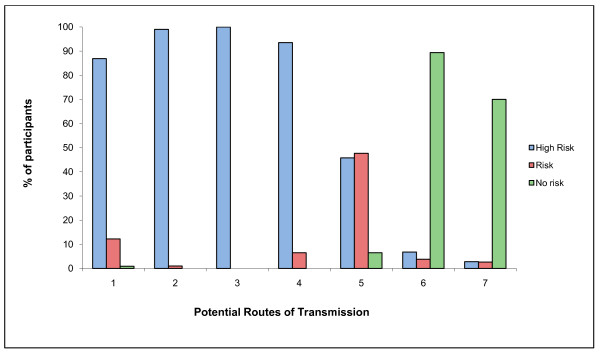
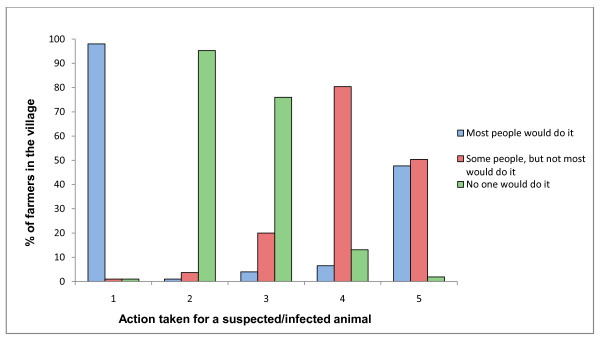
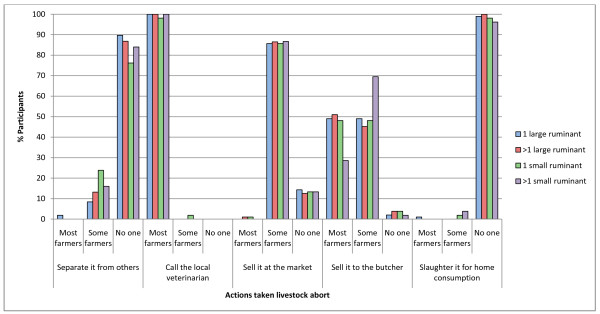
Results: True individual and household seroprevalence were estimated to be 11.0% (95% CI: 3.06% to 18.4%) and 15.5% (95% CI: 6.61% to 24.7%), respectively. Cattle and buffalo kept in a household with sheep and goats had 6.32 (95% CI: 1.44 to 27.9) times the odds of testing seropositive for Brucella spp., compared to cattle and buffalo that were not. Most participants in the study stated that livestock owners assist in the parturition of ruminants without wearing gloves and that some farmers sell animals which they suspect are Brucella infected to butchers or at market. Many participants made their livestock's milk into cheese and other dairy products without pasteurising it.
Conclusions: Brucellosis was endemic at high levels, in the current study. Although livestock owners had good general knowledge of brucellosis, they still appeared to participate in high-risk behaviours, which may contribute to the high seroprevalence in the area. Veterinarians, public health authorities and other community leaders need to collaborate to control the disease in animals and to manage the risk of human exposure.
Figures
References
-
- FAOSTAT: Food and Agricultural commodities production - Egypt. 2008. http://faostat.fao.org/site/339/default.aspx
-
- El-Rafey MS. Milk Hygiene Practice in Egypt. WHO; 2005. http://whqlibdoc.who.int/monograph/WHO_MONO_48_(p635).pdf
-
- Aidaros H. Global perspectives - the Middle East: Egypt. Rev sci tech Off int Epiz. 2005;24(2):589–596. - PubMed
-
- World Health Organisation (WHO) The Control of Neglected Zoonotic Diseases. In: WHO/SDE/FOS, editor. Report of the first meeting on the control of neglected zoonotic diseases, WHO and Department for International Development-Animal Health Programme (DFID-AHP), with the participation of FAO and OIE 20-21 September 2005. WHO Headquarters, Geneva; 2006.
-
- Corbel MJ, Brinley-Morgan WJ. In: Bergey's manual of systematic bacteriology. Krieg NR HJ, editor. Vol. 1. Baltimore, Md: The William and Wilkins Co; 1984. Genus Brucella. Meyer and Shaw 1920, 173AL; pp. 377–388. - PubMed
MeSH terms
LinkOut - more resources
Full Text Sources
Miscellaneous
