. 2011 May 19:11:89.
doi: 10.1186/1471-2229-11-89.

WRKY transcription factors involved in activation of SA biosynthesis genes

Affiliations

WRKY transcription factors involved in activation of SA biosynthesis genes

Marcel C van Verk et al. BMC Plant Biol. .

Abstract

Background: Increased defense against a variety of pathogens in plants is achieved through activation of a mechanism known as systemic acquired resistance (SAR). The broad-spectrum resistance brought about by SAR is mediated through salicylic acid (SA). An important step in SA biosynthesis in Arabidopsis is the conversion of chorismate to isochorismate through the action of isochorismate synthase, encoded by the ICS1 gene. Also AVRPPHB SUSCEPTIBLE 3 (PBS3) plays an important role in SA metabolism, as pbs3 mutants accumulate drastically reduced levels of SA-glucoside, a putative storage form of SA. Bioinformatics analysis previously performed by us identified WRKY28 and WRKY46 as possible regulators of ICS1 and PBS3.

Results: Expression studies with ICS1 promoter::β-glucuronidase (GUS) genes in Arabidopsis thaliana protoplasts cotransfected with 35S::WRKY28 showed that over expression of WRKY28 resulted in a strong increase in GUS expression. Moreover, qRT-PCR analyses indicated that the endogenous ICS1 and PBS3 genes were highly expressed in protoplasts overexpressing WRKY28 or WRKY46, respectively. Electrophoretic mobility shift assays indentified potential WRKY28 binding sites in the ICS1 promoter, positioned -445 and -460 base pairs upstream of the transcription start site. Mutation of these sites in protoplast transactivation assays showed that these binding sites are functionally important for activation of the ICS1 promoter. Chromatin immunoprecipitation assays with haemagglutinin-epitope-tagged WRKY28 showed that the region of the ICS1 promoter containing the binding sites at -445 and -460 was highly enriched in the immunoprecipitated DNA.

Conclusions: The results obtained here confirm results from our multiple microarray co-expression analyses indicating that WRKY28 and WRKY46 are transcriptional activators of ICS1 and PBS3, respectively, and support this in silico screening as a powerful tool for identifying new components of stress signaling pathways.


Figures
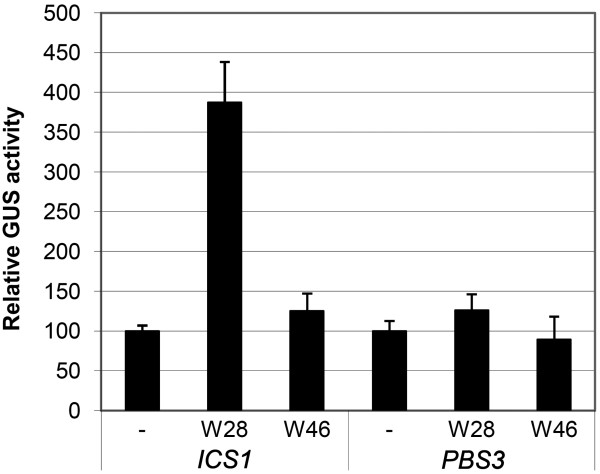
Figure 1
Figure 1
Transactivation of ICS1 and PBS3 promoter::GUS reporter genes by WRKY28 and WRKY46 in Arabidopsis protoplasts. The fusions contained promoter sequences of 960 bp and 1000 bp upstream of the transcription start sites of the ICS1 or PBS3 genes, respectively. Protoplasts were transfected with 6 μg of vector pRT101 containing 35S::WRKY28 (W28) or 35S::WRKY46 (W46) inserts, or with the empty vector (minus sign). The left three bars, correspond to the protoplasts co-transfected with 2 μg of the ICS1::GUS construct, the right three bars, to protoplasts co-transfected with 2 μg of the PBS3::GUS gene. The bars represent the average relative GUS expression observed in four experiments. GUS expression induced in the presence of the empty pRT101 vector was taken as 100%. Error bars represent the SEM.
Figure 2
Figure 2
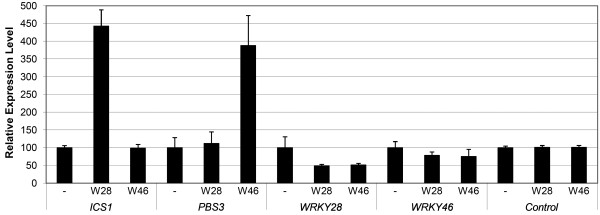
Effect of WRKY28 and WRKY46 on the expression of endogenous Arabidopsis genes. Expression of ICS1, PBS3, WRKY28, WRKY46 and four household genes in Arabidopsis protoplasts was measured by qRT-PCR. Expression of each gene was measured in protoplasts transfected with the empty pRT101 vector (minus sign) or with the pRT101 vector containing 35S::WRKY28 (W28) or 35S::WRKY46 (W46) expression constructs. Bars represent the average level of mRNA accumulation observed in three experiments. mRNA levels in protoplasts transfected with the empty pRT101 vector were taken as 100%. The control represents the average of the data obtained with the four household genes. Error bars represent the SEM.
Figure 3
Figure 3
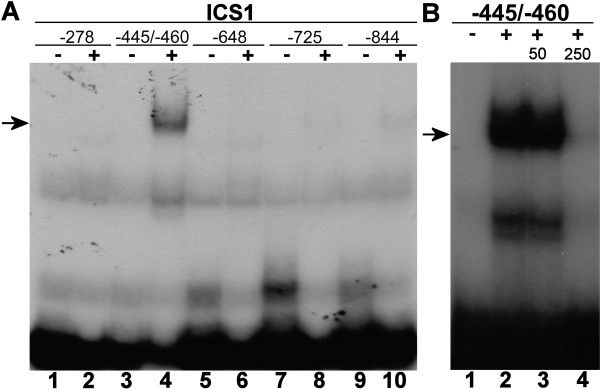
Binding of WRKY28 to ICS1 promoter fragments. (A) EMSAs were performed with promoter fragments of 30 bp, each containing a TGAC core sequence (positions -278, -445/-460, -648, -725) or a WK-like box (-844) in the center. The location of these sequences in the ICS1 promoter relative to the transcription start site is given above the lanes. (B) EMSAs were performed with a 30-bp fragment of the ICS1 promoter containing TGAC core sequences at position -445 and -460. The EMSAs in panel B were done without addition of unlabeled competitor DNA, or in the presence of a 50-fold or 250-fold excess of unlabeled competitor DNA as indicated above the lanes. The promoter fragments were incubated with recombinant GST/WRKY28 fusion protein (plus-signs) or without this protein (minus-signs). The position of protein-DNA complexes is indicated by an arrow.
Figure 4
Figure 4
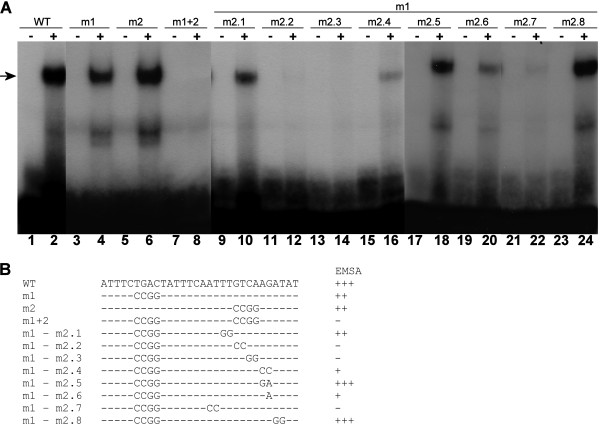
Binding of WRKY28 to mutated ICS1 promoter fragments. (A) EMSAs were performed with annealed 30-bp oligonucleotides containing the ICS1 promoter region indicated as -445/-460 in the legend of Figure 3 with mutations as indicated in panel B. Plus signs above the lanes indicate binding mixtures containing 0.5 μg recombinant GST/WRKY28. Minus signs above the lanes indicate binding mixtures without recombinant protein. The position of the protein-DNA complexes is indicated by an arrow. Plus and minus signs in panel B indicate the relative abundance of the shifted probe.
Figure 5
Figure 5
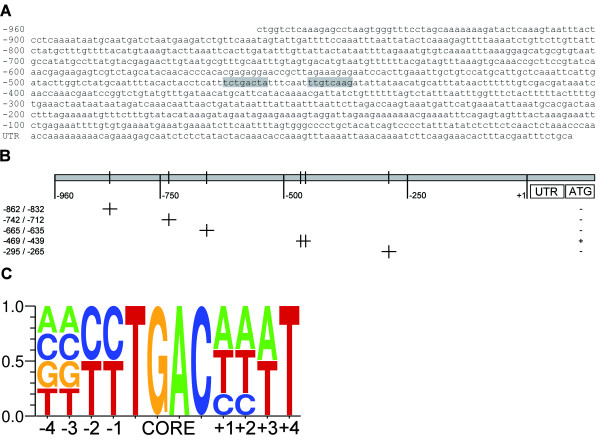
Summary of Electrophoretic Mobility Shift Assays with WRKY28. The indentified WRKY28 binding sites are indicated against a grey background in the sequence of the 960 bp ICS1 promoter (A). Schematic representation of the ICS1 promoter fragments analyzed by EMSA (B). Plus-signs in the right column indicate fragments that produced band shifts; minus-signs, fragments that did not produce a band shift. The position of the WK-like sequence or TGAC core sequences is indicated by vertical lines. Consensus WRKY28 binding sequence deduced from the EMSAs (C).
Figure 6
Figure 6
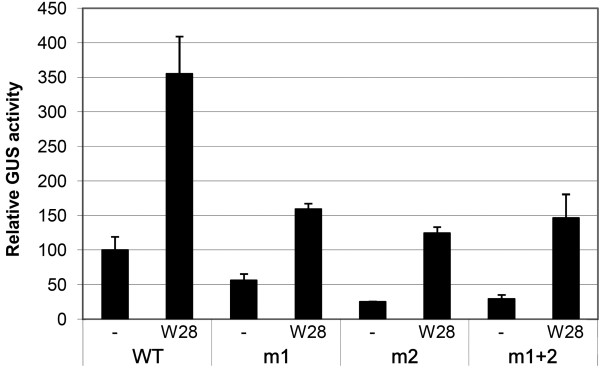
Transactivation of ICS1::GUS genes with mutations in WRKY28 binding sites. Protoplasts were transfected with 2 μg of wild-type promoter::GUS constructs or promoter::GUS constructs containing the mutations m1, m2 or m1+2 as indicated in Figure 4B. W28, cotransfection with 6 μg of expression vector pRT101 containing 35S::WRKY28. Minus signs, cotransfection with 6 μg of empty expression vector. The bars represent the percentage of GUS activity from triple experiments relative to that of the protoplasts cotransfected with the promoter::GUS construct and an empty expression vector, which was set to 100%. Error bars represent the SEM.
Figure 7
Figure 7
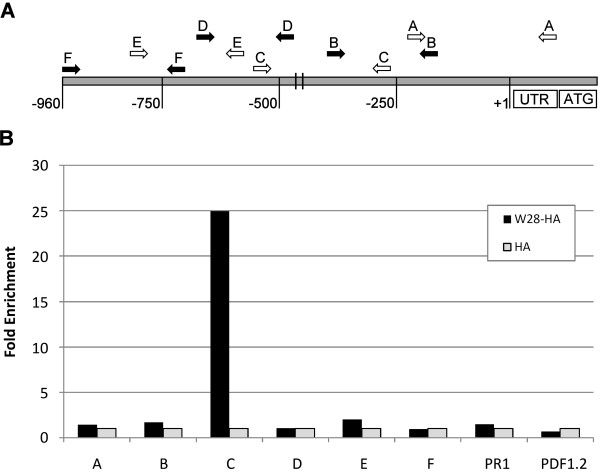
Chromatin Immunoprecipitation assay of WRKY28. Schematic representation of the location of primers corresponding to regions of the ICS1 gene used in the ChIP assays (A). Fold enrichment of immunoprecipitated DNA from protoplasts expressing WRKY28-HA versus protoplasts expressing unfused HA corrected for the qRT-PCR amplification efficiencies (B). The position of the WRKY28 binding sites at -445 and -460 is indicated.
Figure 8
Figure 8
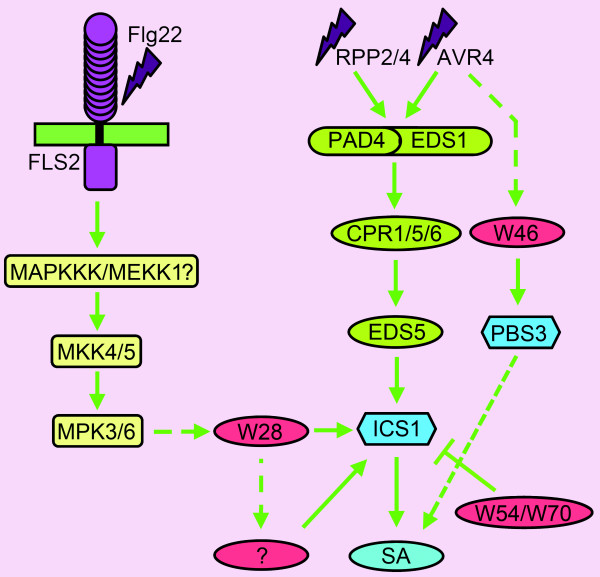
Model for regulation of SA biosynthesis by WRKY28 and WRKY46. Upon infection with a pathogen expressing flagellin (Flg22) or avirulence genes (RPP2/4 or AVR4), WRKY28 or WRKY46 are rapidly induced. Activation of FLS2 receptor by Flg22 results in activation of a MAPK cascade, which leads to induction of WRKY28 expression, which subsequently activates directly and likely also indirectly via yet unknown transcription factors (?), ICS1 gene expression leading to SA production. Avirulence factors like AVR4 trigger SA production through a pathway involving genes PAD4, EDS1, CPR1/5/6, EDS5 and ICS1. WRKY46 is rapidly synthesized and either directly or indirectly positively regulates PBS3 gene expression, having a positive influence on SA metabolism.

References

    1. Métraux JP, Signer H, Ryals J, Ward E, Wyss-Benz M, Gaudin J, Raschdorf K, Schmid E, Blum W, Inverardi B. Increase in Salicylic Acid at the Onset of Systemic Acquired Resistance in Cucumber. Science. 1990;250:1004–1006. - PubMed
    1. Malamy J, Carr JP, Klessig DF, Raskin I. Salicylic acid: a likely endogenous signal in the resistance response of tobacco to viral infection. Science. 1990;250:1002–1004. - PubMed
    1. Dempsey DMA, Shah J, Klessig DF. Salicylic acid and disease resistance in plants. Crit Rev Plant Sci. 1999;18:547–575.
    1. Ryals JA, Neuenschwander UH, Willits MG, Molina A, Steiner HY, Hunt MD. Systemic Acquired Resistance. The Plant Cell. 1996;8:1809–1819. - PMC - PubMed
    1. Glazebrook J. Contrasting mechanisms of defense against biotrophic and necrotrophic pathogens. Annual Review of Phytopathology. 2005;43:205–227. - PubMed

MeSH terms