. 2011 May 19:6:26.
doi: 10.1186/1745-6150-6-26.

A late origin of the extant eukaryotic diversity: divergence time estimates using rare genomic changes

Affiliations

A late origin of the extant eukaryotic diversity: divergence time estimates using rare genomic changes

Diana Chernikova et al. Biol Direct. .

Abstract

Background: Accurate estimation of the divergence time of the extant eukaryotes is a fundamentally important but extremely difficult problem owing primarily to gross violations of the molecular clock at long evolutionary distances and the lack of appropriate calibration points close to the date of interest. These difficulties are intrinsic to the dating of ancient divergence events and are reflected in the large discrepancies between estimates obtained with different approaches. Estimates of the age of Last Eukaryotic Common Ancestor (LECA) vary approximately twofold, from ~1,100 million years ago (Mya) to ~2,300 Mya.

Results: We applied the genome-wide analysis of rare genomic changes associated with conserved amino acids (RGC_CAs) and used several independent techniques to obtain date estimates for the divergence of the major lineages of eukaryotes with calibration intervals for insects, land plants and vertebrates. The results suggest an early divergence of monocot and dicot plants, approximately 340 Mya, raising the possibility of plant-insect coevolution. The divergence of bilaterian animal phyla is estimated at ~400-700 Mya, a range of dates that is consistent with cladogenesis immediately preceding the Cambrian explosion. The origin of opisthokonts (the supergroup of eukaryotes that includes metazoa and fungi) is estimated at ~700-1,000 Mya, and the age of LECA at ~1,000-1,300 Mya. We separately analyzed the red algal calibration interval which is based on single fossil. This analysis produced time estimates that were systematically older compared to the other estimates. Nevertheless, the majority of the estimates for the age of the LECA using the red algal data fell within the 1,200-1,400 Mya interval.

Conclusion: The inference of a "young LECA" is compatible with the latest of previously estimated dates and has substantial biological implications. If these estimates are valid, the approximately 1 to 1.4 billion years of evolution of eukaryotes that is open to comparative-genomic study probably was preceded by hundreds of millions years of evolution that might have included extinct diversity inaccessible to comparative approaches.

Reviewers: This article was reviewed by William Martin, Herve Philippe (nominated by I. King Jordan), and Romain Derelle.


Figures
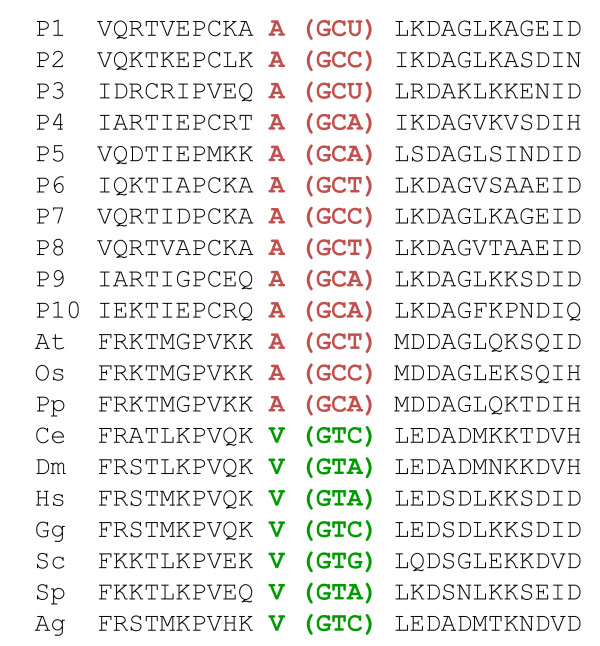
Figure 1
Figure 1
An example of a RGC_CA used in this study. The data are for KOG0100 (heat shock proteins). Using the notation described under Methods, P1 = ... = P10 = At = Os = Pp Dm = Ag = Hs = Ce = Gg = Sc = Sp. The ancestral amino acid is shown in red, the opisthokont-specific substitution is shown in green. The corresponding codons extracted from the underlying nucleotide sequence alignments are shown in parentheses. Species abbreviations: Homo sapiens (Hs), Caenorhabditis elegans (Ce), Drosophila melanogaster (Dm), Saccharomyces cerevisiae (Sc), Schizosaccharomyces pombe (Sp), Arabidopsis thaliana (At), Anopheles gambiae (Ag), Oryza sativa (Os), Physcomitrella patens (Pp), Gallus gallus (Gg), and 10 outgroup prokaryotic species (P1...P10).
Figure 2
Figure 2
The phylogeny of eukaryotes adopted in this study. The figure shows the coelomate scenario (the ecdysozoa scenario is not shown). The numbers at the branches indicate the numbers of RGC_CAs which are used to measure the branch length. Tc, calibration time interval, Mya.
Figure 3
Figure 3
Estimates for a divergence time Te corresponding to a calibration point Tc and the branch path L1 + L2.
Figure 4
Figure 4
Cross-validation: the dependence of Te on DTc = | Te - Tce |. Estimates for the divergence times of extant groups of eukaryotes are plotted against the absolute value of the difference between the value of a calibration point X and an estimate for X. Results obtained for all three calibration intervals (Figure 2) were pooled together.
Figure 5
Figure 5
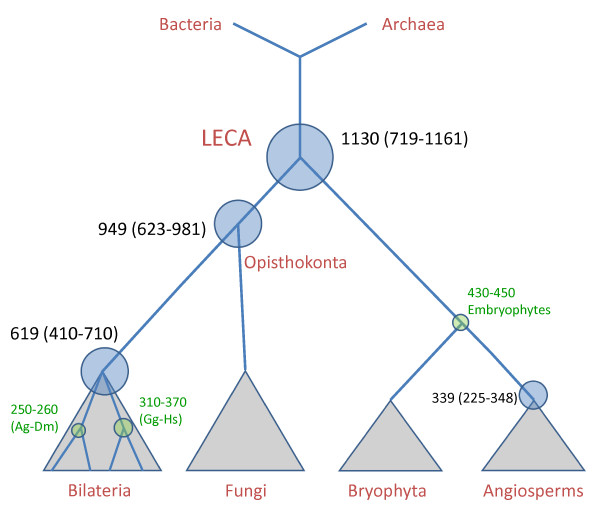
The time scale for the evolution of eukaryotes suggested by the RGC_CA-based estimates obtained without the red algal calibration intervals. Calibration intervals (green), mean time estimates for all programs (from Table 2) and Multidivtime 95% confidence intervals (in parentheses) are shown next to the respective nodes. The size of the circles is approximately proportional to the calibration intervals or 95% confidence intervals.
Figure 6
Figure 6
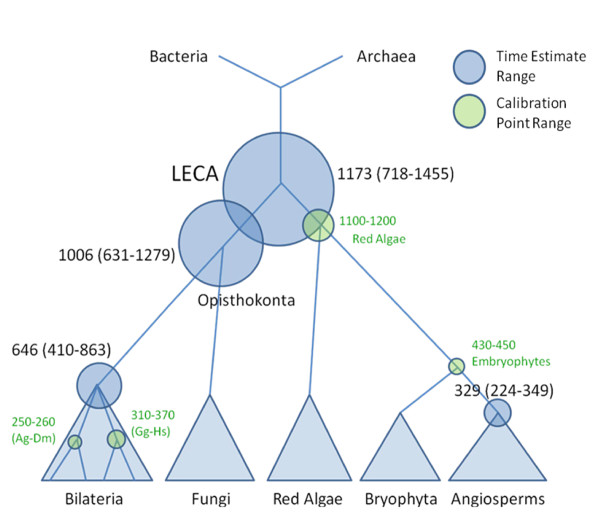
The time scale for the evolution of eukaryotes from the RGC_CA-based estimates. Calibration intervals (green), mean time estimates for all programs (from Table 2) and Multidivtime 95% confidence intervals (in parentheses) are shown next to the respective nodes. The size of the circles is approximately proportional to the calibration intervals or 95% confidence intervals.

References

    1. Graur D, Martin W. Reading the entrails of chickens: molecular timescales of evolution and the illusion of precision. Trends Genet. 2004;20:80–86. doi: 10.1016/j.tig.2003.12.003. - DOI - PubMed
    1. Roger AJ, Hug LA. The origin and diversification of eukaryotes: problems with molecular phylogenetics and molecular clock estimation. Philos Trans R Soc Lond B Biol Sci. 2006;361:1039–1054. doi: 10.1098/rstb.2006.1845. - DOI - PMC - PubMed
    1. Berney C, Pawlowski J. A molecular time-scale for eukaryote evolution recalibrated with the continuous microfossil record. Proc Biol Sci. 2006;273:1867–1872. doi: 10.1098/rspb.2006.3537. - DOI - PMC - PubMed
    1. Battistuzzi FU, Filipski A, Hedges SB, Kumar S. Performance of approximate-clock methods in estimating evolutionary divergence times and their credibility intervals. Mol Biol Evol. 2010;27:1289–1300. doi: 10.1093/molbev/msq014. - DOI - PMC - PubMed
    1. Adl SM, Simpson AG, Farmer MA, Andersen RA, Anderson OR, Barta JR, Bowser SS, Brugerolle G, Fensome RA, Fredericq S. et al. The new higher level classification of eukaryotes with emphasis on the taxonomy of protists. J Eukaryot Microbiol. 2005;52:399–451. doi: 10.1111/j.1550-7408.2005.00053.x. - DOI - PubMed

Publication types

LinkOut - more resources