Physical activity and sedentary activity patterns among children and adolescents: a latent class analysis approach
- PMID: 21597117
- PMCID: PMC3100677
- DOI: 10.1123/jpah.8.4.457
Physical activity and sedentary activity patterns among children and adolescents: a latent class analysis approach
Abstract
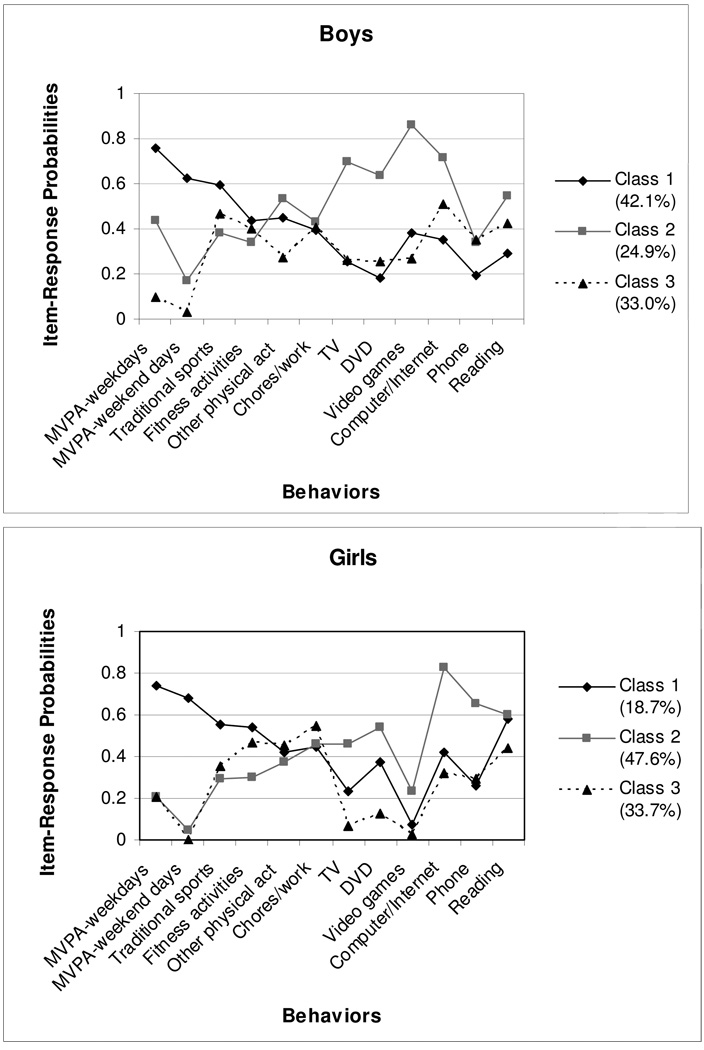
Background: While much is known about the overall levels of physical activity and sedentary activity among youth, few studies have attempted to define clusters of such behaviors. The purpose of this study was to identify and describe unique classes of youth based on their participation in a variety of physical activity and sedentary behaviors.
Methods: Latent class analysis was used to characterize segments of youth based on patterns of self-reported and accelerometer-measured participation in 12 behaviors. Children and adolescents (N=720) from 6th-11th grade were included in the analysis. Differences in class membership were examined using multinomial logistic regression.
Results: Three distinct classes emerged for boys and girls. Among boys, the 3 classes were characterized as "Active" (42.1%), "Sedentary" (24.9%), and "Low Media/Moderate Activity" (33.0%). For girls, classes were "Active" (18.7%), "Sedentary" (47.6%), and "Low Media/Functional Activity" (33.7%). Significant differences were found between the classes for a number of demographic indicators including the proportion in each class who were classified as overweight or obese.
Conclusions: The behavioral profiles of the classes identified in this study can be used to suggest possible audience segments for intervention and to tailor strategies appropriately.
Figures
References
-
- US Department of Health and Human Services. Physical Activity and Health: A Report of the Surgeon General. Atlanta, GA: Department of Health and Human Services, Centers for Disease Control and Prevention, National Center for Chronic Disease Prevention and Health Promotion; 1996.
-
- Strong WB, Malina RM, Blimkie CJ, Daniels SR, Dishman RK, Gutin B, et al. Evidence based physical activity for school-age youth. J Pediatr. 2005;146:732–737. - PubMed
-
- US Department of Health and Human Services. 2008 Physical Activity Guidelines for Americans. 2008
-
- Weinsier RL, Hunter GR, Heini AF, Goran MI, Sell SM. The etiology of obesity: relative contribution of metabolic factors, diet, and physical activity. Am J Med. 1998;105:145–150. - PubMed
-
- Raudsepp L, Viira R. Changes in physical activity in adolescent girls: a latent growth modeling approach. Acta Paediatrica. 2008;97:647–652. - PubMed
Publication types
MeSH terms
Grants and funding
LinkOut - more resources
Full Text Sources
Medical