


The contribution of common CYP2A6 alleles to variation in nicotine metabolism among European-Americans
- PMID: 21597399
- PMCID: PMC3116045
- DOI: 10.1097/FPC.0b013e328346e8c0
The contribution of common CYP2A6 alleles to variation in nicotine metabolism among European-Americans
Abstract
Objective: To study the association between cytochrome P450 2A6 (CYP2A6) genotype and metabolism of nicotine to cotinine, identify functional polymorphisms, and develop a predictive genetic model of nicotine metabolism.
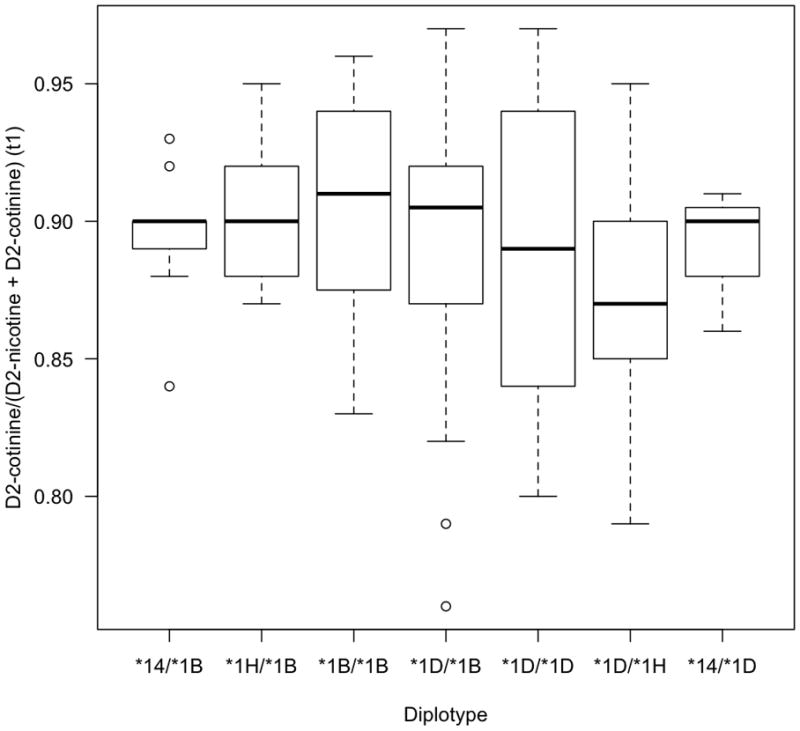
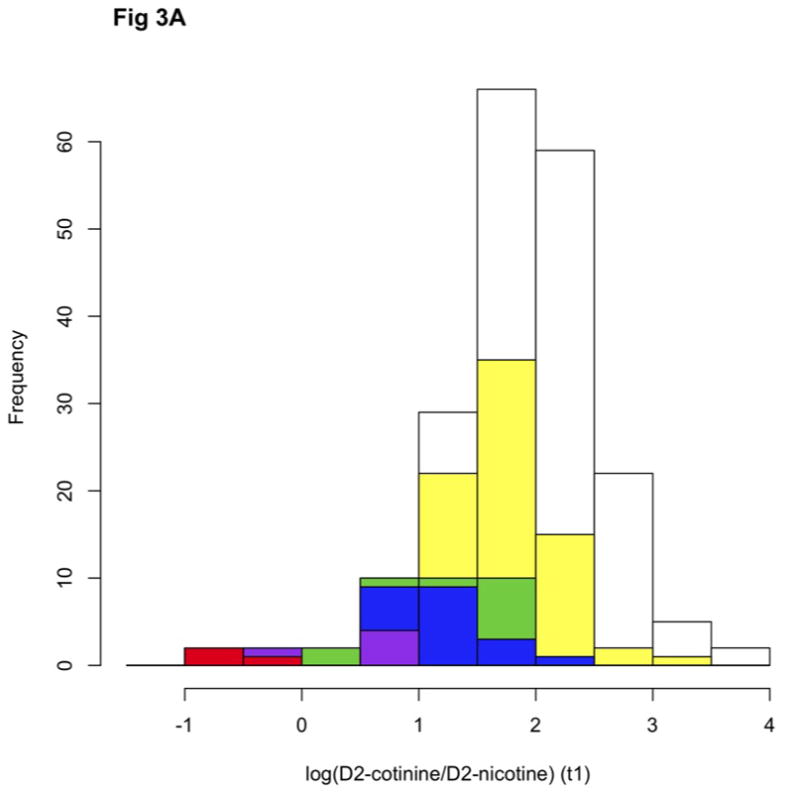
Methods: The conversion of deuterated (D2)-nicotine to D2-cotinine was quantified in 189 European-Americans and the contribution of CYP2A6 genotype to variability in first-pass nicotine metabolism was assessed. Specifically, (i) single time point measures of D2-cotinine/(D2-cotinine+D2-nicotine) after oral administration were used as a metric of CYP2A6 activity; (ii) the impact of CYP2A6 haplotype was treated as acting multiplicatively; (iii) parameter estimates were calculated for all haplotypes in the subject pool, defined by a set of polymorphisms previously reported to affect function, including gene copy number; and (iv) a minimum number of predictive polymorphisms were justified to be included in the model based on statistical evidence of differences between haplotypes.
Results: The final model includes seven polymorphisms and fits the phenotype, 30-min after D2-nicotine oral administration, with R=0.719. The predictive power of the model is robust: parameter estimates calculated in men (n=89) predict the phenotype in women (n=100) with R=0.758 and vice versa with R=0.617; estimates calculated in current smokers (n=102) predict the phenotype in former-smokers (n=86) with R=0.690 and vice versa with R=0.703. Comparisons of haplotypes also demonstrate that CYP2A6*12 is a loss-of-function allele indistinguishable from CYP2A6*4 and CYP2A6*2 and that the CYP2A6*1B 5'-untranslated region conversion has negligible impact on metabolism. After controlling for CYP2A6 genotype, modest associations were found between increased metabolism and both female sex (P=4.8×10) and current smoking (P=0.02).
Conclusion: Among European-Americans, seven polymorphisms in the CYP2A6 gene explain the majority of variability in the metabolism of nicotine to cotinine after oral administration. Parameters determined from this in-vivo experiment can be used to predict nicotine metabolism based on CYP2A6 genotype.
Figures


References
-
- Jarvik ME, Madsen DC, Olmstead RE, Iwamoto-Schaap PN, Elins JL, Benowitz NL. Nicotine blood levels and subjective craving for cigarettes. Pharmacol Biochem Behav. 2000;66:553–8. - PubMed
-
- Strasser AA, Lerman C, Sanborn PM, Pickworth WB, Feldman EA. New lower nicotine cigarettes can produce compensatory smoking and increased carbon monoxide exposure. Drug Alcohol Depend. 2007;86:294–300. - PubMed
-
- Hatsukami DK, Lemmonds C, Zhang Y, Murphy SE, Le C, Carmella SG, et al. Evaluation of carcinogen exposure in people who used “reduced exposure” tobacco products. J Natl Cancer Inst. 2004;96:844–52. - PubMed
Publication types
MeSH terms
Substances
Grants and funding
LinkOut - more resources
Full Text Sources
Other Literature Sources
Molecular Biology Databases
