. 2012 Jan;217(1):63-79.
doi: 10.1007/s00429-011-0327-8. Epub 2011 May 20.

Short-term effects of unilateral lesion of the primary motor cortex (M1) on ipsilesional hand dexterity in adult macaque monkeys

Affiliations

Short-term effects of unilateral lesion of the primary motor cortex (M1) on ipsilesional hand dexterity in adult macaque monkeys

Shahid Bashir et al. Brain Struct Funct. 2012 Jan.

Abstract

Although the arrangement of the corticospinal projection in primates is consistent with a more prominent role of the ipsilateral motor cortex on proximal muscles, rather than on distal muscles involved in manual dexterity, the role played by the primary motor cortex on the control of manual dexterity for the ipsilateral hand remains a matter a debate, either in the normal function or after a lesion. We, therefore, tested the impact of permanent unilateral motor cortex lesion on the manual dexterity of the ipsilateral hand in 11 macaque monkeys, within a time window of 60 days post-lesion. For comparison, unilateral reversible pharmacological inactivation of the motor cortex was produced in an additional monkey. Manual dexterity was assessed quantitatively based on three motor parameters derived from two reach and grasp manual tasks. In contrast to the expected dramatic, complete deficit of manual dexterity of the contralesional hand that persists for several weeks, the impact on the manual dexterity of the ipsilesional hand was generally moderate (but statistically significant) and, when present, lasted less than 20 days. Out of the 11 monkeys, only 3 showed a deficit of the ipsilesional hand for 2 of the 3 motor parameters, and 4 animals had a deficit for only one motor parameter. Four monkeys did not show any deficit. The reversible inactivation experiment yielded results consistent with the permanent lesion data. In conclusion, the primary motor cortex exerts a modest role on ipsilateral manual dexterity, most likely in the form of indirect hand postural control.


Figures
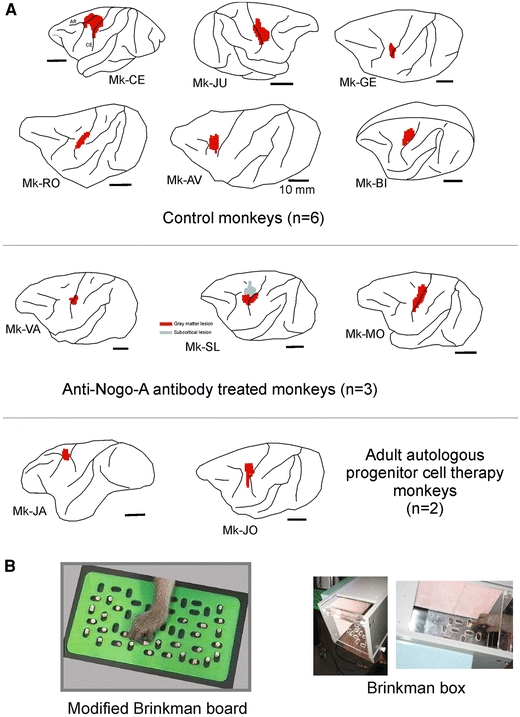
Fig. 1
Fig. 1
a Location and extent of the permanent unilateral lesion of the M1 hand representation as seen on corresponding lateral views of the brain for 11 monkeys included in the present study (see Table 1). The lesion territory is represented in red, as derived from the lesioned zone of cerebral cortex (gray matter) visible on consecutive frontal histological sections. Spread of the lesion to the subcortical white matter below the gray matter is not represented here, except in monkey Mk-SL in which a subcortical white matter territory was lesioned (gray spot), in a region located more medially than the red territory. The motor cortex lesion was performed in all monkeys on the left hemisphere, except in Mk-JU in which the lesion was in the right hemisphere. Six monkeys (top panel) were control animals for two pilot treatment studies: three monkeys were treated with anti-Nogo-A antibody (middle panel) whereas two monkeys were subjected to an autologous cell therapy (see “Methods” and Table 1). b View of the Modified Brinkman Board (left) and the Brinkman box (right)
Fig. 2
Fig. 2
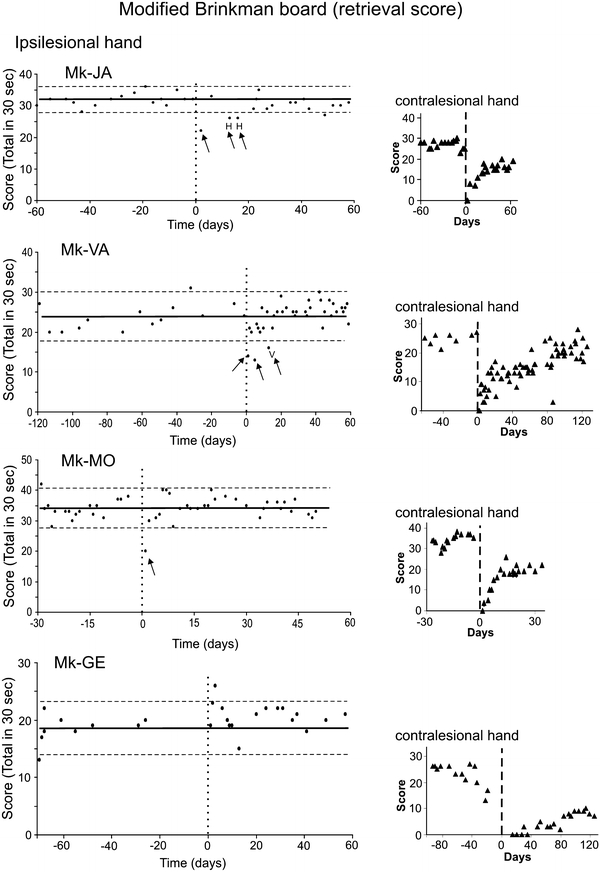
Behavioral data (manual dexterity) obtained from four representative monkeys (Mk-JA, Mk-VA, Mk-MO and Mk-GE) for the Modified Brinkman Board task. The manual dexterity of the ipsilesional hand is given by the retrieval score, corresponding to the total number of pellets retrieved in 30 s, as a function of time (days). The day of the M1 lesion is at time zero (vertical dashed line). The retrieval scores for the vertical and horizontal slots were cumulated. The thick horizontal line is the average retrieval score, computed from the pre-lesion daily sessions only. The horizontal dashed lines are for the average retrieval score plus 2SDs and minus 2SDs. For comparison, the retrieval scores (triangles) are given on the right for the contralesional hand for the same monkeys. The period at plateau pre-lesion were of variable duration, depending on the date set for the lesion across monkeys. Similarly, on the right, the post-lesion period shown on the graphs was set depending on the variable time course of recovery across monkeys
Fig. 3
Fig. 3
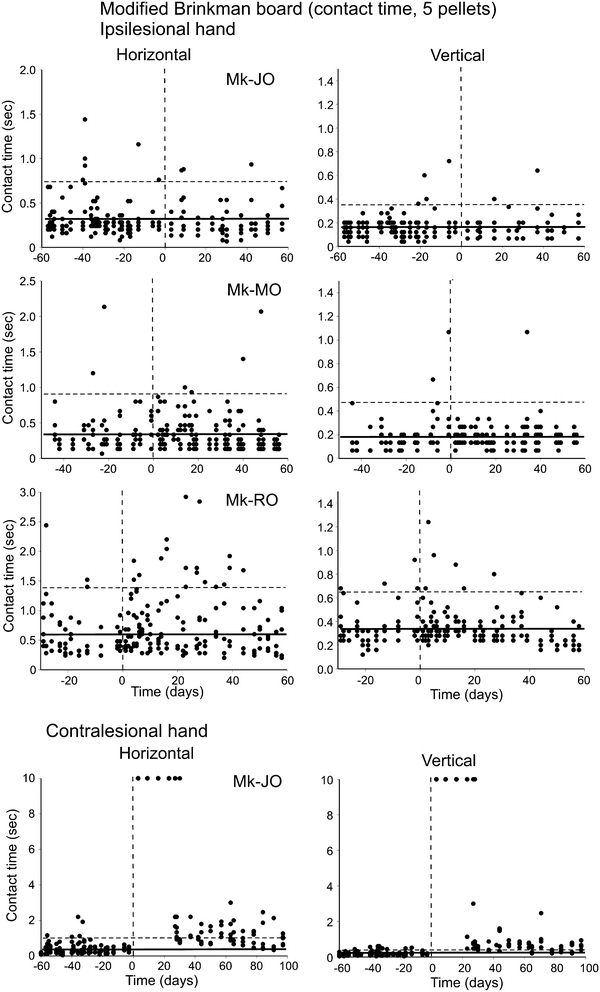
Behavioral data (manual dexterity) obtained from three representative monkeys (Mk-JO, Mk-MO and Mk-RO) for the Modified Brinkman Board task. The manual dexterity of the ipsilesional hand is given by the contact time, corresponding to the time of contact (in seconds) between the fingers and the first five pellets in vertical slots (left column) and the first five pellet in horizontal slots (right column) targeted by the monkey. Along the abscissa, the day of the M1 lesion is at time zero (vertical dashed line). The thick horizontal line is the average contact time, computed from the pre-lesion daily sessions only. The horizontal dashed line is for the average contact time plus 2SDs. For comparison, the contact time is given in the bottom panel for the contralesional hand in Mk-JO (note the different scale in the ordinate). The contact time values saturated at 10 s indicate that monkey Mk-JO was totally unable to perform the grasping of the pellets on the corresponding daily sessions following the lesion, reflecting the dramatic deficit observed for the contralesional hand
Fig. 4
Fig. 4
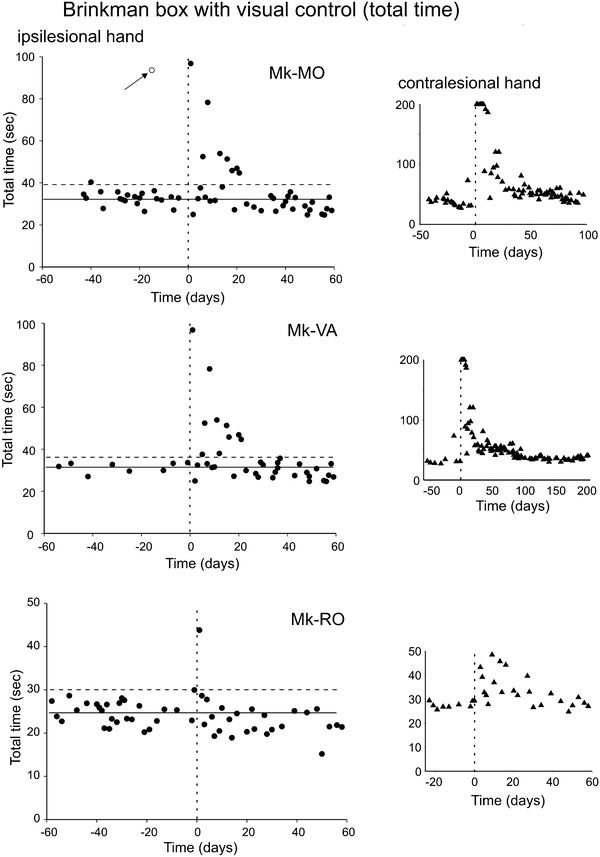
Behavioral data (manual dexterity) obtained from three representative monkeys (Mk-MO, Mk-VA and Mk-RO) for the Brinkman box task, performed with visual feedback. The manual dexterity of the ipsilesional hand is given by the total time needed by the monkey to empty the 20 wells. Along the abscissa, the day of the M1 lesion is at time zero (vertical dashed line). The thick horizontal line is the average total time, computed from the pre-lesion daily sessions only. The horizontal dashed line is for the average total time plus 2SDs. For comparison, the total time is given in the small graphs on the right for the contralesional hand in each monkey (note the different scale in the ordinate). On the right, the post-lesion period shown on the graphs was set depending on the variable time course of recovery across monkeys. In the top graph (Mk-MO), the arrow points to a daily session in which the monkey took a lot of time to empty the box (probably due to poor motivation on that day), thus representing an outlier data point
Fig. 5
Fig. 5
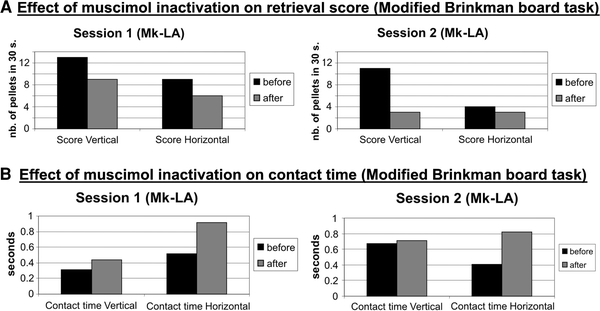
Immediate effect of reversible inactivation of the M1 hand representation unilaterally in Mk-LA, obtained by infusion of muscimol, on the dexterity of the ipsilateral hand. Two distinct sessions are illustrated (sessions 1 and 2). a The plots show the effect of muscimol infusion on the retrieval score in the Modified Brinkman Board task. b The plots show the effect of muscimol infusion on the contact time in the Modified Brinkman Board task. a, b The black bars are the pre-infusion data (before inactivation), whereas the gray bars are for the post-infusion data (after inactivation). Retrieval scores and contact times are given separately for the vertical and horizontal slots
Fig. 6
Fig. 6
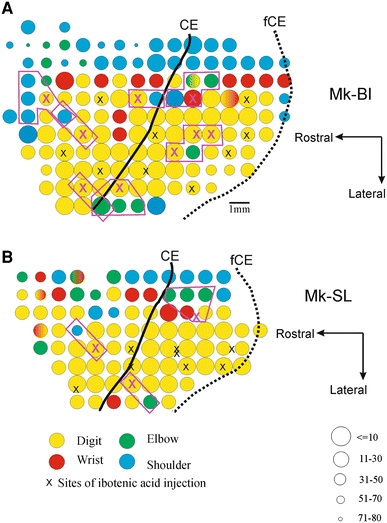
Representative unfolded ICMS maps (in the left hemisphere) of the forelimb before lesion, derived from two animals, Mk-BI (a) and Mk-SL (b), with positions of ICMS sites selected for infusion of ibotenic acid (x symbols) to produce the lesion of the hand area. The method to unfold the rostral bank of the central sulcus has been described previously (Kaeser et al. 2010). As several electrode tracks running within the same rostrocaudal plane along the rostral bank of the central sulcus are projected on the same line segment, some ICMS sites and/or sites of ibotenic acid infusion may be superimposed. On these surface maps, a few ICMS sites eliciting contralateral finger movements (yellow circles), where ibotenic acid was infused, appear to be located close (less than 2 mm) to ICMS sites corresponding to representation of proximal muscles (elbow and shoulder, green and blue circles, respectively). Such sites of infusion of ibotenic acid are depicted by the purple x symbols. The real distance between such sites of infusion of ibotenic acid and the proximal ICMS sites (identified on the maps by purple polygons) was calculated from the original 3D coordinates system. These distance data are presented in Fig. 7 and Table 2. CE central sulcus, fCE fundus of the central sulcus. As coded on the bottom right corner, the size of the circles represents the ICMS threshold at which the just noticeable movement was observed. The body territory (digit, wrist, elbow or shoulder) activated by the ICMS is given by the color code (bottom left). For clarity, at the periphery of the forelimb representation, sites eliciting movements of other territories (e.g. face) or unresponsive were not represented
Fig. 7
Fig. 7
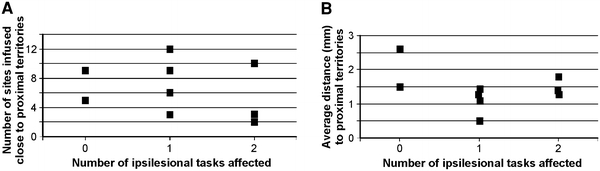
To assess whether transient deficits for manual dexterity performed with the ipsilesional hand may be due to a spread of ibotenic acid to proximal territories in M1, the number of infusion sites closely located to elbow or shoulder ICMS sites were plotted for individual monkeys as a function of the number of manual dexterity tasks for which a deficit was observed (a none, one or two; see Table 2). Similarly, in b, the average distance from ibotenic acid infusion sites to the closely located proximal ICMS sites was plotted for individual monkeys as a function of the number of manual dexterity tasks for which a deficit was observed. Mk-AV and Mk-JO were not considered as their ICMS map was incomplete (see Table 2)

References

    1. Aizawa H, Mushiake H, Inase M, Tanji J. An output zone of the monkey primary motor cortex specialized for bilateral hand movement. Exp Brain Res. 1990;82:219–221. doi: 10.1007/BF00230856. - DOI - PubMed
    1. Alagona G, Delvaux V, Gérard P, De Pasqua V, Pennisi G, Delwaide PJ, Nicoletti F, De Noordhout AM. Ipsilateral motor responses to focal transcranial magnetic stimulation in healthy subjects and acute-stroke patients. Stroke. 2001;32:1304–1309. doi: 10.1161/01.STR.32.6.1304. - DOI - PubMed
    1. Bawa P, Hamm JD, Dhillon P, Gross PA. Bilateral responses of upper limb muscles to transcranial magnetic stimulation in human subjects. Exp Brain Res. 2004;158:385–390. doi: 10.1007/s00221-004-2031-x. - DOI - PubMed
    1. Beaud ML, Schmidlin E, Wannier T, Freund P, Bloch J, Mir A, Schwab ME, Rouiller EM. Anti-Nogo-A antibody treatment does not prevent cell body shrinkage in the motor cortex in adult monkeys subjected to unilateral cervical cord lesion. BMC Neurosci. 2008;9:5. doi: 10.1186/1471-2202-9-5. - DOI - PMC - PubMed
    1. Bernard JA, Taylor SF, Seidler RD. Handedness, dexterity, and motor cortical representations. J Neurophysiol. 2011;105:88–99. doi: 10.1152/jn.00512.2010. - DOI - PubMed

Publication types

LinkOut - more resources