


Exercise among breast and prostate cancer survivors--what are their barriers?
- PMID: 21598023
- PMCID: PMC3223316
- DOI: 10.1007/s11764-011-0184-8
Exercise among breast and prostate cancer survivors--what are their barriers?
Abstract
Introduction: Despite proven benefits of regular physical activity, estimates indicate that few cancer survivors meet physical activity guidelines. The purpose of this paper is to identify and compare exercise barriers among cancer survivors, both cross-sectionally and longitudinally as they undergo home-based behavioral interventions.
Methods: Data on a sample of 452 breast and prostate cancer survivors who completed the FRESH START trial were analyzed collectively, as well as separately by cancer type.
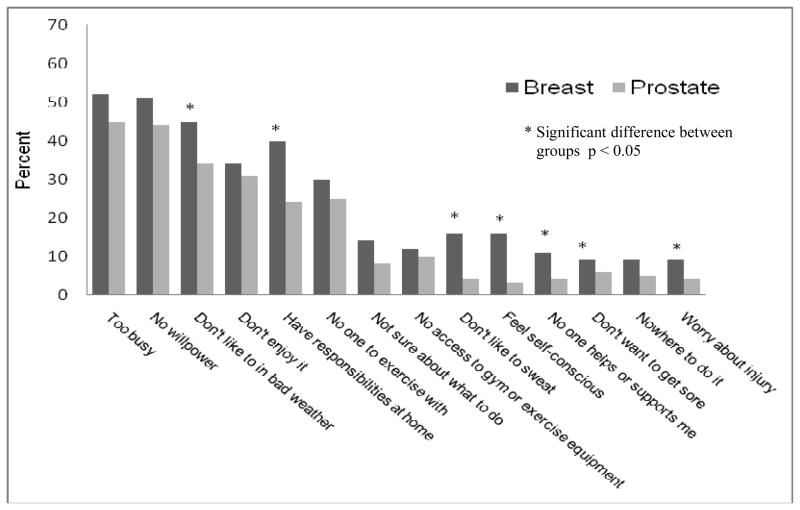
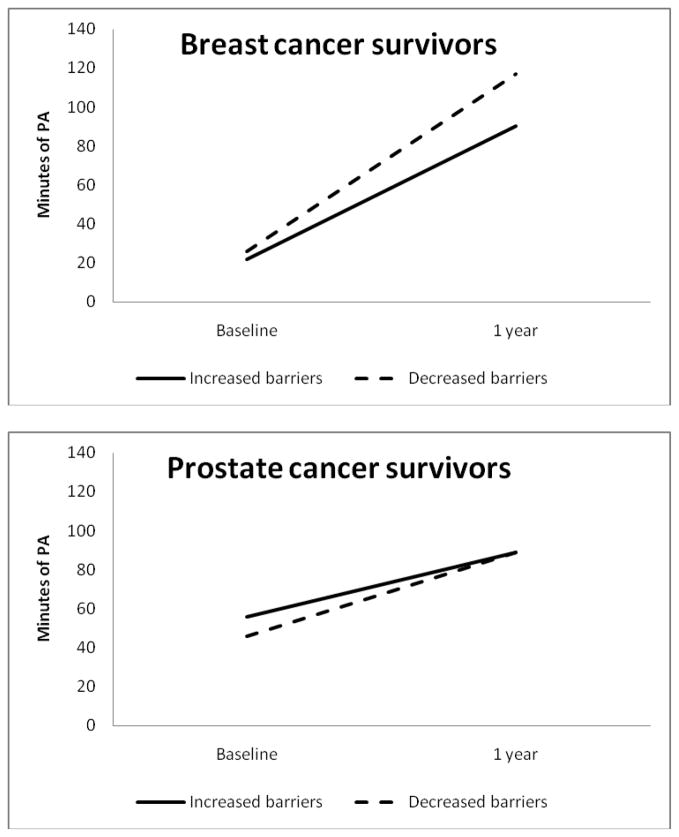
Results: More total barriers (3.5 vs. 2.4; p < 0.01) were reported among breast cancer survivors compared with prostate cancer survivors. Commonly reported baseline exercise barriers among both groups were "too busy" (breast, 52% and prostate, 45%) and "no willpower" (breast, 51% and prostate, 44%). At baseline, breast cancer survivors who reported "no willpower" also reported 18.7 fewer minutes of physical activity compared with those not reporting this barrier (p < 0.01). Among prostate cancer survivors, this difference was 39.5 min (p < 0.01). Change in barriers was not associated with change in minutes of physical activity from baseline to post-intervention in either cancer survivor group.
Conclusions: This is the largest study evaluating barriers and physical activity over time among cancer survivors. There are similarities and differences that both need to be taken into consideration when promoting physical activity among subgroups of survivors.
Implications for cancer survivors: Knowledge concerning barriers associated with reported physical activity may be helpful in designing optimally targeted physical activity interventions among breast and prostate cancer survivors.
Figures
References
-
- American Cancer Society. Cancer Facts & Figures 2010. Atlanta: American Cancer Society; 2010. http://www.cancer.org/acs/groups/content/@nho/documents/document/acspc-0....
-
- Age-adjusted SEER incidence and U.S. death rates and 5-year relative survival rates by primary cancer site, sex and time period (Table 1.4) SEER Cancer Statistics. http://seer.cancer.gov/csr/1975_2006/results_merged/topic_survival.pdf.
-
- Alfano CM, Rowland JH. Recovery issues in cancer survivorship: A new challenge for supportive care. Cancer J. 2006;12(5):432–43. - PubMed
-
- Pinto BM, Frierson GM, Rabin C, et al. Home-based physical activity intervention for breast cancer patients. J Clin Oncol. 2005;23(15):3577–87. - PubMed
