. 2011 May 20:12:49.
doi: 10.1186/1471-2156-12-49.

Timing the tides: genetic control of diurnal and lunar emergence times is correlated in the marine midge Clunio marinus

Affiliations

Timing the tides: genetic control of diurnal and lunar emergence times is correlated in the marine midge Clunio marinus

Tobias S Kaiser et al. BMC Genet. .

Abstract

Background: The intertidal zone of seacoasts, being affected by the superimposed tidal, diurnal and lunar cycles, is temporally the most complex environment on earth. Many marine organisms exhibit lunar rhythms in reproductive behaviour and some show experimental evidence of endogenous control by a circalunar clock, the molecular and genetic basis of which is unexplored. We examined the genetic control of lunar and diurnal rhythmicity in the marine midge Clunio marinus (Chironomidae, Diptera), a species for which the correct timing of adult emergence is critical in natural populations.

Results: We crossed two strains of Clunio marinus that differ in the timing of the diurnal and lunar rhythms of emergence. The phenotype distribution of the segregating backcross progeny indicates polygenic control of the lunar emergence rhythm. Diurnal timing of emergence is also under genetic control, and is influenced by two unlinked genes with major effects. Furthermore, the lunar and diurnal timing of emergence is correlated in the backcross generation. We show that both the lunar emergence time and its correlation to the diurnal emergence time are adaptive for the species in its natural environment.

Conclusions: The correlation implies that the unlinked genes affecting lunar timing and the two unlinked genes affecting diurnal timing could be the same, providing an unexpectedly close interaction of the two clocks. Alternatively, the genes could be genetically linked in a two-by-two fashion, suggesting that evolution has shaped the genetic architecture to stabilize adaptive combinations of lunar and diurnal emergence times by tightening linkage. Our results, the first on genetic control of lunar rhythms, offer a new perspective to explore their molecular clockwork.


Figures
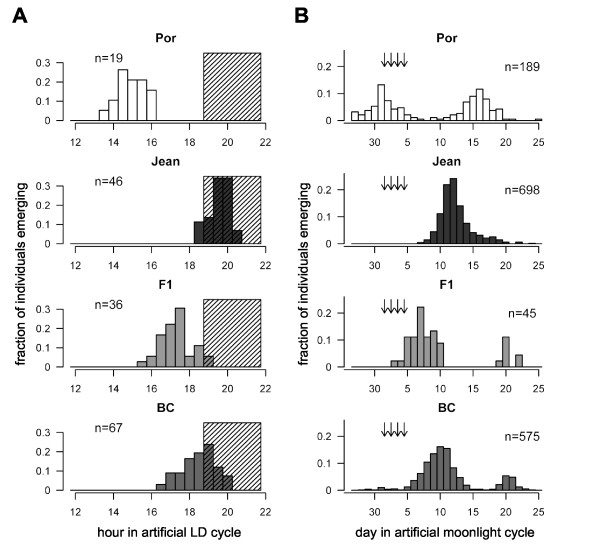
Figure 1
Figure 1
Emergence patterns of parental strains, hybrids, and backcrosses of two populations of Clunio marinus. (A) Diurnal rhythm plotted as the fraction of individuals that emerged during 30 minute intervals. Parental strain of Port-en-Bessin (n = 19). Parental strain of St. Jean-de-Luz (n = 46). F1 generation (n = 36). Backcross generation (n = 67). Daytime is given in hours after the middle of dark phase ("hour 0"), which necessarily makes the middle of the light phase "hour 12". The grey shading marks dark phase. For the backcross only the single reared crosses were recorded in 30 min intervals and are given here. Comprehensive diurnal data is available in [3]. (B) Lunar rhythm plotted as the fraction of individuals that emerged during each day of the artificial moonlight cycle. Parental strain of Port-en-Bessin (n = 189). Parental strain of St. Jean-de-Luz (n = 698). F1 generation (n = 45). Backcross generation (n = 575). Arrows mark the days with artificial moonlight. Data of two lunar cycles added up.
Figure 2
Figure 2
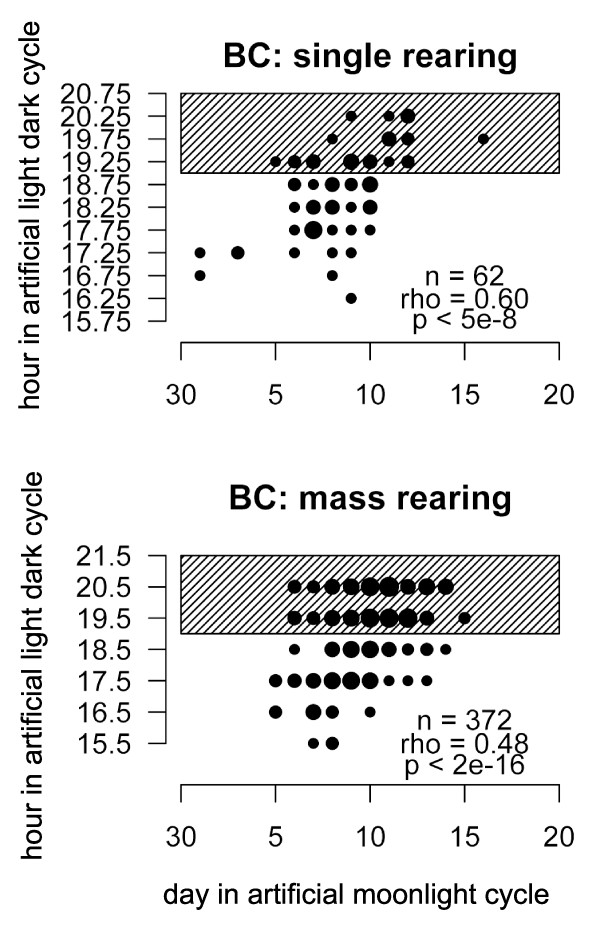
Correlation of lunar and diurnal emergence times for the major peak of the BC progeny. Hour of diurnal emergence is plotted against day of the artificial moonlight cycle. Circle area is proportional to the number of individuals at the respective time point. The shaded area marks dark phase. (A) Single rearing. (B) Mass rearing. There were six additional individuals emerging on days 1 to 4 for which diurnal emergence time is not known; there were no more individuals emerging after day 15.
Figure 3
Figure 3
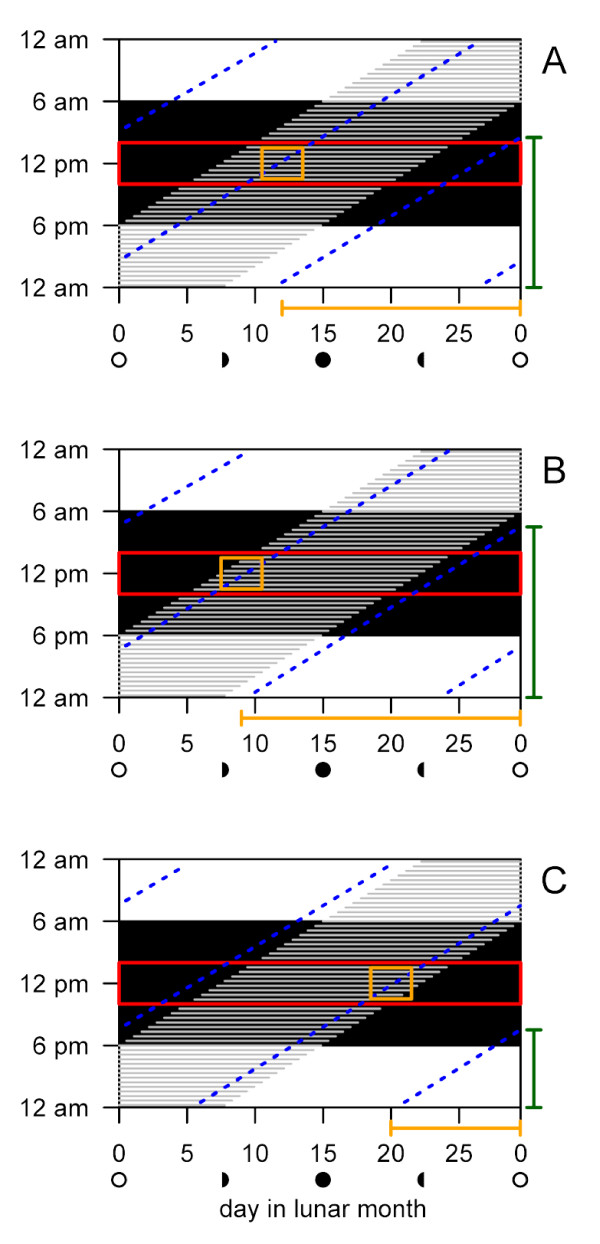
Schematic relationship of the moon phases, the tides, Clunio's moonlight sensitivity and the locally adapted diurnal and lunar emergence times. Time of day (in hours) is plotted against time in the lunar cycle (in days). The black area represents the dark phase. The grey shading indicates when the moon is in the sky. The red box marks the circadian period of sensitivity of Clunio to moonlight [24,28]. As a consequence, moonlight can theoretically be detected throughout the moonlit quarters around full moon. We hypothesize that the water level additionally influences the detectability of moonlight: Moonlight is best perceived when the time of low tide (blue dotted lines) falls to midnight, so that presence of the moon in the sky, Clunio's moonlight sensitivity and the low tide coincide (yellow box). As tidal regimes differ for other places along the coast (compare A, B and C), the time when moonlight is best perceived differs. Nevertheless, all known Clunio populations emerge during the spring tides, i.e. short after new moon and/or full moon. Thus, they must respond to the moonlight stimulus with a different delay of their emergence peak (indicated by the yellow bars below the graph). According to our hypothesis this should correspond to the time between the artificial moonlight treatment and the emergence peak in the respective laboratory strain (see Figure 4). Note, that the time span between low tide at midnight and full moon/new moon (yellow bars) is highly correlated with the daytime of low tide on full moon/new moon days (green bars, compare Figure 5).
Figure 4
Figure 4
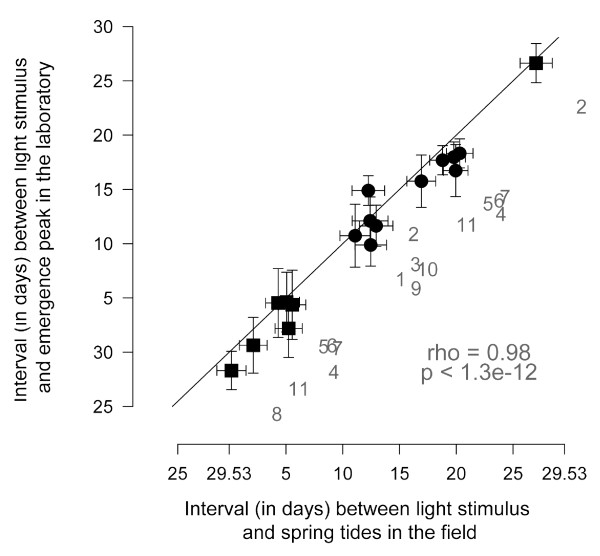
Lunar emergence times of Clunio laboratory strains are adapted to the tidal regime at their place of origin. We define the event of moonlight stimulus perception as the day when a low tide falls between 11 p.m. and 1 a.m. during the moonlit quarters of the lunar cycle. For different places along the coast, this event occurs at different phases of the lunar cycle, depending on the local tidal regime (compare Figure 3). The interval (in days) from this event to the spring tides in the field is plotted on the X-axis for each population. The interval (in days) between onset of artificial moonlight and the emergence peak in the laboratory is plotted on the Y-axis for the same populations. Error bars are standard deviations. Squares mark emergence peaks that fall to full moon, circles mark emergence peaks that fall to new moon in the field. Correlation coefficient and p value of the correlation are given in the graph. Strain identities: 1 Vigo (West Spain). 2 Santander (North Spain). 3 St. Jean-de-Luz (Basque Coast, France). 4 Port-en-Bessin (Normandie, France). 5 Lulworth (English Channel, UK). 6 Studland (English Channel, UK). 7 Bembridge (Isle of Wight, UK). 8 Roscoff (Bretagne, France). 9 Concarneau (Bretagne, France). 10 Camaret-sur-Mer (Bretagne, France). 11 St. Briac-sur-Mer (Bretagne, France). Data from [3,30,53]. For strains 9 to 11 own unpublished data is given.
Figure 5
Figure 5
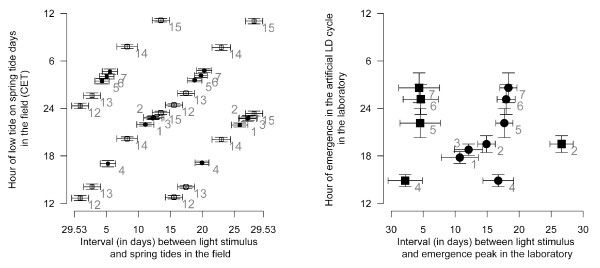
Correlation of zeitgebers for different geographic locations and the corresponding adaptive combinations of lunar and diurnal emergence times. (A) Correlation of zeitgebers in different geographic locations for full moon spring tides (squares) and new moon spring tides (circles). The laboratory strains' places of origin (filled squares and circles) and other reference localities (open squares and circles) are given with standard deviations. For the places of origin of the laboratory strains, only the low tide during which Clunio is known to emerge in the field is given, for the other reference places both daily low tides are given. (B) Combinations of lunar and diurnal emergence times in laboratory strains of different geographic origins. Peaks predicted to fall onto full moon are given as squares, those predicted to fall onto new moon are given as circles. The strains of Vigo (1) and St. Jean-de-Luz (3) have a lunar rhythm and do not emerge during full moon. Error bars are standard deviations. Strain identities: 1 Vigo (West Spain). 2 Santander (North Spain). 3 St. Jean-de-Luz (Basque Coast, France). 4 Port-en-Bessin (Normandie, France). 5 Lulworth (English Channel, UK). 6 Studland (English Channel, UK). 7 Bembridge (Isle of Wight, UK). Other reference places: 9 Devonport (English Channel, UK). 10 Ullapool (Scotland, UK). 11 Bremerhaven (Germany). 12 Brest (Bretagne, France). Data from [3,53]

References

    1. Franke HD. The role of light and endogenous factors in the timing of the reproductive-cycle of Typosyllis prolifera and some other polychaetes. American Zoologist. 1986;26(2):433–445.
    1. Hauenschild C. Lunar Periodicity. Cold Spring Harbor Symposia on Quantitative Biology. 1960;25:491–497. - PubMed
    1. Neumann D. Die lunare und tägliche Schlüpfperiodik der Mücke Clunio - Steuerung und Abstimmung auf die Gezeitenperiodik. Zeitschrift für Vergleichende Physiologie. 1966;53(1):1–61. doi: 10.1007/BF00343045. - DOI - PubMed
    1. Saigusa M. Entrainment of a Semilunar Rhythm by a Simulated Moonlight Cycle in the Terrestrial Crab, Sesarma haematocheir. Oecologia. 1980;46(1):38–44. doi: 10.1007/BF00346963. - DOI - PubMed
    1. Naylor E. Marine animal behaviour in relation to lunar phase. Earth Moon and Planets. 2001;85-6:291–302.

Publication types

LinkOut - more resources