


Review
doi: 10.1016/j.yjmcc.2011.05.002.
Epub 2011 May 11.
AKAPs: the architectural underpinnings of local cAMP signaling
Affiliations
- PMID: 21600214
- PMCID: PMC3168680
- DOI: 10.1016/j.yjmcc.2011.05.002
Item in Clipboard
Review
AKAPs: the architectural underpinnings of local cAMP signaling
J Mol Cell Cardiol.
2012 Feb.
Abstract
The cAMP-dependent protein kinase A (PKA) is targeted to specific compartments in the cardiac myocyte by A-kinase anchoring proteins (AKAPs), a diverse set of scaffold proteins that have been implicated in the regulation of excitation-contraction coupling and cardiac remodeling. AKAPs bind not only PKA, but also a large variety of structural and signaling molecules. In this review, we discuss the basic concepts underlying compartmentation of cAMP and PKA signaling, as well as a few of the individual AKAPs that have been shown to be functionally relevant in the heart. This article is part of a Special Issue entitled "Local Signaling in Myocytes".
Copyright © 2011 Elsevier Ltd. All rights reserved.
Figures
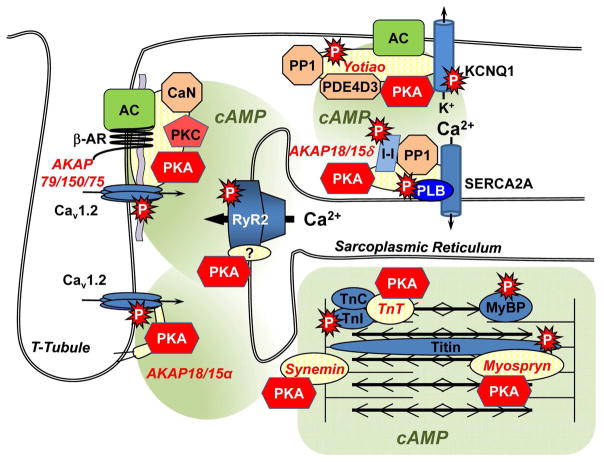
AKAP79/150/75 and AKAP18/15α can regulate the L-type Ca2+ channel, yotiao the KNCQ1 slow outward potassium ion current, and AKAP18/15δ phospholamban and Ca2+ reuptake. Troponin T, myospryn, and synemin are sarcomeric AKAPs. The AKAP responsible for PKA phosphorylation of RyR2 at the sarcoplasmic reticulum is unclear, albeit AKAP5 knock-out mice have diminished RyR2 phosphorylation [31].
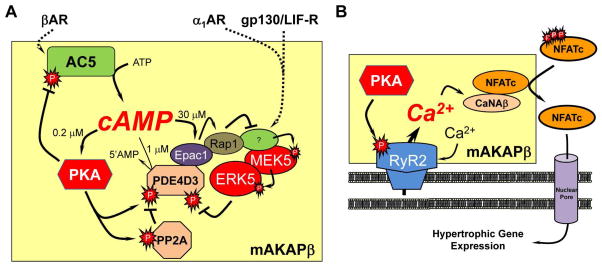
The yellow boxes represent the mAKAPβ signalosome. A. There is evidence for three conjoined negative feedback loops intrinsic to the mAKAPβ complex that control local cAMP levels: (1) AC5, cAMP, PKA; (2) cAMP, PKA, PDE4D3; and (3) cAMP, Epac1, Rap1, MEK5, ERK5, PDE4D3. βAR stimulation will activate AC5, resulting in cAMP production and PKA activation. PKA phosphorylation inhibits AC5 and activates PDE4D3 activity, resulting in decreased cAMP accumulation [31, 97, 108]. The MEK5/ERK5 MAPK pathway is activated in myocytes by α1AR and gp130/LIF-R agonists [109]. Activation of ERK5 will lead to PDE4D3 inhibition and increased PKA activity [10]. When high cAMP levels activate the guanine nucleotide exchange factor Epac1, Rap1 will inhibit the ERK5 pathway, reversing the ERK5-mediated inhibition of PDE4D3 and limiting downstream signaling. In addition, there is an incoherent feedforward loop that will oppose PKA phosphorylation of PDE4D3 resulting from PKA phosphorylation and activation of PP2A in the complex. An incoherent feedforward loop is present when two pathways lead to the same effector with opposite results [99]. Compare PKA-PDE4D3 and PKA-PP2A-PDE4D3. B. Calcineurin Aβ (CaNAβ) may serve as an mAKAPβ signalosome effector. RyR2 bound to mAKAPβ is PKA phosphorylated when myocytes are stimulated by β-agonists, potentially increasing local Ca2+ levels [89]. Norepinephrine-treatment of myocytes results in CaNAβ recruitment into the complex, where it can catalyze the dephosphorylation and nuclear translocation of NFATc transcription factors [93]. While not illustrated in this Figure, ERK5 and HIF-1α are also potential effectors for mAKAPβ complexes.
References
-
- Conti M, Beavo J. Biochemistry and physiology of cyclic nucleotide phosphodiesterases: essential components in cyclic nucleotide signaling. Annu Rev Biochem. 2007;76:481–511. - PubMed
-
- Hayes JS, Brunton LL, Mayer SE. Selective activation of particulate cAMP-dependent protein kinase by isoproterenol and prostaglandin E1. J Biol Chem. 1980;255(11):5113–9. - PubMed
-
- Keely SL. Activation of cAMP-dependent protein kinase without a corresponding increase in phosphorylase activity. Res Commun Chem Pathol Pharmacol. 1977;18(2):283–90. - PubMed
Publication types
MeSH terms
Substances
Grants and funding
LinkOut - more resources
Full Text Sources
Other Literature Sources
