


Usefulness of plasma galectin-3 levels in systolic heart failure to predict renal insufficiency and survival
- PMID: 21600537
- PMCID: PMC3137764
- DOI: 10.1016/j.amjcard.2011.03.056
Usefulness of plasma galectin-3 levels in systolic heart failure to predict renal insufficiency and survival
Abstract
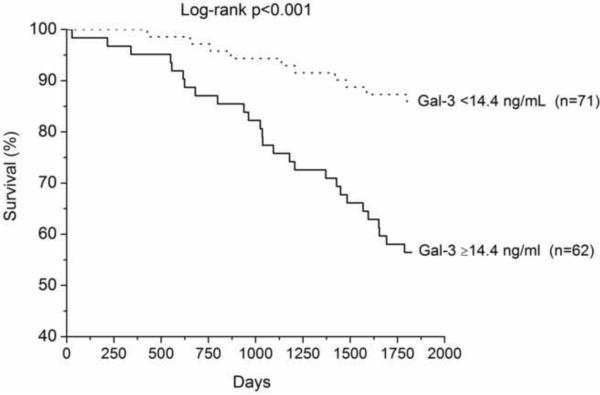
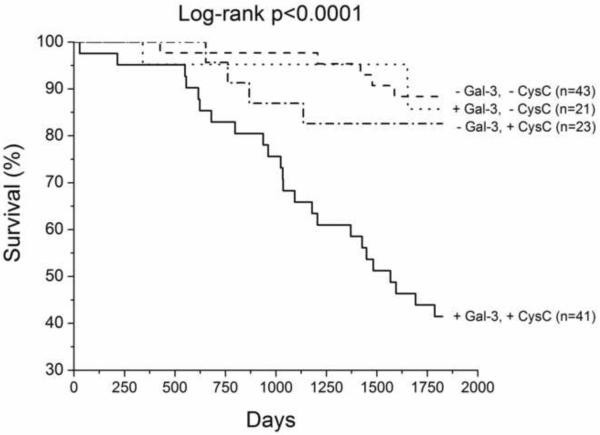
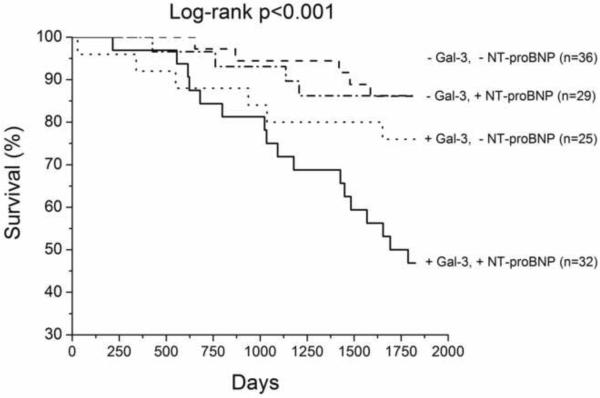
Galectin-3 plays an important role in fibroblast activation and fibrosis in animal models. Increased galectin-3 levels are associated with poor long-term survival in heart failure (HF). We examined the relation between plasma galectin-3 levels and myocardial indexes of systolic HF. We measured plasma galectin-3 in 133 subjects with chronic HF and 45 with advanced decompensated HF using echocardiographic and hemodynamic evaluations. In the chronic HF cohort, median plasma galectin-3 level was 13.9 ng/ml (interquartile range 12.1 to 16.9). Higher galectin-3 was associated with more advanced age (r = 0.22, p = 0.010), poor renal function (estimated glomerular filtration rate, r = -0.24, p = 0.007; cystatin C, r = 0.38, p <0.0001) and predicted all-cause mortality (hazard ratio 1.86, 95% confidence interval 1.36 to 2.54, p <0.001). In multivariate analysis, galectin-3 remained an independent predictor of all-cause mortality after adjusting for age, estimated glomerular filtration rate, left ventricular (LV) ejection fraction, and mitral early diastolic myocardial relaxation velocity at septal mitral annulus (hazard ratio 1.94, 95% confidence interval 1.30 to 2.91, p = 0.001). However, galectin-3 did not predict the combined end point of all-cause mortality, cardiac transplantation, or HF hospitalization (p >0.05). Furthermore, there were no relations between galectin-3 and LV end-diastolic volume index (r = -0.05, p = 0.61), LV ejection fraction (r = 0.10, p = 0.25), or LV diastolic function (mitral early diastolic myocardial relaxation velocity at septal mitral annulus, r = 0.06, p = 0.52; left atrial volume index, r = 0.08, p = 0.41). In the advanced decompensated HF cohort, we did not observe any relation between galectin-3 and echocardiographic or hemodynamic indexes. In conclusion, high plasma galectin-3 levels were associated with renal insufficiency and poorer survival in patients with chronic systolic HF. However, we did not observe a relation between galectin-3 and echocardiographic or hemodynamic indexes.
Copyright © 2011 Elsevier Inc. All rights reserved.
Figures
References
-
- Sharma UC, Pokharel S, van Brakel TJ, van Berlo JH, Cleutjens JP, Schroen B, Andre S, Crijns HJ, Gabius HJ, Maessen J, Pinto YM. Galectin-3 marks activated macrophages in failure-prone hypertrophied hearts and contributes to cardiac dysfunction. Circulation. 2004;110:3121–3128. - PubMed
-
- Thandavarayan RA, Watanabe K, Ma M, Veeraveedu PT, Gurusamy N, Palaniyandi SS, Zhang S, Muslin AJ, Kodama M, Aizawa Y. 14-3-3 protein regulates Ask1 signaling and protects against diabetic cardiomyopathy. Biochem Pharmacol. 2008;75:1797–1806. - PubMed
-
- Liu YH, D'Ambrosio M, Liao TD, Peng H, Rhaleb NE, Sharma U, Andre S, Gabius HJ, Carretero OA. N-acetyl-seryl-aspartyl-lysyl-proline prevents cardiac remodeling and dysfunction induced by galectin-3, a mammalian adhesion/growth-regulatory lectin. Am J Physiol Heart Circ Physiol. 2009;296:H404–412. - PMC - PubMed
Publication types
MeSH terms
Substances
Grants and funding
LinkOut - more resources
Full Text Sources
Research Materials
Miscellaneous
