. 2011 Jul 15;286(28):24649-55.
doi: 10.1074/jbc.M111.221168. Epub 2011 May 20.

A rice phenolic efflux transporter is essential for solubilizing precipitated apoplasmic iron in the plant stele

Affiliations

A rice phenolic efflux transporter is essential for solubilizing precipitated apoplasmic iron in the plant stele

Yasuhiro Ishimaru et al. J Biol Chem. .

Abstract

Iron deficiency is one of the major agricultural problems, as 30% of the arable land of the world is too alkaline for optimal crop production, rendering plants short of available iron despite its abundance. To take up apoplasmic precipitated iron, plants secrete phenolics such as protocatechuic acid (PCA) and caffeic acid. The molecular pathways and genes of iron uptake strategies are already characterized, whereas the molecular mechanisms of phenolics synthesis and secretion have not been clarified, and no phenolics efflux transporters have been identified in plants yet. Here we describe the identification of a phenolics efflux transporter in rice. We identified a cadmium-accumulating rice mutant in which the amount of PCA and caffeic acid in the xylem sap was dramatically reduced and hence named it phenolics efflux zero 1 (pez1). PEZ1 localized to the plasma membrane and transported PCA when expressed in Xenopus laevis oocytes. PEZ1 localized mainly in the stele of roots. In the roots of pez1, precipitated apoplasmic iron increased. The growth of PEZ1 overexpression lines was severely restricted, and these lines accumulated more iron as a result of the high solubilization of precipitated apoplasmic iron in the stele. We show that PEZ1 is responsible for an increase of PCA concentration in the xylem sap and is essential for the utilization of apoplasmic precipitated iron in the stele.


Figures

FIGURE 1.
FIGURE 1.
The pez1 mutants accumulated Cd. Cd concentration in the leaves (A) and seeds (B) of WT, pez1-1 (1-1), and pez1-2 (1-2) grown in soil. Leaf dry weight (DW) (C) and SPAD value (D) of WT, pez1-1, and pez1-2 grown in soil. Cd concentration in the leaves (E) and roots (F) of WT, pez1-1, and pez1-2 grown in hydroponic culture solution. Columns (means ± S.D.) with different letters are significantly different from each other according to a one-way analysis of variance followed by a Student-Newman-Keuls test. p < 0.05, n = 5 each.
FIGURE 2.
FIGURE 2.
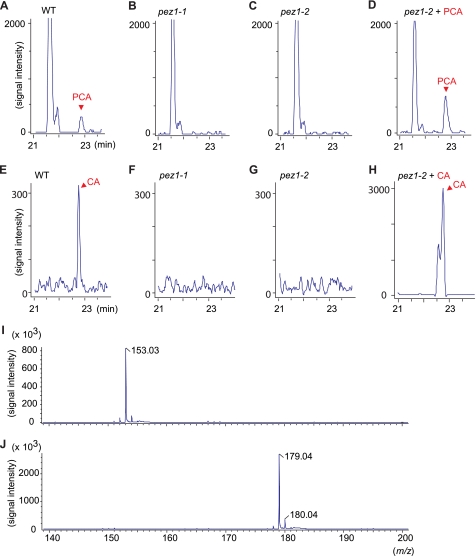
PCA was decreased in the xylem sap of pez1 mutants. Mass chromatograms [PCA-H] m/z 152.5–153.5 of the xylem sap of WT (A), pez1-1 (B), pez1-2 (C), and pez1-2 + 500 μm PCA (D). A peak in PCA appeared at 22.8 min. Mass chromatograms [CA-H] m/z 178.5–179.5 of the xylem sap of WT (E), pez1-1 (F), pez1-2 (G) and pez1-2 + 500 μm CA (H). Also shown are mass spectrometry of PCA (I) and CA (J).
FIGURE 3.
FIGURE 3.
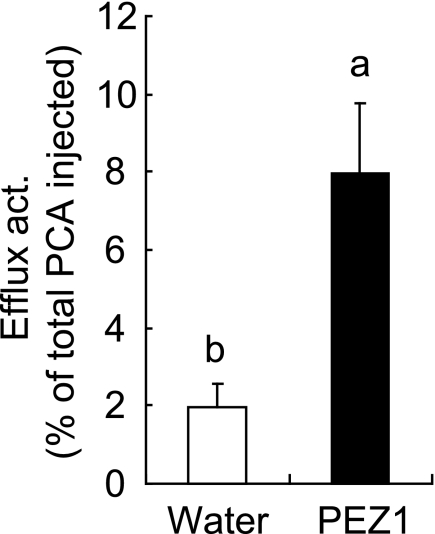
PCA efflux activity of PEZ1. Oocytes injected with water or PEZ1 cRNA were loaded with 1.0 mm 14C-labeled PCA. Columns (means ± S.D.) with different letters are significantly different from each other according to a one-way analysis of variance followed by a Student-Newman-Keuls test. p < 0.01, n = 8 each.
FIGURE 4.
FIGURE 4.
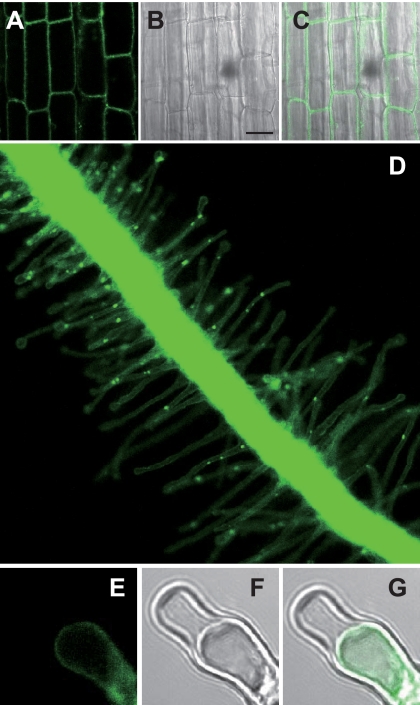
Subcellular localization of 35Sp-PEZ1-GFP in the rice root. Shown are fluorescence (A), differential interference contrast (B), and overlay (C) images of rice root epidermal cells. Scale bars = 20 μm. D, fluorescence image of a rice root. Also shown are fluorescence (E), differential interference contrast (F), and overlay (G) images of rice root hair cells during plasmolysis when the samples were flooded with 20% sucrose.
FIGURE 5.
FIGURE 5.
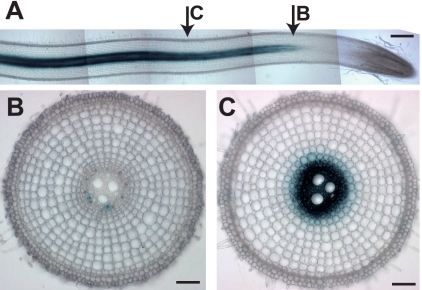
Histochemical observation of GUS activity in PEZ1 promoter GUS-transgenic plants. A, longitudinal section. B, transverse section from the base of the root (∼2.5 mm from the root tip). C, transverse section of the root (∼5 mm from the root tip). Scale bars = 500 μm (A) and 100 μm (B and C). Rice plants were grown for 6 weeks after germination on +Fe MS medium.
FIGURE 6.
FIGURE 6.
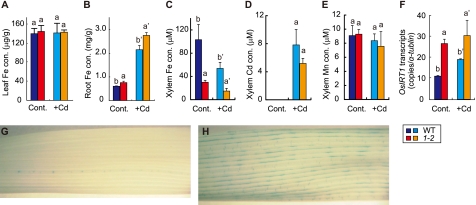
PEZ1 is essential for solubilizing apoplasmic Fe. Fe concentrations in the leaf (A) and the root (B) of WT and pez1-2 grown with or without Cd. Shown are Fe (C), Cd (D), and Mn (E) concentrations in xylem sap. Also shown is expression of OsIRT1 in WT and pez1-2 (F) and Perl's staining of WT (G) and pez1-2 (H). Columns (means ± S.D.) with different letters are significantly different from each other according to a one-way analysis of variance followed by a Student-Newman-Keuls test. p < 0.05, n = 3.
FIGURE 7.
FIGURE 7.
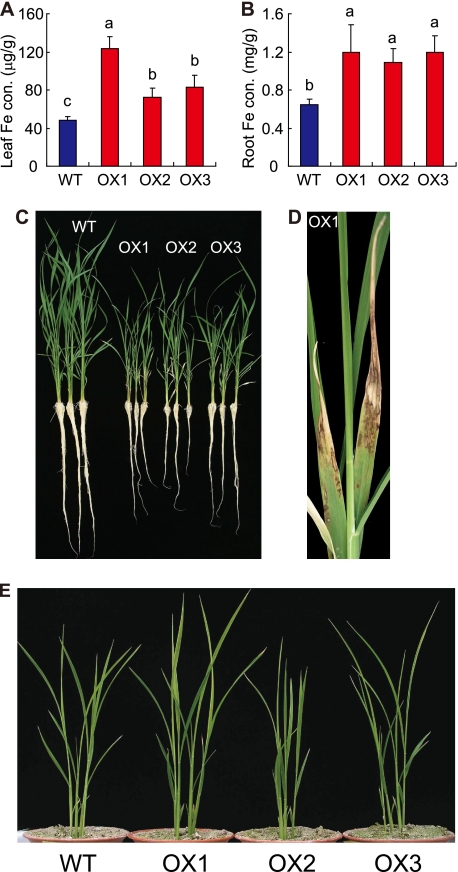
PEZ1 overexpression lines accumulated more Fe. Fe concentrations in leaves (A) and roots (B) of WT, overexpression (OX) 1, OX2, and OX3 plants under normal nutrient conditions. Columns (means ± S.D.) with different letters are significantly different from each other according to a one-way analysis of variance followed by a Student-Newman-Keuls test. p < 0.05, n = 3. C and D, phenotype of WT and OX1, OX2, and OX3 plants under normal nutrient conditions. E, WT and OX1, OX2, and OX3 plants grown in calcareous soil.
FIGURE 8.
FIGURE 8.
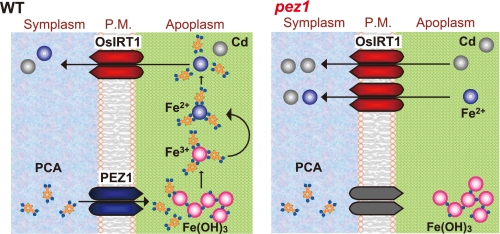
Models of Fe and Cd uptake mechanisms in WT or pez1. P.M., plasma membrane.

References

    1. Tester M., Langridge P. (2010) Science 327, 818–822 - PubMed
    1. Marschner H. (1995) in Mineral Nutrition of Higher Plants, pp. 313–324, Academic Press
    1. Guerinot M. L., Yi Y. (1994) Plant Physiol. 104, 815–820 - PMC - PubMed
    1. Römheld V., Marschner H. (1983) Plant Physiol. 71, 949–954 - PMC - PubMed
    1. Jeong J., Guerinot M. L. (2009) Trends Plant Sci. 14, 280–285 - PubMed

Publication types