. 2011 Jul;77(13):4406-11.
doi: 10.1128/AEM.03002-10. Epub 2011 May 20.

Effect of Lactobacillus fermentum on beta2 toxin production by Clostridium perfringens

Affiliations

Effect of Lactobacillus fermentum on beta2 toxin production by Clostridium perfringens

Janneke G Allaart et al. Appl Environ Microbiol. 2011 Jul.

Abstract

Clostridium perfringens, although a member of the normal gut flora, is also an important cause of intestinal disease in animals and, to a lesser extent, in humans. Disease is associated with the production of one or more toxins, and little is known about environmental influences on the production of these toxins. One of the health-promoting effects of lactic acid bacteria (LAB) is the establishment and maintenance of a low pH in the intestine since an acidic environment inhibits the growth of many potentially harmful bacteria. Here, the effect of the LAB Lactobacillus fermentum on beta2 toxin production by C. perfringens is described. Coculturing of C. perfringens with L. fermentum showed that under in vitro conditions, L. fermentum was capable of silencing beta2 toxin production by C. perfringens without influencing bacterial viability. The reduction in toxin production was shown to be most likely a result of the decline in pH. Quantitative PCR showed that the reduction in beta2 toxin production was due to a decrease in cpb2 mRNA. These results suggest that in the intestine, the production of beta2 toxin by C. perfringens might be regulated by other members of the normal intestinal flora.


Figures
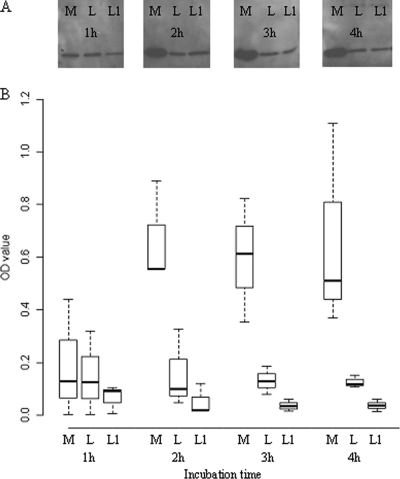
Fig. 1.
Fig. 1.
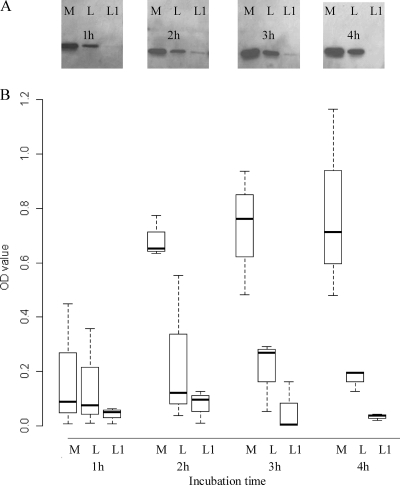
Differences in beta2 toxin production by C. perfringens strain Cp15 alone (M), in the presence of L. fermentum (L), or with a 1-h L. fermentum preincubation step (L1) after 1, 2, 3, and 4 h of incubation. (A) Western blot assay of a single experiment. (B) Mean optical density (OD) values of the various bands of three independent experiments as quantified by densitometry. The P value for the difference between the mean toxin levels of M and L is <0.0001, that for the difference between the mean toxin levels of M and L1 is < 0.0001, and that for the difference between the mean toxin levels of L and L1 is < 0.019.
Fig. 2.
Fig. 2.
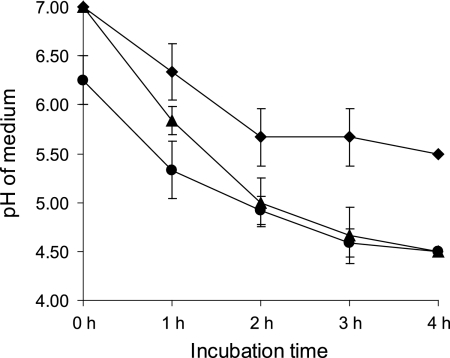
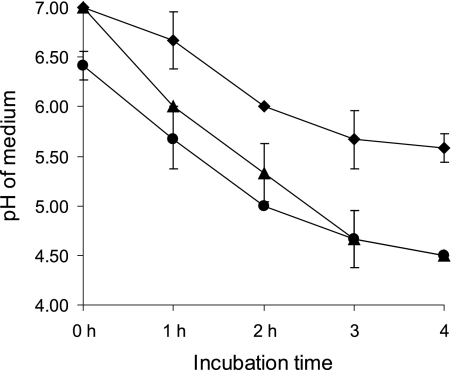
Decline in medium pH due to the growth of C. perfringens strain Cp15 alone (⧫), in the presence of L. fermentum (▴), or with a 1-h L. fermentum preincubation step (•). The start of the experiment is at 0 h, immediately after the C. perfringens cultures were added. Means of 3 individual experiments and standard deviations are shown.
Fig. 3.
Fig. 3.
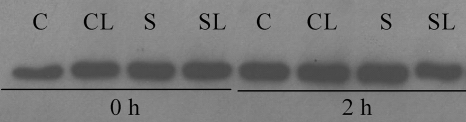
Stability of beta2 toxin in a culture of C. perfringens strain Cp15 alone (C), in a Cp15 culture to which L. fermentum was added (CL), in the supernatant of a culture of Cp15 alone (S), or in the supernatant of a CP15 culture to which L. fermentum was added (SL). The 0-h time point is the start of the experiment, immediately after the L. fermentum cultures were added. The 2-h time point is after 2 h of incubation starting at the moment the L. fermentum cultures were added.
Fig. 4.
Fig. 4.
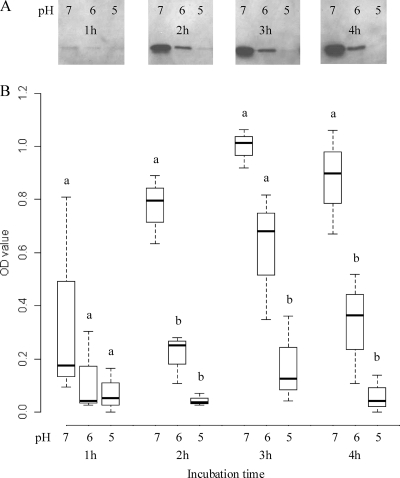
Differences in beta2 toxin production by C. perfringens strain Cp15 in MRS broth with an initial pH of 7, 6, or 5 after 1, 2, 3, or 4 h of incubation. (A) Western blot assay of a single experiment. (B) Mean optical density (OD) values of the various bands of three independent experiments as quantified by densitometry. A different letter indicates a significant difference (P < 0.05) in the mean toxin levels at the pH levels and times indicated.
Fig. 5.
Fig. 5.
Decline in medium pH due to the growth of C. perfringens strain Cp15 in MRS broth with an initial pH of 7 (⧫), 6 (▴), or 5 (•). Means of 3 individual experiments and standard deviations are shown.
Fig. 6.
Fig. 6.
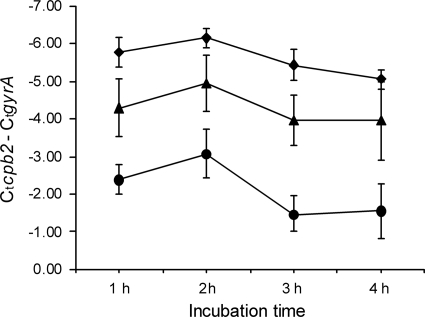
Differences in amounts of beta2 mRNA produced by C. perfringens strain Cp15 in MRS broth with an initial pH of 7 (⧫), 6 (▴), or 5 (•). The amount of beta2 mRNA produced is expressed relative to the amount of gyrase mRNA produced. Means of 2 individual experiments done in triplicate and standard deviations are shown.
Fig. 7.
Fig. 7.
Differences in beta2 toxin production by C. perfringens strain Cp15 alone (M), in the presence of L. fermentum (L), or with a 1-h L. fermentum preincubation step (L1) on a monolayer of Caco-2 cells after 1, 2, 3, or 4 h of incubation. (A) Western blot assay of a single experiment. (B) Mean optical density (OD) values of the various bands of three independent experiments as quantified by densitometry. The P value for the difference between the mean toxin levels of M and L is <0.010, that for the difference between the mean toxin levels of M and L1 is < 0.0001, and that for the difference between the mean toxin levels of L and L1 is < 0.067.
Fig. 8.
Fig. 8.
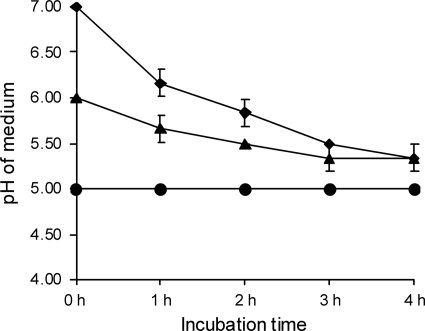
Decline in medium pH due to the growth of C. perfringens strain Cp15 alone (⧫), in the presence of L. fermentum (▴), or with a 1-h L. fermentum preincubation step (•) on a monolayer of Caco-2 cells after 1, 2, 3, or 4 h of incubation. The 0-h time point is the start of the experiment, immediately after the C. perfringens cultures were added. Means of 3 individual experiments and standard deviations are shown.

References

    1. Bassler B. L. 1999. How bacteria talk to each other: regulation of gene expression by quorum sensing. Curr. Opin. Microbiol. 2:582–587 - PubMed
    1. Berg R. D. 1996. The indigenous gastrointestinal microflora. Trends Microbiol. 4:430–435 - PubMed
    1. Bueschel D. M., Jost B. H., Billington S. J., Trinh H. T., Songer J. G. 2003. Prevalence of cpb2, encoding beta2 toxin, in Clostridium perfringens field isolates: correlation of genotype with phenotype. Vet. Microbiol. 94:121–129 - PubMed
    1. Carman R. J., et al. 2008. Clostridium perfringens toxin genotypes in the feces of healthy North Americans. Anaerobe 14:102–108 - PMC - PubMed
    1. Dogi C. A., Perdigón G. 2006. Importance of the host specificity in the selection of probiotic bacteria. J. Dairy Res. 73:357–366 - PubMed

MeSH terms

Substances

LinkOut - more resources