


First-time DWI offenders are at risk of recidivating regardless of sanctions imposed
- PMID: 21603059
- PMCID: PMC3095888
- DOI: 10.1016/j.jcrimjus.2011.01.001
First-time DWI offenders are at risk of recidivating regardless of sanctions imposed
Abstract
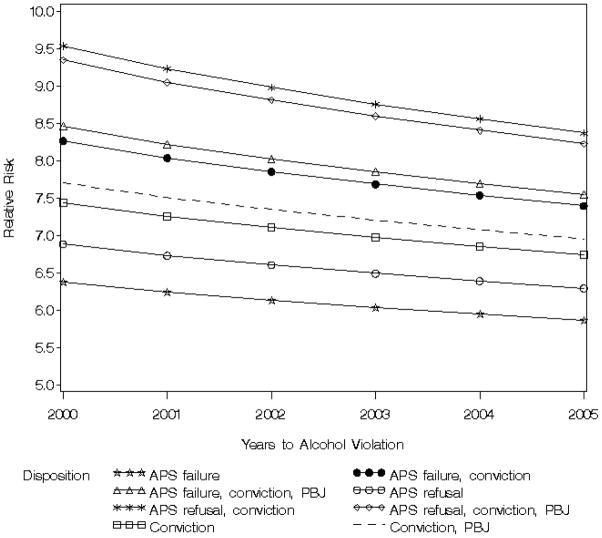
OBJECTIVE: Research demonstrates that punitive approaches to DWI employed by the judiciary have failed to significantly reduce recidivism. However, little is known about the deterrent effects of administrative and diversion sanctions. We examine whether such sanctions deter first-time DWI offenders. METHODS: We grouped combinations of administrative, judicial, and diversion sanctions routinely employed in the state of Maryland for processing drivers arrested for DWI into one of eight mutually exclusive disposition sequences. We applied this classification to Maryland drivers who had been licensed in the state and had precisely one DWI on their record prior to January 1, 1999. We then used a proportional hazards model to estimate the probability of remaining free of a new DWI during a 6-year period (January 1, 1999 - December 31, 2004) as a function of the disposition of the index violation, and of selected factors that could affect that probability. RESULTS: Drivers with a prior DWI were at relatively high risk of recidivating regardless of how they were sanctioned. Those who received administrative and alternative sanctions had a risk of recidivating similar to that of drivers who were convicted. CONCLUSION: All dispositions sequences, not just convictions, indicate that first-time DWI offenders are at high risk of recidivating.
Figures

References
-
- Anda RF, Remington PL, Williamson DF. A sobering perspective on a lower blood alcohol limit, letter to the Editor. Journal of the American Medical Association. 1986;256:3213. - PubMed
-
- Andrews DA, Bonta J. The psychology of criminal conduct. Cincinnati, OH: Anderson; 2003.
-
- Beccaria C. On crimes and punishments. Upper Saddle River, NJ: Prentice Hall; 1764/1963.
-
- Beitel GA, Sharp MC, Glauz WD. Probability of arrest while driving under the influence of alcohol. Journal of Studies on Alcohol. 1975;36:109–116. - PubMed
Grants and funding
LinkOut - more resources
Full Text Sources