


Longitudinal Modeling of Adolescents' Activity Involvement, Problem Peer Associations, and Youth Smoking
- PMID: 21603061
- PMCID: PMC3095902
- DOI: 10.1016/j.appdev.2010.09.005
Longitudinal Modeling of Adolescents' Activity Involvement, Problem Peer Associations, and Youth Smoking
Abstract
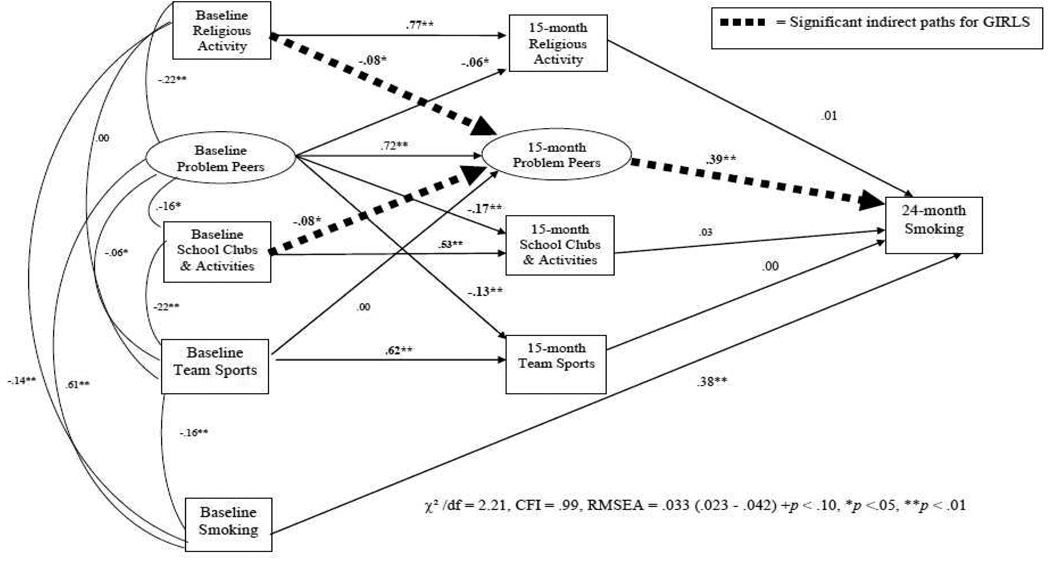
Longitudinal associations among different types of organized activity involvement, problem peer associations, and cigarette smoking were examined in a sample of 1,040 adolescents (mean age = 15.62 at baseline, 16.89 at 15-month assessment, 17.59 at 24 months) enriched for smoking experimentation (83% had tried smoking). A structural equation model tested longitudinal paths between three categories of involvement (team sports, school clubs and activities, and religious activities, measured at baseline and 15 months), problem peer associations (baseline and 15 months), and cigarette smoking behavior (baseline and 24 months). Multi-group analyses indicated pathways differed by type of activity and adolescent gender. Boys' baseline team sports and religious involvement predicted lower levels of smoking at 24 months via continued activity involvement at 15 months. Girls' involvement in school clubs and activities and religious activities indirectly predicted lower levels of smoking at 24 months via reduced exposure to problem peers at 15 months.
Figures


References
-
- Barber B, Eccles J, Stone M. Whatever happened to the jock, the brain, and the princess? Young adult pathways linked to adolescent involvement and social identity. Journal of Adolescent Research. 2001;16:429–455.
-
- Barber BL, Stone MR, Hunt JE, Eccles JS. Benefits of activity participation: The roles of identity affirmation and peer group norm sharing. In: Mahoney JL, Larson RW, Eccles JS, editors. Organized activities as contexts of development: Extracurricular activities, after-school and community programs. Mahwah, NJ: Lawrence Erlbaum Associates; 2005. pp. 185–210.
-
- Bohnert AM, Garber J. Prospective relations between organized activity participation and psychopathology during adolescence. Journal of Abnormal Child Psychology. 2007;35:1021–1033. - PubMed
-
- Bollen KA, Stine R. Direct and indirect effects: Classical and bootstrap estimates of variability. Sociological Methodology. 1990;20:115–140.
-
- Brown BB, Mory MS, Kinney D. Casting adolescent crowds in a relational perspective: Caricature, channel and context. In: Montemayor R, Adams GR, Gullotta TP, editors. Personal relationships during adolescence. Thousand Oaks, CA: Sage; 1994. pp. 123–167.
Publication types
Grants and funding
LinkOut - more resources
Full Text Sources