


doi: 10.1016/j.ddmec.2011.01.003.
The Role of Phospholipase A(2)-derived Mediators in Obesity
Affiliations
- PMID: 21603130
- PMCID: PMC3097474
- DOI: 10.1016/j.ddmec.2011.01.003
Item in Clipboard
The Role of Phospholipase A(2)-derived Mediators in Obesity
Drug Discov Today Dis Mech.
2010 Winter.
Abstract
Obesity has become an epidemic and its prevalence is increasing exponentially. A great deal of focus has been given to understanding the molecular processes that regulate obesity. The characterization of phospholipase A(2)s, especially adipose-specific PLA(2), have lead to a proposed role of their downstream products in the progression of obesity and obesity related disorders. This review summarizes recent developments in the role of PLA(2) and their downstream effects in the development of metabolic disorders.
Figures
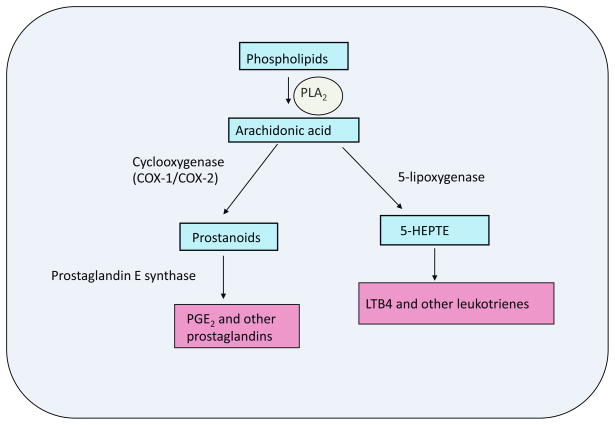
Phospholipase A2 (PLA2) cleaves sn-2 fatty acids from phospholipids. Arachidonic acid is an important fatty acid produced by PLA2 activity, since it can be converted into many bioactive molecules, prostaglandins and leukotrienes. Numerous enzymes are involved in the generation of bioactive molecules, and cylclooxygenase-1 and -2, prostaglandin E synthase, and 5-lipoxygenase are key players in the production of prostaglandins and luekotrienes.
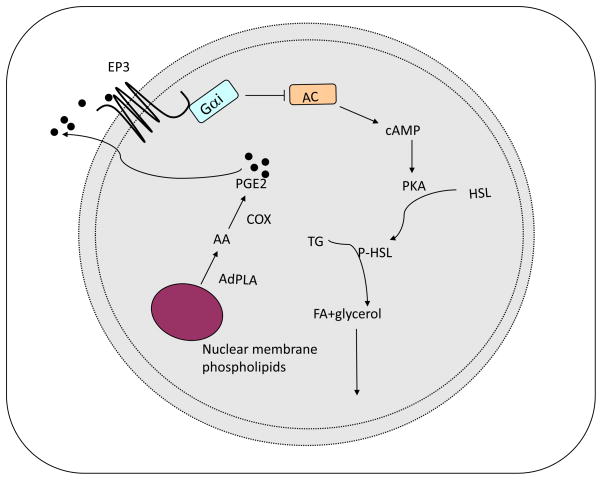
AdPLA is an adipose specific PLA2 that can produce arachidonic acid (AA) from the sn-2 position of membrane phospholipids. Subsequently, prostaglandin E2 (PGE2) is produced via cyclooxygenase (COX) pathway and acts to suppress lipolysis through Giα-coupled prostaglandin E3 (EP3) to inhibit adenylate cyclase (AC). This model suggests an autocrine-paracrine role of PGE2 in the regulation of lipolysis in adipose tissue.
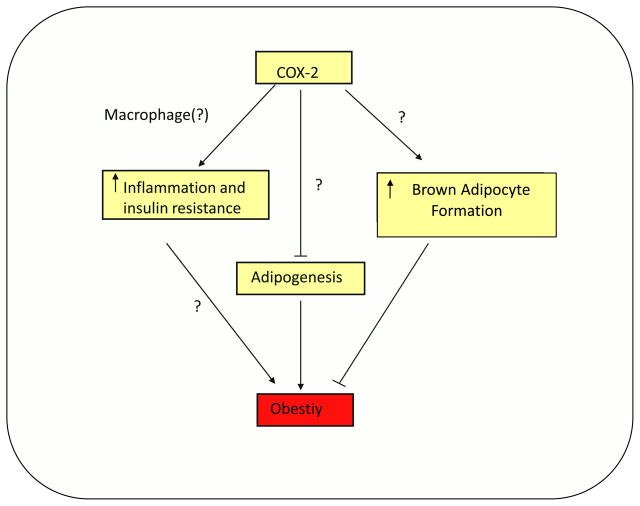
Cyclooxyganse-2 (COX-2) may contribute to increased inflammation and insulin resistance associated with obesity, possibly through increasing cytokine secretion or by increasing prostaglandin production from the macrophage. On the other hand, COX-2 may also act to increase brown adipocyte generation in white adipose tissue thus ameliorating obesity.
References
-
- Flegal KM, Carroll MD, Ogden CL, Curtin LR. Prevalence and Trends in Obesity Among US Adults, 1999–2008. JAMA: The Journal of the American Medical Association. 2010;303:235–241. - PubMed
-
- Bray GA. Medical Consequences of Obesity. J Clin Endocrinol Metab. 2004;89:2583–2589. - PubMed
-
- Foreyt JP, Goodrick GK. Evidence for Success of Behavior Modification in Weight Loss and Control. Annals of Internal Medicine. 1993;119:698–701. - PubMed
-
- Sjostrom L, Lindroos AK, Peltonen M, Torgerson J, Bouchard C, Carlsson Br, Dahlgren S, Larsson B, Narbro K, Sjostrom CD, Sullivan M, Wedel H. Lifestyle, Diabetes, and Cardiovascular Risk Factors 10 Years after Bariatric Surgery. New England Journal of Medicine. 2004;351:2683–2693. - PubMed
-
- Elangbam CS. Review Paper: Current Strategies in the Development of Anti-obesity Drugs and Their Safety Concerns. Veterinary Pathology Online. 2009;46:10–24. - PubMed
Grants and funding
LinkOut - more resources
Full Text Sources
Other Literature Sources