. 2010 Fall;10(3):213-6.

Statistics: a brief overview

Statistics: a brief overview

Ryan Winters et al. Ochsner J. 2010 Fall.

Abstract

The Accreditation Council for Graduate Medical Education sets forth a number of required educational topics that must be addressed in residency and fellowship programs. We sought to provide a primer on some of the important basic statistical concepts to consider when examining the medical literature. It is not essential to understand the exact workings and methodology of every statistical test encountered, but it is necessary to understand selected concepts such as parametric and nonparametric tests, correlation, and numerical versus categorical data. This working knowledge will allow you to spot obvious irregularities in statistical analyses that you encounter.

Keywords: ACGME resident education; mathematics; statistics.


Figures
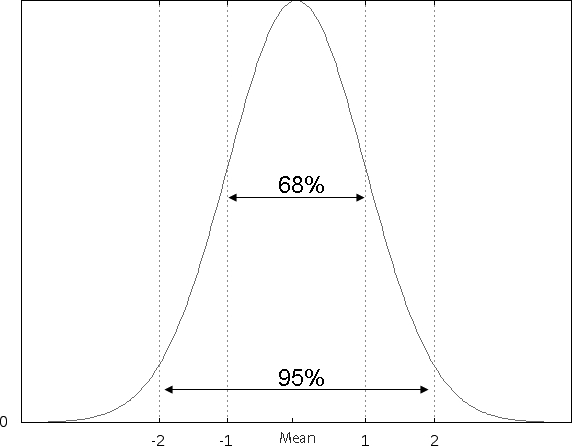
Figure 1
Figure 1
Normal (Gaussian) distribution. Mean  =  0 in this example. The 1 SD on either side of the mean encompasses ∼68% of all values under the curve, while 2 SD encompasses 95% of all values under the curve.

References

    1. Blume J., Peipert J. F. What your statistician never told you about P-values. J Am Assoc Gynecol Laparosc. 2003;10((4)):439–444. - PubMed
    1. Greenhalgh T. How to read a paper: statistics for the non-statistician, I: different types of data need different statistical tests [erratum appears in BMJ. 1997;315(7109):675] BMJ. 1997;315:364–366. - PMC - PubMed
    1. Greenhalgh T. How to read a paper: statistics for the non-statistician, II: “significant” relations and their pitfalls. BMJ. 1997;315:422–425. - PMC - PubMed
    1. Guyatt G., Jaeschke R., Heddle N., et al. Basic statistics for clinicians: 1. hypothesis testing. CMAJ. 1995;152((1)):27–32. - PMC - PubMed
    1. Guyatt G., Jaeschke R., Heddle N., et al. Basic statistics for clinicians: 2. interpreting study results: confidence intervals. CMAJ. 1995;152((2)):169–173. - PMC - PubMed

LinkOut - more resources