


Atrial fibrillation: current perspective
Affiliations
- PMID: 21603450
- PMCID: PMC3096286
Item in Clipboard
Atrial fibrillation: current perspective
Ochsner J.
2009 Winter.
No abstract available
Keywords: Atrial fibrillation; catheter ablation; mechanisms of atrial fibrillation; radiofrequency ablation.
Figures
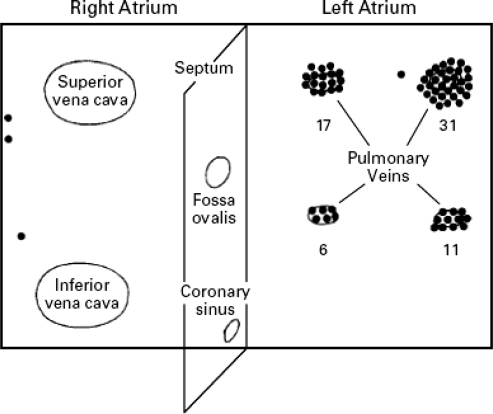
Diagram showing foci triggering atrial fibrillation. Note the clustering of these foci in the pulmonary veins. (Reprinted with permission from Haissaguerre M, Jais P, Shah DC, et al. N Engl J Med. 1998;339:659–666.17)
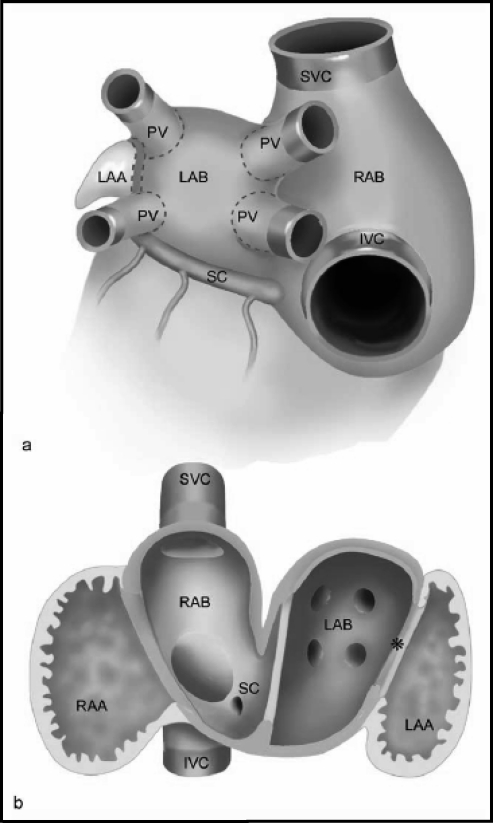
(a) Schematic depicting the outer sides of the atrial chambers with pulmonary veins (PV), superior vena cava (SVC), and inferior venal cava (IVC). The right and left atrial bodies (RAB and LAB) are covered by smooth-walled inner myocardium that stretches into the extracardiac PVs and partially into the systemic veins. (b) Schematic depicting the tissue seen from inside the left and right atria and how the smooth-walled myocardial tissue extends into the systemic veins. Left-sided sinus venosus tissue (*) and SC = coronary sinus. (Reprinted with permission from Douglas YL, Jongbloed MR, Gittenberger-de Groot AD, et al. Am J Cardiol. 2006;97:662–670.18)
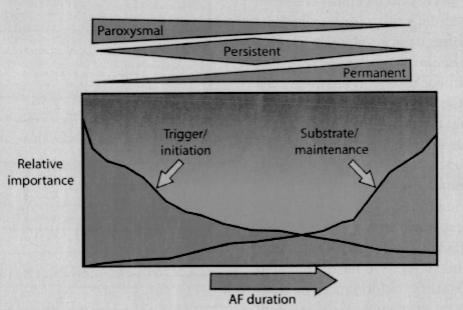
Spectrum of importance of mechanisms of atrial fibrillation as they relate to atrial fibrillation classification and how these change over time. (Reprinted with permission from Crandall MA, Bradley DJ, Packer DL, Asirvatham SJ. Mayo Clin Proc. 2009;84:643–662.2)
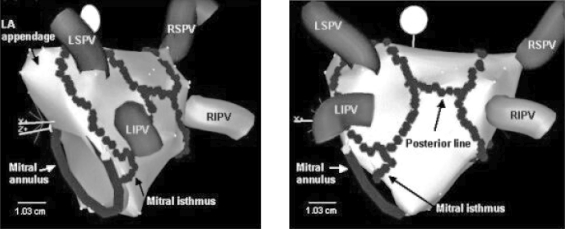
Electroanatomic maps of the left atrium demonstrating the left atrial radiofrequency ablation lines (series of connected dots) created during pulmonary vein isolation and two additional linear lines. The posterior line connects the two circular lesions that surround the ipsalateral pulmonary veins, and one line connects the mitral valve annulus to the circular lesion that surrounds the left pulmonary veins (mitral isthmus line). LSPV = left superior pulmonary vein; LIPV = left inferior pulmonary vein; RSPV = right superior pulmonary vein; and RIPV = right inferior pulmonary vein. (Reprinted with permission from Padanilam BJ, Prystowsky EN. Medscape Cardiology 2005:9.23)
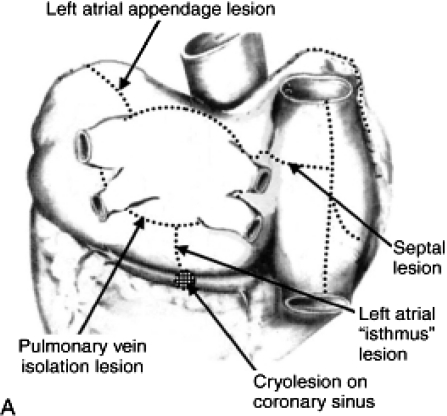
Lesions created in the Maze III procedure: (i) isolation of the PVs; (ii) formation of lines connecting the lesions created around the PVs to each other, the LAA (with LAA resection), and the mitral valve (with cryoablation within the coronary sinus to complete the mitral isthmus line); and (iii) a cavo-tricuspid isthmus line in the right atrium. (Reprinted with permission from Cox JL. J Thorac Cardiovasc Surg. 2003;126:1693–1699 and Saunders Elsevier publishing.25,27)
References
-
- Fuster V., Rydén L. E., Cannom D. S., et al. ACC/AHA/ESC 2006 Guidelines for the Management of Patients with Atrial Fibrillation: a report of the American College of Cardiology/American Heart Association Task Force on Practice Guidelines and the European Society of Cardiology Committee for Practice Guidelines (Writing Committee to Revise the 2001 Guidelines for the Management of Patients With Atrial Fibrillation): developed in collaboration with the European Heart Rhythm Association and the Heart Rhythm Society. J Am Coll Cardiol. 2006;48(4):e149–e246. - PubMed
-
- Go A. S., Hylek E. M., Phillips K. A., et al. Prevalence of diagnosed atrial fibrillation in adults: national implications for rhythm management and stroke prevention: the AnTicoagulation and Risk Factors in Atrial Fibrillation (ATRIA) Study. JAMA. 2001;285(18):2370–2375. - PubMed
-
- Calkins H., Brugada J., Packer D. L., et al. European Heart Rhythm Association (EHRA); European Cardiac Arrhythmia Society (ECAS); American College of Cardiology (ACC); American Heart Association (AHA); Society of Thoracic Surgeons (STS) HRS/EHRA/ECAS expert Consensus Statement on catheter and surgical ablation of atrial fibrillation: recommendations for personnel, policy, procedures and follow-up. A report of the Heart Rhythm Society (HRS) Task Force on catheter and surgical ablation of atrial fibrillation. Heart Rhythm. 2007;4(6):816–861. Erratum in: Heart Rhythm. 2009;6(1):148. - PubMed
-
- Wyse D. G., Waldo A. L., DiMarco J. P., et al. A comparison of rate control and rhythm control in patients with atrial fibrillation. N Engl J Med. 2002;347(23):1825–1833. - PubMed
LinkOut - more resources
Full Text Sources