. 2009 Winter;9(4):248-56.

Cardiac resynchronization therapy

Affiliations

Cardiac resynchronization therapy

Joseph S Owen et al. Ochsner J. 2009 Winter.

Abstract

Systolic heart failure is a major problem for Americans today, with 550,000 new cases diagnosed per year, and ultimately contributes to 287,000 deaths annually. While pharmacologic therapy has drastically improved outcomes in patients with systolic heart failure, hospitalizations from systolic heart failure continue to increase and remain a major cost burden. In response to this unmet need, recent years have seen dramatic improvements in device-based therapy targeting one cause of systolic dysfunction: dyssynchronous ventricular contraction. Cardiac resynchronization therapy aims to restore mechanical synchrony by electrically activating the heart in a synchronized manner. This review summarizes the rationale for cardiac resynchronization therapy, evidence for its use, current guidelines, and ongoing and future directions for research.

Keywords: Biventricular pacing; cardiac resynchronization therapy; cardiomyopathy; review; systolic heart failure.


Figures
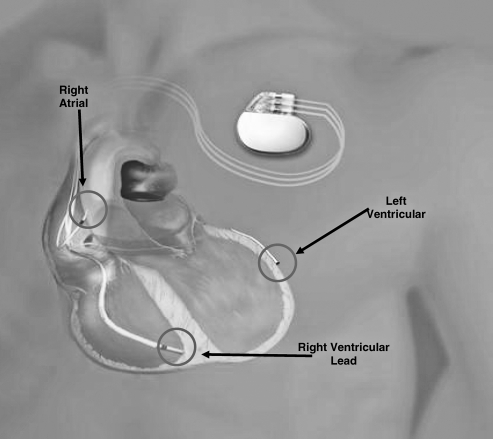
Figure 1
Figure 1
A typical cardiac resynchronization system. Note pacing leads in the right atrium, right ventricle, and left ventricle.
Figure 2
Figure 2
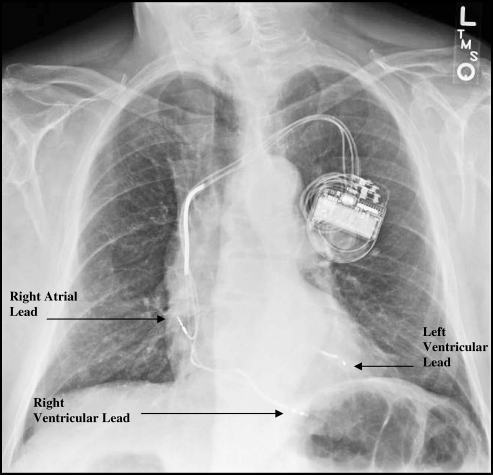
Chest x-ray showing pacing leads in the right atrium, right ventricle, and left ventricle.
Figure 3
Figure 3
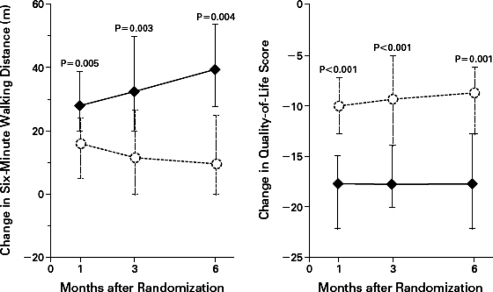
Change in 6-minute walking distance and quality-of-life scores in the MIRACLE trial, demonstrating significant improvements in patients receiving cardiac resynchronization therapy (CRT) (solid diamonds) when compared with those receiving no CRT (circles). Note that a more negative quality-of-life score indicates superior quality of life. (Adapted with permission from Abraham WT, Fisher WG, Smith AL, et al. N Engl J Med. 2002;346:1845–1853.9)
Figure 4
Figure 4
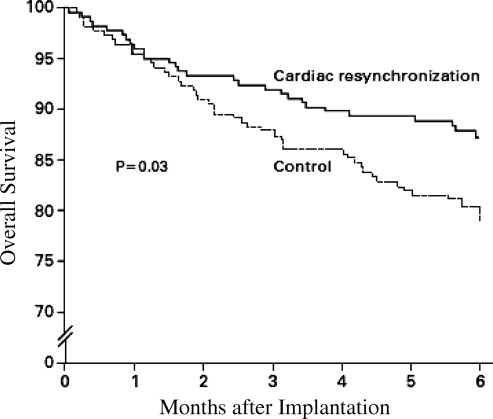
Kaplan-Meier estimates of the overall survival for worsening heart failure in the control and resynchronization groups in the MIRACLE trial, demonstrating a 40% decrease in the combined end point (death or hospitalization for worsening heart failure) during 6 months' follow-up. (Adapted with permission from Abraham WT, Fisher WG, Smith AL, et al. N Engl J Med. 2002;346:1845–1853.9)
Figure 5
Figure 5
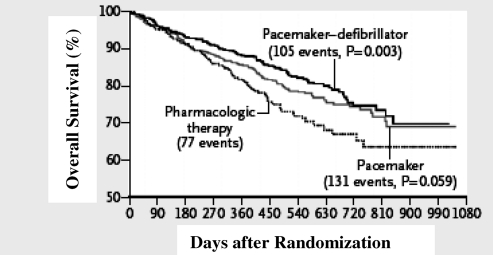
Kaplan-Meier curve showing overall survival in the cardiac resynchronization therapy-pacemaker (CRT-P) group, CRT-defibrillator (CRT-D) group, and control group in the COMPANION trial. The CRT-D cohort showed a significant reduction in all-cause mortality, while the CRT-P cohort barely missed statistical significance for this end point. (Adapted with permission from Bristow MR, Saxon LA, Boehmer J, et al. N Engl J Med. 2004;350:2140–2150.7)
Figure 6
Figure 6
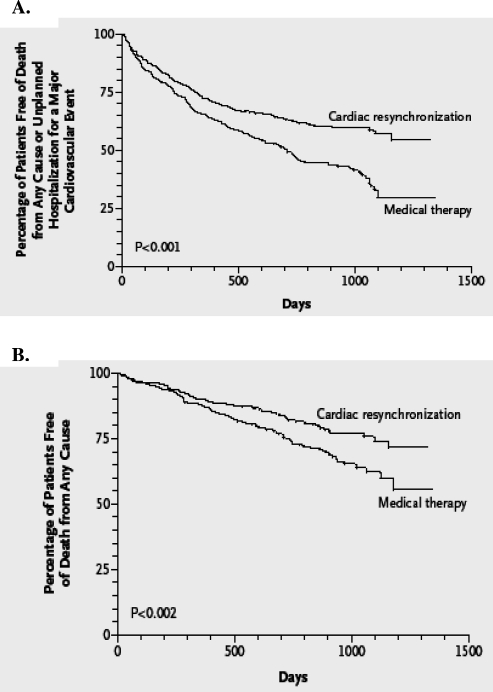
Kaplan-Meier survival curves from the CARE-HF trial, showing CRT's benefit both for (A) the combined end point of mortality and/or heart failure hospitalization and for (B) all-cause mortality. (Adapted with permission from Cleland JGF, Daubert JC, Erdmann E, et al. N Engl J Med. 2005;352:1539–1549.8)

References

    1. US Dept of Health and Human Services. Heart failure fact sheet. Available at: www.cdc.gov/dhdsp/library/pdfs/fs_heart_failure.pdf. Accessed August 8, 2009.
    1. Leclercq C., Bleeker G. B., Linde C., et al. Cardiac resynchronization therapy: clinical results and evolution of candidate selection. Eur Heart J. 2007;9(suppl I):I94–I106.
    1. Jeevanantham V., Daubert J. P., Zareba W. Cardiac resynchronization therapy in heart failure patients: an update. Cardiol J. 2009;16:197–209. - PubMed
    1. McAlister F. A., Ezekowitz J., Hooton N., et al. Cardiac resynchronization therapy for patients with left ventricular systolic dysfunction: a systematic review. JAMA. 2007;297:2502–2514. - PubMed
    1. Cazeau S., Ritter P., Bakdach S., et al. Four chamber pacing in dilated cardiomyopathy. Pacing Clin Electrophysiol. 1994;17(11, pt 2):1974–1979. - PubMed