Health and turnover of working mothers after childbirth via the work-family interface: an analysis across time
- PMID: 21604833
- PMCID: PMC3835182
- DOI: 10.1037/a0023964
Health and turnover of working mothers after childbirth via the work-family interface: an analysis across time
Abstract
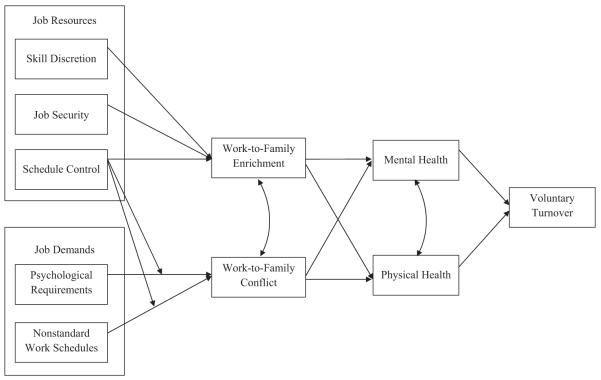
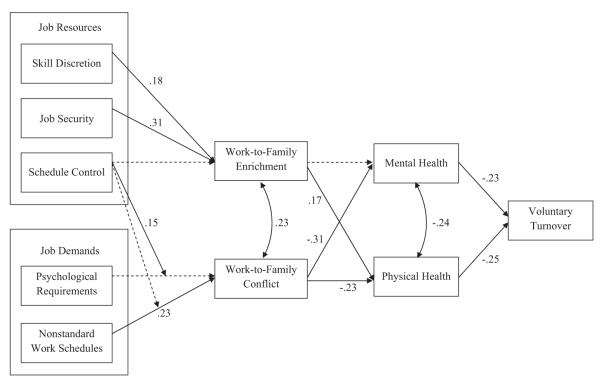
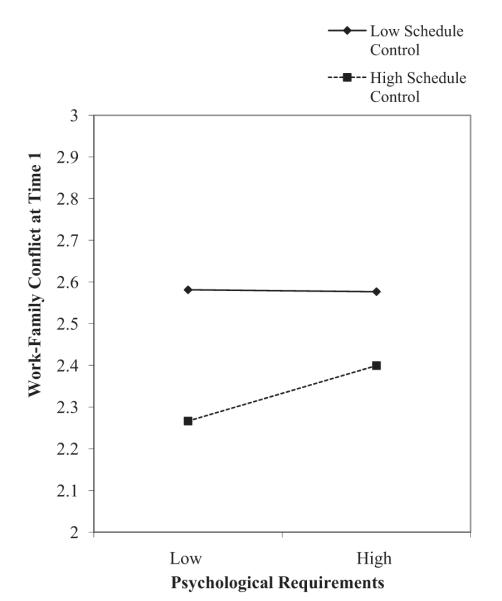
This study examined organizational levers that impact work-family experiences, participant health, and subsequent turnover. Using a sample of 179 women returning to full-time work 4 months after childbirth, we examined the associations of 3 job resources (job security, skill discretion, and schedule control) with work-to-family enrichment and the associations of 2 job demands (psychological requirements and nonstandard work schedules) with work-to-family conflict. Further, we considered subsequent impact of work-to-family conflict and enrichment on women's health (physical and mental health) 8 months after women returned to work and the impact of health on voluntary turnover 12 months after women returned to work. Having a nonstandard work schedule was directly and positively related to conflict, whereas schedule control buffered the effect of psychological requirements on conflict. Skill discretion and job security, both job resources, directly and positively related to enrichment. Work-to-family conflict was negatively related to both physical and mental health, but work-to-family enrichment positively predicted only physical health. Physical health and mental health both negatively influenced turnover. We discuss implications and opportunities for future research.
PsycINFO Database Record (c) 2011 APA, all rights reserved
Figures
References
-
- Akerstedt T. Psychological and physiological effects of shift work. Scandinavian Journal of Work, Environment & Health. 1990;16:67–73. - PubMed
-
- Andrews DR, Wan TTH. The importance of mental health to the experience of job strain: An evidence-guided approach to improve retention. Journal of Nursing Management. 2009;17:340–351. doi:10.1111/j.1365-2934.2008.00852.x. - PubMed
-
- Aryee S, Luk V, Leung A, Lo S. Role stressors, interrole conflict, and well-being: The moderating influence of spousal support and coping behaviors among employed parents in Hong Kong. Journal of Vocational Behavior. 1999;54:259–278. doi:10.1006/jvbe.1998.1667.
-
- Bakker AB, Demerouti E. The job demands–resources model: State of the art. Journal of Managerial Psychology. 2007;22:309–328. doi:10.1108/02683940710733115.