


Mitochondrial oxidative stress drives tumor progression and metastasis: should we use antioxidants as a key component of cancer treatment and prevention?
- PMID: 21605374
- PMCID: PMC3123229
- DOI: 10.1186/1741-7015-9-62
Mitochondrial oxidative stress drives tumor progression and metastasis: should we use antioxidants as a key component of cancer treatment and prevention?
Abstract
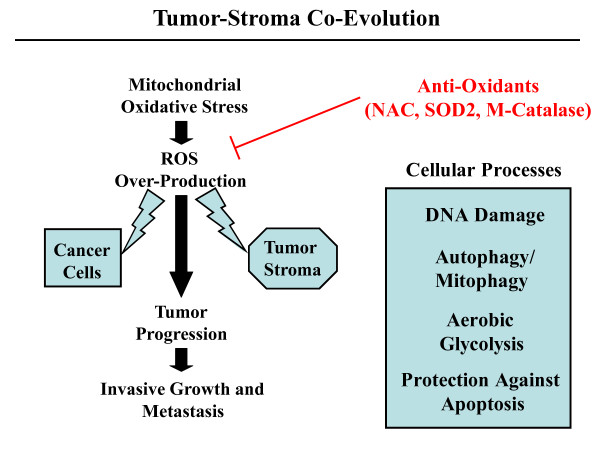
The functional role of oxidative stress in cancer pathogenesis has long been a hotly debated topic. A study published this month in BMC Cancer by Goh et al., directly addresses this issue by using a molecular genetic approach, via an established mouse animal model of human breast cancer. More specifically, alleviation of mitochondrial oxidative stress, via transgenic over-expression of catalase (an anti-oxidant enzyme) targeted to mitochondria, was sufficient to lower tumor grade (from high-to-low) and to dramatically reduce metastatic tumor burden by >12-fold. Here, we discuss these new findings and place them in the context of several other recent studies showing that oxidative stress directly contributes to tumor progression and metastasis. These results have important clinical and translational significance, as most current chemo-therapeutic agents and radiation therapy increase oxidative stress, and, therefore, could help drive tumor recurrence and metastasis. Similarly, chemo- and radiation-therapy both increase the risk for developing a secondary malignancy, such as leukemia and/or lymphoma. To effectively reduce mitochondrial oxidative stress, medical oncologists should now re-consider the use of powerful anti-oxidants as a key component of patient therapy and cancer prevention. Please see related research article: http://www.biomedcentral.com/1471-2407/11/191.
Figures
Comment on
-
Mitochondrial targeted catalase suppresses invasive breast cancer in mice.BMC Cancer. 2011 May 23;11:191. doi: 10.1186/1471-2407-11-191. BMC Cancer. 2011. PMID: 21605372 Free PMC article.
References
-
- Singh PN, Sabate J, Fraser GE. Does low meat consumption increase life expectancy in humans? Am J Clin Nutr. 2003;78:526S–532S. - PubMed
-
- Goodson AG, Cotter MA, Cassidy P, Wade M, Florell SR, Liu T, Boucher KM, Grossman D. Use of oral N-acetylcysteine for protection of melanocytic nevi against UV-induced oxidative stress: towards a novel paradigm for melanoma chemoprevention. Clin Cancer Res. 2009;15:7434–7440. doi: 10.1158/1078-0432.CCR-09-1890. - DOI - PMC - PubMed
Publication types
MeSH terms
Substances
Grants and funding
LinkOut - more resources
Full Text Sources
Other Literature Sources
Medical
