


doi: 10.1016/j.mito.2011.05.002.
Epub 2011 May 13.
Why are there no proven therapies for genetic mitochondrial diseases?
Affiliations
- PMID: 21605707
- PMCID: PMC3155622
- DOI: 10.1016/j.mito.2011.05.002
Item in Clipboard
Why are there no proven therapies for genetic mitochondrial diseases?
Mitochondrion.
2011 Sep.
Abstract
Although mitochondrial disease research in general is robust, adequate treatment of these life-threatening conditions has lagged, partly because of a persistence of clinical anecdotes as substitutes for scientifically and ethically rigorous clinical trials. Here I summarize the key lessons learned from some of the "first generation" of randomized controlled trials for genetic mitochondrial diseases and suggest how future trials may benefit from both past experience and exciting new resources available for patient-oriented research and training in this field.
Copyright © 2011 © Elsevier B.V. and Mitochondria Research Society. All rights reserved. Published by Elsevier B.V. All rights reserved.
Figures
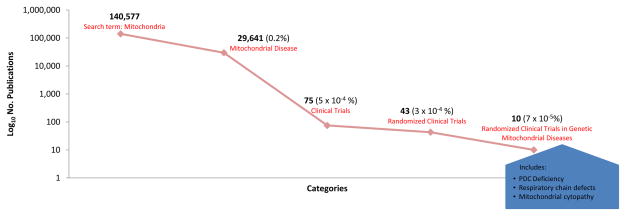
PubMed citations as of February 11, 2011.
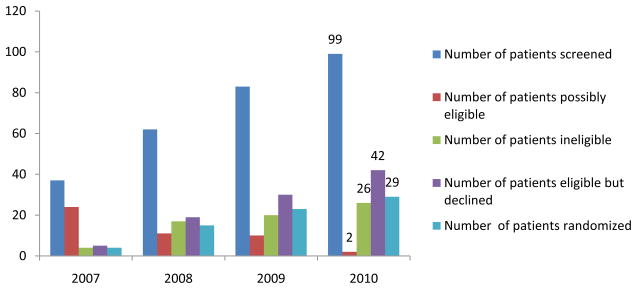
Subject screening and enrollment in the CoQ10 trial, 2007–2010.
References
-
- Anderson S, Bankier AT, Barrel BG, De Bruijn MHL, Coulson AR, Drouin J, et al. Sequence and organization of the human mitochondrial genome. Nature. 1981;290:457–465. - PubMed
-
- Arogov Z, Bank WJ, Maris J, et al. Treatment of mitochondrial myopathy due to complex III deficiency with vitamins K3 and C: A 31P-NMR follow-up study. Ann Neurol. 1986;19:598. - PubMed
-
- Balaban RS, Nemoto S, Finkel T. Mitochondrial, oxidants and aging. Cell. 2005;120:483–495. - PubMed
-
- Barshop BA, Naviaux RK, McGowan KA, Levine F, Nyhan WL, Loupis-Geller A, et al. Chronic treatment of mitochondrial disease patients with dichloroacetate. Mol Genet Metab. 2004;83(1–2):138–49. - PubMed
-
- Beal MF. Mitochondria, oxidative damage, and inflammation in Parkinson’s disease. Ann NY Acad Sci. 2003;991:120–31. - PubMed
Publication types
MeSH terms
Substances
Grants and funding
LinkOut - more resources
Full Text Sources
Medical
Miscellaneous
