


Behaviour of the motoneurone pool in a fatiguing submaximal contraction
- PMID: 21606110
- PMCID: PMC3167116
- DOI: 10.1113/jphysiol.2011.207191
Behaviour of the motoneurone pool in a fatiguing submaximal contraction
Abstract
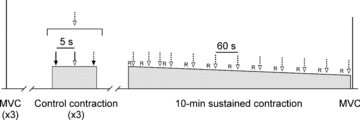
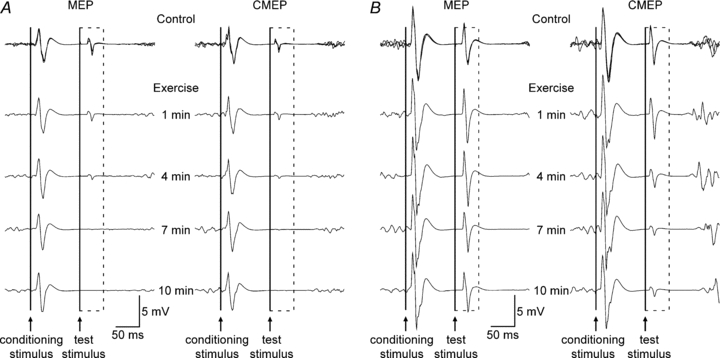
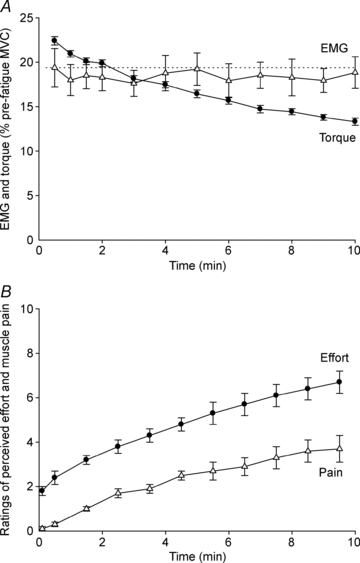
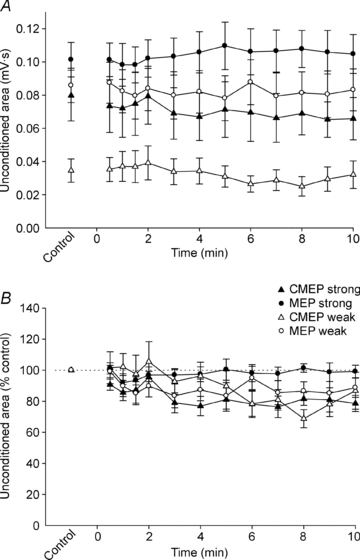
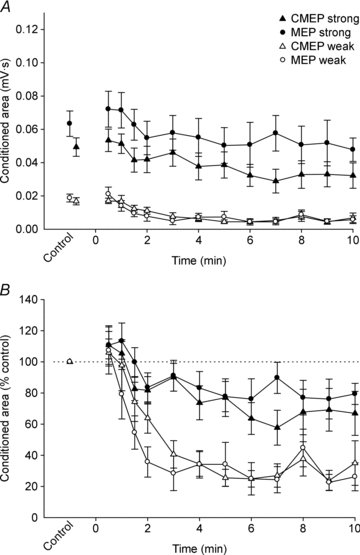
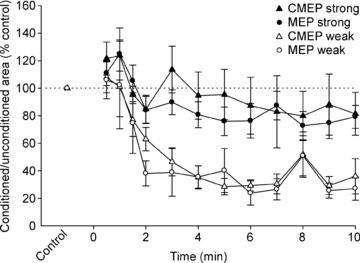
During fatigue caused by a sustained maximal voluntary contraction (MVC), motoneurones become markedly less responsive when tested during the silent period following transcranial magnetic stimulation (TMS). To determine whether this reduction depends on the repetitive activation of the motoneurones, responses to TMS (motor evoked potentials, MEPs) and to cervicomedullary stimulation (cervicomedullary motor evoked potentials, CMEPs) were tested during a sustained submaximal contraction at a constant level of electromyographic activity (EMG). In such a contraction, some motoneurones are repetitively activated whereas others are not active. On four visits, eight subjects performed a 10 min maintained-EMG elbow flexor contraction of 25% maximum. Test stimuli were delivered with and without conditioning by TMS given 100 ms prior. Test responses were MEPs or CMEPs (two visits each, small responses evoked by weak stimuli on one visit and large responses on the other). During the sustained contraction, unconditioned CMEPs decreased ∼20% whereas conditioned CMEPs decreased ∼75 and 30% with weak and strong stimuli, respectively. Conditioned MEPs were reduced to the same extent as CMEPs of the same size. The data reveal a novel decrease in motoneurone excitability during a submaximal contraction if EMG is maintained. Further, the much greater reduction of conditioned than unconditioned CMEPs shows the critical influence of voluntary drive on motoneurone responsiveness. Strong test stimuli attenuate the reduction of conditioned CMEPs which indicates that low-threshold motoneurones active in the contraction are most affected. The equivalent reduction of conditioned MEPs and CMEPs suggests that, similar to findings with a sustained MVC, impaired motoneurone responsiveness rather than intracortical inhibition is responsible for the fatigue-related impairment of the MEP during a sustained submaximal contraction.
Figures
Comment in
-
Understanding the mechanisms of neuromuscular fatigue with paired-pulse stimulation.J Physiol. 2012 Jan 1;590(1):5-6. doi: 10.1113/jphysiol.2011.219204. J Physiol. 2012. PMID: 22210284 Free PMC article. No abstract available.
References
-
- Benwell NM, Mastaglia FL, Thickbroom GW. Differential changes in long-interval intracortical inhibition and silent period duration during fatiguing hand exercise. Exp Brain Res. 2007;179:255–262. - PubMed
-
- Berardelli A, Inghilleri M, Rothwell JC, Cruccu G, Manfredi M. Multiple firing of motoneurones is produced by cortical stimulation but not by direct activation of descending motor tracts. Electroencephalogr Clin Neurophysiol. 1991;81:240–242. - PubMed
-
- Binder MD, Heckman CJ, Powers RK. The physiological control of motoneuron activity. In: Rowell LB, Shepherd JT, editors. Handbook of Physiology, section 12, Exercise: Regulation and Integration of Multiple Systems. Bethesda, SD: American Physiological Society; 1996. pp. 3–53.
-
- Borg G. Psychophysical scaling with applications in physical work and the perception of exertion. Scand J Work Environ Health. 1990;16(Suppl 1):55–58. - PubMed
Publication types
MeSH terms
LinkOut - more resources
Full Text Sources
