Prognostic impact of white blood cell count in intermediate risk acute myeloid leukemia: relevance of mutated NPM1 and FLT3-ITD
- PMID: 21606167
- PMCID: PMC3166101
- DOI: 10.3324/haematol.2011.040592
Prognostic impact of white blood cell count in intermediate risk acute myeloid leukemia: relevance of mutated NPM1 and FLT3-ITD
Abstract
Background: High white blood cell count at presentation is an unfavorable prognostic factor for treatment outcome in intermediate cytogenetic risk acute myeloid leukemia. Since the impact of white blood cell count on outcome of subgroups defined by the molecular markers NPMc(+) and FLT3-internal tandem duplication (ITD) is unknown, we addressed this issue.
Design and methods: We studied the effect of white blood cell count on outcome in a clinically and molecularly well-defined cohort of 525 patients with acute myeloid leukemia using these molecular markers. In addition, since an increased white blood cell count has been associated with an increased FLT3-ITD/FLT3 (wild-type) ratio, we investigated whether the effect of white blood cell count on outcome could be explained by the FLT3-ITD/FLT3 ratio.
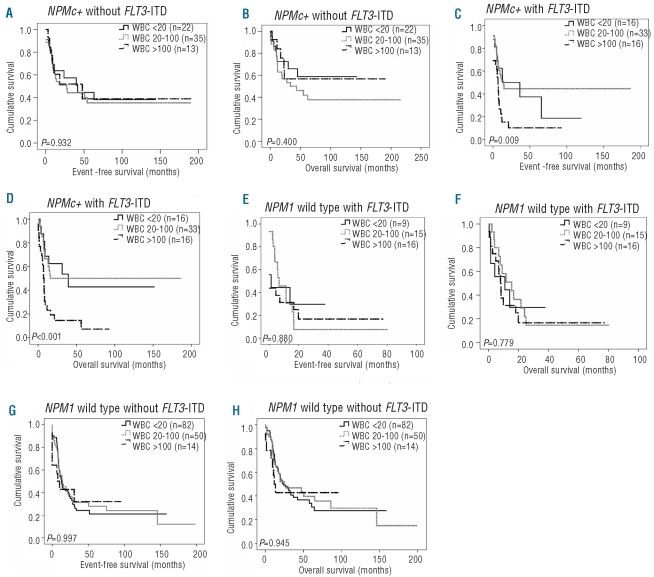
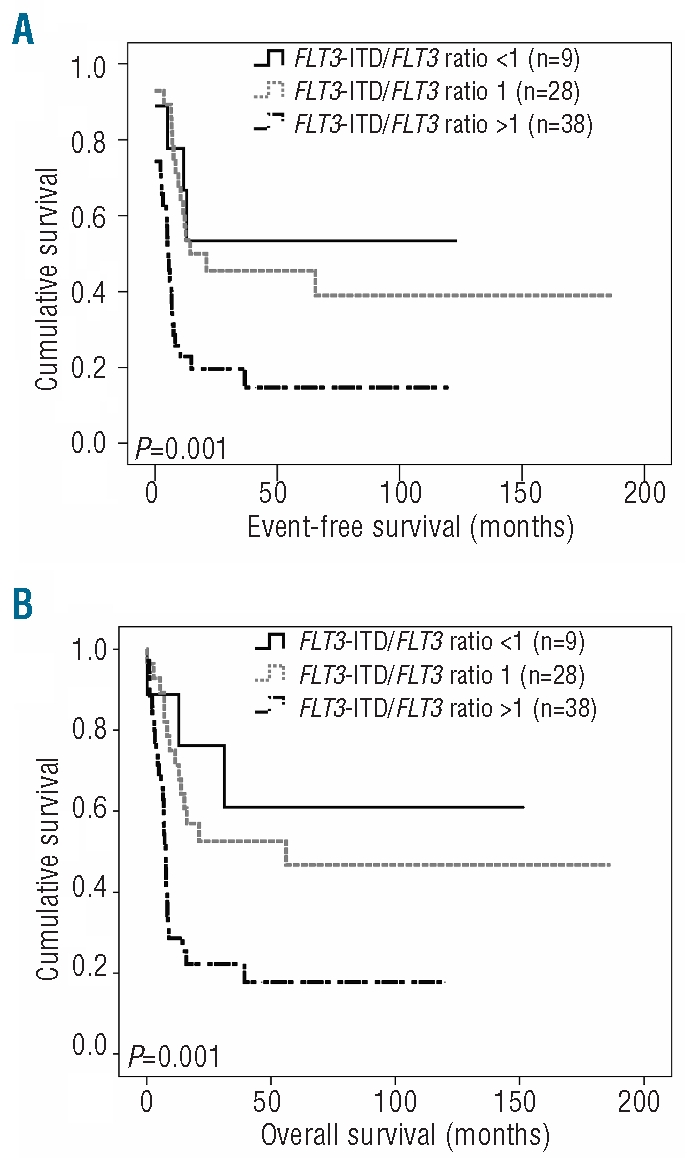
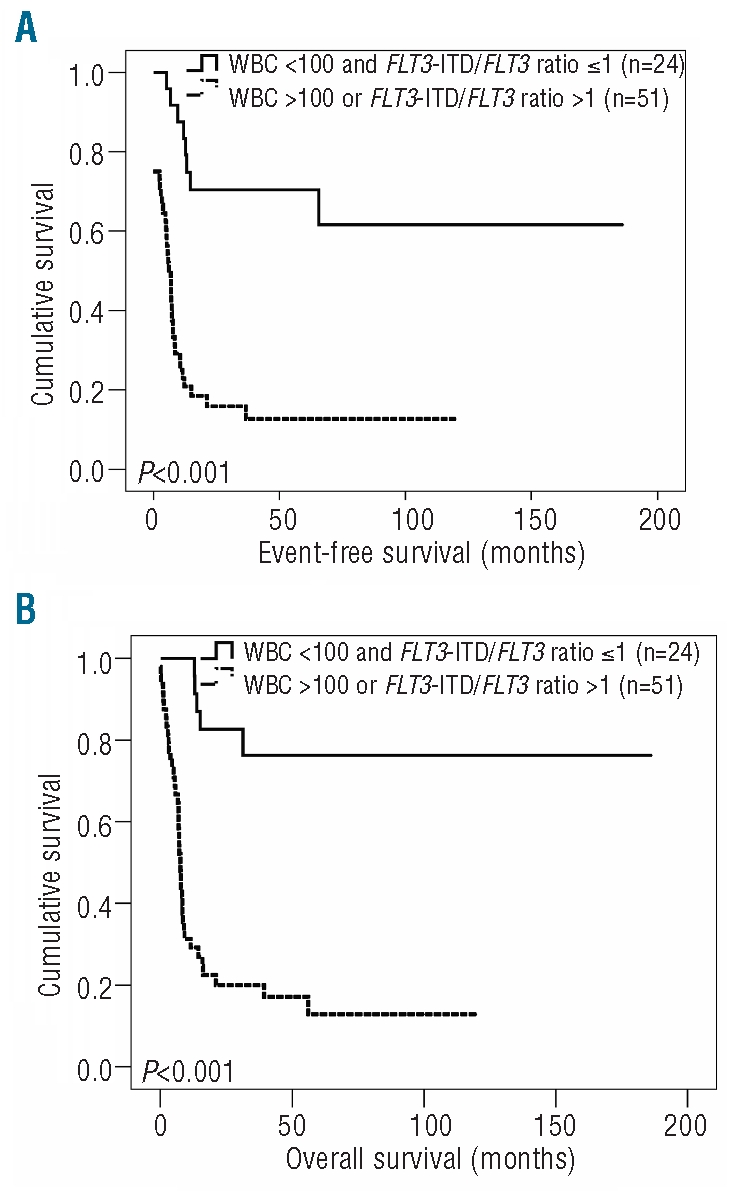
Results: This analysis revealed that white blood cell count had no impact on outcome in patients with the genotypic combinations 'NPMc(+) without FLT3-ITD' and 'NPM1 wild-type with or without FLT3-ITD'. In contrast, white blood cell count had a significant impact on complete remission rate (P=0.034), event-free survival (P=0.009) and overall survival (P<0.001) in patients with the genotypic combination 'NPMc(+) with FLT3-ITD'. A FLT3-ITD/FLT3 ratio greater than 1 was also associated with a reduced complete remission rate (P=0.066) and significantly reduced event-free survival (P= 0.001) and overall survival (P=0.001) in patients with the genotypic combination 'NPMc(+) with FLT3-ITD'. Multivariable analysis revealed that white blood cell count and FLT3-ITD/FLT3 ratio were independent prognostic indicators for outcome in the subgroup with the genotypic combination 'NPMc(+) with FLT3-ITD'.
Conclusions: Our results demonstrate that both high white blood cell count and FLT3-ITD/FLT3 ratio are prognostic factors in patients with acute myeloid leukemia with the genotypic combination 'NPMc(+) with FLT3-ITD'.
Figures
References
-
- Estey E, Dohner H. Acute myeloid leukaemia. Lancet. 2006;368(9550):1894–907. - PubMed
-
- Lowenberg B, Downing JR, Burnett A. Acute myeloid leukemia. N Engl J Med. 1999;341(14):1051–62. - PubMed
-
- Breems DA, Van Putten WL, De Greef GE, Van Zelderen-Bhola SL, Gerssen-Schoorl KB, Mellink CH, et al. Monosomal karyotype in acute myeloid leukemia: a better indicator of poor prognosis than a complex karyotype. J Clin Oncol. 2008;26(29):4791–7. - PubMed
-
- Byrd JC, Mrozek K, Dodge RK, Carroll AJ, Edwards CG, Arthur DC, et al. Pretreatment cytogenetic abnormalities are predictive of induction success, cumulative incidence of relapse, and overall survival in adult patients with de novo acute myeloid leukemia: results from Cancer and Leukemia Group B (CALGB 8461) Blood. 2002;100(13):4325–36. - PubMed
-
- Grimwade D, Walker H, Oliver F, Wheatley K, Harrison C, Harrison G, et al. The importance of diagnostic cytogenetics on outcome in AML: analysis of 1,612 patients entered into the MRC AML 10 trial. The Medical Research Council Adult and Children's Leukaemia Working Parties. Blood. 1998;92(7):2322–33. - PubMed
MeSH terms
Substances
LinkOut - more resources
Full Text Sources
Medical
Miscellaneous