. 2011 Jun 7;108(23):9643-8.
doi: 10.1073/pnas.1103321108. Epub 2011 May 23.

Genetic and molecular analyses reveal an evolutionary trajectory for glycan synthesis in a bacterial protein glycosylation system

Affiliations

Genetic and molecular analyses reveal an evolutionary trajectory for glycan synthesis in a bacterial protein glycosylation system

Bente Børud et al. Proc Natl Acad Sci U S A. .

Abstract

Although protein glycosylation systems are becoming widely recognized in bacteria, little is known about the mechanisms and evolutionary forces shaping glycan composition. Species within the genus Neisseria display remarkable glycoform variability associated with their O-linked protein glycosylation (pgl) systems and provide a well developed model system to study these phenomena. By examining the potential influence of two ORFs linked to the core pgl gene locus, we discovered that one of these, previously designated as pglH, encodes a glucosyltransferase that generates unique disaccharide products by using polyprenyl diphosphate-linked monosaccharide substrates. By defining the function of PglH in the glycosylation pathway, we identified a metabolic conflict related to competition for a shared substrate between the opposing glycosyltransferases PglA and PglH. Accordingly, we propose that the presence of a stereotypic, conserved deletion mutation inactivating pglH in strains of Neisseria gonorrhoeae, Neisseria meningitidis, and related commensals, reflects a resolution of this conflict with the consequence of reduced glycan diversity. This model of genetic détente is supported by the characterization of pglH "missense" alleles encoding proteins devoid of activity or reduced in activity such that they cannot exert their effect in the presence of PglA. Thus, glucose-containing glycans appear to be a trait undergoing regression at the genus level. Together, these findings document a role for intrinsic genetic interactions in shaping glycan evolution in protein glycosylation systems.


Conflict of interest statement

The authors declare no conflict of interest.

Figures
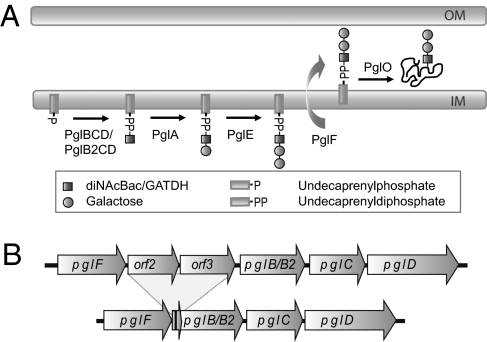
Fig. 1.
Fig. 1.
Glycosylation pathway and core pgl locus in Neisseria. (A) Current model of the broad spectrum O-linked glycosylation systems in Neisseria. (B) Gross polymorphisms in the neisserial core pgl locus associated with ORFs 2 and 3. Shown are the two states documented in strains of Neisseria (7, 10) and in a survey of currently available genome sequences (Table S1): the top configuration represents the ancestral form and the bottom corresponds to the deleted form. The stereotypic deletion retains the first 40 bp of ORF2 and the last 100 bp of ORF3. A 30-bp sequence of unknown origin that spans the ORF2 and 3 sequences is shown in black. Ancestral and deleted forms are found in combination with both pglB and pglB2 allele variants.
Fig. 2.
Fig. 2.
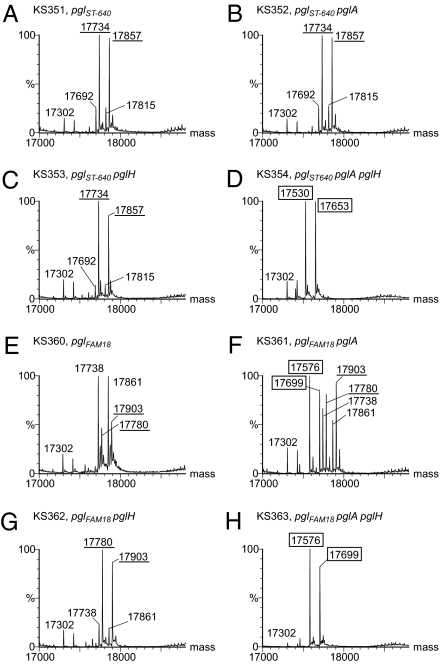
ORF3/pglH is associated with altered disaccharide glycan composition. ESI MS analysis of intact PilE with pili from either the N400 pglST-640 or N400 pglFAM18 strains with different pgl backgrounds were carried out to characterize the glycan structure. (AD) N400 pglST-640 has the pglB allele responsible for synthesizing diNAcBac glycans. The strains KS351, KS352, and KS353 all produced two major signals that represent PilE carrying the diNAcBac-AcHex disaccharide with one (17,734 Da) or two (17,857 Da) PE modifications. For KS354, the two major signals represent PilE with diNAcBac monosaccharide with one (17,530 Da) or two (17,653 Da) PE modifications. (EH) N400 pglFAM18 has the pglB2 allele accountable for synthesizing GATDH glycans. The strains KS360, KS361, and KS362, all produced signals that represent PilE carrying GATDH-AcHex disaccharides with one (17,780 Da) or two (17,903 Da) PE modifications and also GATDH-Hex disaccharides with one (17,738 Da) or two (17,861 Da) PE modifications. For KS363, the two major signals represent PilE with GATDH monosaccharides with one (17,576 Da) or two (17,699 Da) PE modifications. Also, KS361 produced two major signals that represent PilE carrying GATDH monosaccharide with one or two PE modifications. Monosaccharides are indicated with molecular weights (in Da) boxed. All acetylated disaccharides are underlined. Table S2 shows all the ion species, m/z values, and corresponding molecular weights.
Fig. 3.
Fig. 3.
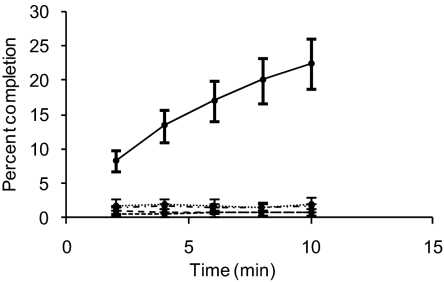
PglH is a glucosyltransferase synthesizing disaccharide glycans. In vitro radioactivity-based assay using recombinantly expressed PglH from N. meningitidis strain Z2491 shows that it specifically transfers UDP-Glc (solid line) to Und-PP-diNAcBac. In comparison, PglH shows no transferase activity in the presence of UDP-Gal, (round dot) UDP-GlcNAc (square dot), UDP-GalNAc (dash), and GDP-Man (dash/dot). Assays were performed in triplicate, and error bars indicate SD.
Fig. 4.
Fig. 4.
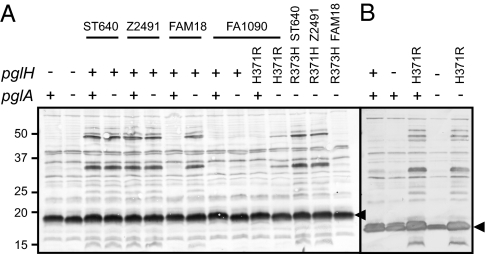
Identification of pglH polymorphisms associated with diminished glucosyltransferase activity. Expression of the diNAcBac-Glc disaccharide was monitored by reactivity of endogenous glycoproteins following immunoblotting with pDAb2 polyclonal antibody. (A) Variant alleles of pglH were expressed ectopically in the strain N400 derivative 4/3/1. In the strain expressing the pglHFAM18 allele, glycoform-specific immunoreactivity was detected only in the pglA-null background, and in the strain expressing the pglHFA1090 allele, no immunoreactivity was seen in either background. Conversion of H371R in the pglHFA1090 allele partially restored activity but only in the pglA null background. Introduction of his in place of arg 371/373 in the other alleles had varying effects. Minus signs denote absence of the pglH gene or pglA::kan. Plus signs denote ectopically expressed pglH or intact pglA. Strains used are KS101, KS122, KS443, KS444, KS445, KS446, KS447, KS448, KS449, KS450, KS451, KS452, KS454, KS456, and KS458. (B) Mutation H371R in the endogenous pglH locus of strain FA1090 restores diNAcBac-Glc expression, and activity was seen in the presence of an intact pglA allele. Minus signs denote pglA::kan or pglH::ermC/rpsL; plus signs denote intact pglA or pglH. Strains used are KS300, KS422, KS459, KS423, and KS460. Arrow denotes the position of the major glycoprotein PilE.
Fig. 5.
Fig. 5.
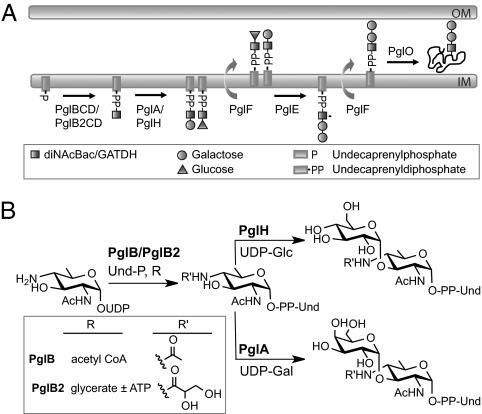
PglA and PglH compete for substrates generated by PglB/PglB2 in a branched pathway for protein glycan biosynthesis. (A) PglH is involved in the broad-spectrum O-linked glycosylation systems in Neisseria by adding glucose onto diNacBac or GATDH UndPP monosaccharide. (B) The figure displays the chemical reactions of the phospho-glycosyltransferases, PglB/PglB2, and the glycosyltransferases, PglA and PglH. Boxed are the substrates (R) for the two glycosyltransferases, PglB and PglB2, and side groups (R′) on the glycans. Und, undecaprenol; UDP, uridine diphosphate.

References

    1. Nothaft H, Szymanski CM. Protein glycosylation in bacteria: Sweeter than ever. Nat Rev Microbiol. 2010;8:765–778. - PubMed
    1. Champion OL, et al. Comparative phylogenomics of the food-borne pathogen Campylobacter jejuni reveals genetic markers predictive of infection source. Proc Natl Acad Sci USA. 2005;102:16043–16048. - PMC - PubMed
    1. Carter AT, et al. Independent evolution of neurotoxin and flagellar genetic loci in proteolytic Clostridium botulinum. BMC Genomics. 2009;10:115. - PMC - PubMed
    1. Twine SM, et al. Motility and flagellar glycosylation in Clostridium difficile. J Bacteriol. 2009;191:7050–7062. - PMC - PubMed
    1. Vik A, et al. Broad spectrum O-linked protein glycosylation in the human pathogen Neisseria gonorrhoeae. Proc Natl Acad Sci USA. 2009;106:4447–4452. - PMC - PubMed

Publication types

MeSH terms

LinkOut - more resources