


Glucocorticoids target suppressor of cytokine signaling 1 (SOCS1) and type 1 interferons to regulate Toll-like receptor-induced STAT1 activation
- PMID: 21606371
- PMCID: PMC3111275
- DOI: 10.1073/pnas.1017296108
Glucocorticoids target suppressor of cytokine signaling 1 (SOCS1) and type 1 interferons to regulate Toll-like receptor-induced STAT1 activation
Abstract
Endogenous and pharmacologic glucocorticoids (GCs) limit inflammatory cascades initiated by Toll-like receptor (TLR) activation. A long-standing clinical observation has been the delay between GC administration and the manifestation of GC's anti-inflammatory actions. We hypothesized that the GCs would have inhibitory effects that target late temporal pathways that propagate proinflammatory signals. Here we interrogated signal transducer and activator of transcription 1 (STAT1) regulation by GC and its consequences for cytokine production during activation of macrophages with TLR-specific ligands. We found that robust STAT1 activation does not occur until 2-3 h after TLR engagement, and that GC suppression of STAT1 phosphorylation first manifests at this time. GC attenuates TLR4-mediated STAT1 activation only through induction of suppressor of cytokine signaling 1 (SOCS1), which increases throughout the 6-h period after treatment. Inhibition of TLR3-mediated STAT1 activation occurs via two mechanisms, impairment of type I IFN secretion and induction of SOCS1. Our data show that SOCS1 and type I interferons are critical GC targets for regulating STAT1 activity and may account for overall GC effectiveness in inflammation suppression in the clinically relevant time frame.
Conflict of interest statement
The authors declare no conflict of interest.
Figures
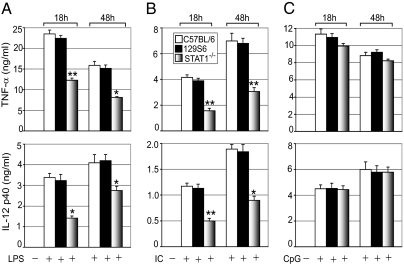
 ) macrophages. Cells were treated with TLR ligands for the indicated periods. Concentrations of TNF-α and IL-12p40 in the culture media were analyzed by ELISA. Data are mean ± SEM; n = 3. *P < 0.05; **P < 0.01 for STAT1−/− macrophages compared with control 129S6 macrophages.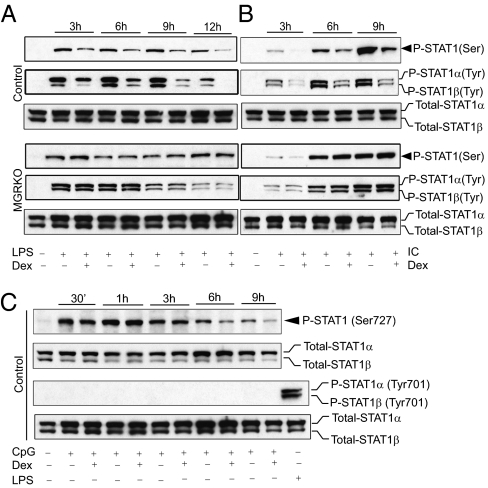
References
-
- O'Neill LA. Targeting signal transduction as a strategy to treat inflammatory diseases. Nat Rev Drug Discov. 2006;5:549–563. - PubMed
-
- Rhen T, Cidlowski JA. Anti-inflammatory action of glucocorticoids—new mechanisms for old drugs. N Engl J Med. 2005;353:1711–1723. - PubMed
-
- Brewer JA, et al. T-cell glucocorticoid receptor is required to suppress COX-2–mediated lethal immune activation. Nat Med. 2003;9:1318–1322. - PubMed
-
- Kleiman A, Tuckermann JP. Glucocorticoid receptor action in beneficial and side effects of steroid therapy: Lessons from conditional knockout mice. Mol Cell Endocrinol. 2007;275:98–108. - PubMed
Publication types
MeSH terms
Substances
Grants and funding
LinkOut - more resources
Full Text Sources
Other Literature Sources
Medical
Molecular Biology Databases
Research Materials
Miscellaneous
