


Comment
doi: 10.1172/JCI58196.
Epub 2011 May 23.
The yin, the yang, and the angiopoietin-1
Affiliations
- PMID: 21606600
- PMCID: PMC3104784
- DOI: 10.1172/JCI58196
Item in Clipboard
Comment
The yin, the yang, and the angiopoietin-1
J Clin Invest.
2011 Jun.
Abstract
Twenty years after the discovery of the vascular endothelial Tie receptor tyrosine kinases and 15 years after the discovery of the Tie2 ligand, angiopoietin-1 (Angpt1, also known as Ang1), a study published in the current issue of the JCI reveals an unexpected loss-of-function phenotype of mice conditionally deleted of the Angpt1 gene. The results suggest that Angpt1 is needed as a vascular stabilizing factor that organizes and limits the angiogenesis response and protects from pathological consequences, such as tissue fibrosis.
Figures
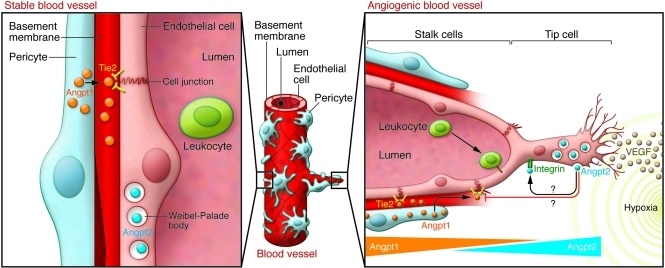
In stable vessels, Angpt1 is produced by pericytes, Tie2 is activated in endothelial cells, and Angpt2 is stored in Weibel-Palade bodies. However, the data by Jeansson et al. in this issue of the JCI indicates that Angpt1 function is not necessary for normal vascular physiology (7), although Tie2 has been found to be constitutively phosphorylated in quiescent endothelium (6). In vessels undergoing angiogenesis in response to VEGF secreted by nearby hypoxic cells, Angpt2 is expressed predominantly in the tip cells of angiogenic sprouts, where it may regulate cell-matrix interactions by binding to integrins and connective tissue matrix. The Tie2 receptor is expressed in the stalk cells, which become coated with pericytes and the basement membrane matrix that accumulates in between the cells in the stabilization phase of angiogenesis. Angpt1, from the perivascular cells, interacts with the Tie2 receptor. In this context, Angpt1 is necessary for the stabilization of the newly formed vessels, for attenuation of angiogenesis, and for limiting the production of excess of connective tissue. Whether Angpt2 counteracts the Angpt1-induced Tie2 activation in the stalk cells located behind the angiogenic tip cell area is as yet not clear. Angpt2 may also facilitate leukocyte adhesion to the endothelium of newly forming sprouts.
Comment on
-
Angiopoietin-1 is essential in mouse vasculature during development and in response to injury.J Clin Invest. 2011 Jun;121(6):2278-89. doi: 10.1172/JCI46322. Epub 2011 May 23. J Clin Invest. 2011. PMID: 21606590 Free PMC article.
References
-
- Fukuhara S, et al. Differential function of Tie2 at cell-cell contacts and cell-substratum contacts regulated by angiopoietin-1. Nat Cell Biol. 2008;10(5):513–526. - PubMed
-
- Saharinen P, et al. Angiopoietins assemble distinct Tie2 signalling complexes in endothelial cell-cell and cell-matrix contacts. Nat Cell Biol. 2008;10(5):527–537. - PubMed
Publication types
MeSH terms
Substances
LinkOut - more resources
Full Text Sources
Miscellaneous
