. 2011 Aug;4(2):209-17.
doi: 10.1007/s12307-011-0065-8. Epub 2011 May 24.

Cancer-immune equilibrium: questions unanswered

Affiliations

Cancer-immune equilibrium: questions unanswered

Alka Bhatia et al. Cancer Microenviron. 2011 Aug.

Abstract

Cancer-immune (CI) equilibrium constitutes an important component of the cancer immunoediting theory. It is defined as a period during which our immune system and cancer live in harmony in the body. The immune system, though not able to completely eliminate the cancer, doesn't allow it to progress or metastasize further. Mechanisms of this phase are poorly understood because this phase is difficult to identify even by the most modern detection methods. Till now, the work done on the equilibrium phase of cancer, suggests promising improvements in cancer therapy if the disease could be withheld in this phase. However, there are many queries which remain to be addressed about this interesting yet unresolved phase of cancer immunity.


Figures
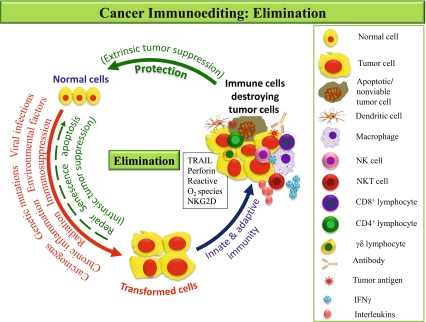
Fig. 1
Fig. 1
Elimination: Begins after transformation of normal cells as a result of one or more tumorigenic stimuli i.e. carcinogens. The transformation is normally prevented by intrinsic tumor suppressing mechanisms (i.e. repair, senescence or apoptosis). If these mechanisms fail to remove the transformed cells, extrinsic factors are induced involving both innate and adaptive immune response. Macrophages and NK cells play important role and eliminate tumor cells either by phagocytosis or direct cytotoxicity. Cells of adaptive immunity are also activated once the tumor antigens are presented to them by the antigen presenting cells i.e. DC leading to complete elimination
Fig. 2
Fig. 2
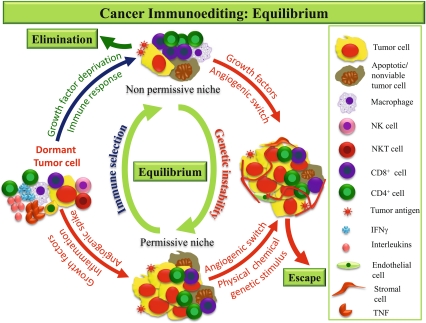
Equilibrium: Some of the cancer cells may resist elimination and undergo dormancy. These cells, being immunogenic, attract strong inflammatory response and various molecules i.e. INFγ, ILs and TNF etc are released by adaptive cells which keep a check on tumor multiplication. Therefore, during early stage of equilibrium the cells are quiescent and rate of apoptosis is low with no increase in tumor size. Persistent immune response, deprivation of growth promoting factors and hypoxia in the absence of vascular supply all create an unsuitable microenvironment (nonpermissive niche) for the tumor and eventually all tumor cells are eliminated leading to an outcome similar to elimination. Over the time or in later stage the tumor cells acquire genetic abnormities and angiogenic phenotype; they start proliferating rapidly and outgrow apoptosis resulting in a favorable microenvironment (permissive niche). The tumor is now ready to evade the CI equilibrium
Fig. 3
Fig. 3
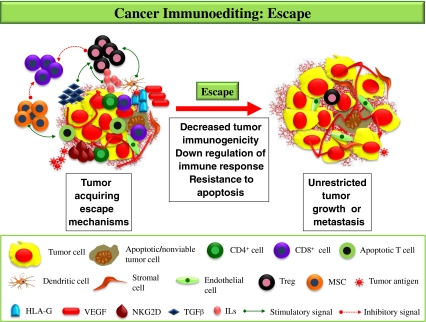
Escape: Once in a favorable environment, the tumor sheds all its antigens and other molecules which immune cells use for their recognition i.e. MHC, NKG2D and therefore, become less immunogenic. Further with appearance of Treg, MSC and molecules like HLA-G there is down regulation of the adaptive immunity. Finally with rich vascular supply due to growth factors i.e. VEGF and resistance to apoptosis the tumor escape immune response, grow to a clinically detectable size or may even metastasize

References

    1. Dunn GP, Old LJ, Schreiber RD. The three Es of cancer immunoediting. Annu Rev Immunol. 2004;22:329–360. doi: 10.1146/annurev.immunol.22.012703.104803. - DOI - PubMed
    1. Teng MWL, Swann JB, Koebel MC, Schreiber RD, Smyth JM. Immune-mediated dormancy: an equilibrium with cancer. J Leukocyte Biol. 2008;84:988–993. doi: 10.1189/jlb.1107774. - DOI - PubMed
    1. Kauffman HM, McBride MA, Delmonico FL. First report of the United Network for Organ Sharing Transplant Tumor Registry: donors with a history of cancer. Transplantation. 2000;70:1747–1751. doi: 10.1097/00007890-200012270-00014. - DOI - PubMed
    1. Myron KH, McBride MA, Cherikh WS, Spain PC, Marks WH, Roza AM. Transplant tumor registry: donor related malignancies. Transplantation. 2002;74:358–362. doi: 10.1097/00007890-200208150-00011. - DOI - PubMed
    1. MacKie MR, Reid R, Junor B. Fatal melanoma transferred in a donated kidney 16 years after melanoma surgery. N Eng J Med. 2003;348:567–568. doi: 10.1056/NEJM200302063480620. - DOI - PubMed

LinkOut - more resources