


doi: 10.1002/mus.22037.
Electrical conduction block in large nerves: high-frequency current delivery in the nonhuman primate
Affiliations
- PMID: 21607972
- PMCID: PMC3101373
- DOI: 10.1002/mus.22037
Item in Clipboard
Electrical conduction block in large nerves: high-frequency current delivery in the nonhuman primate
Muscle Nerve.
2011 Jun.
Abstract
Recent studies have made significant progress toward the clinical implementation of high-frequency conduction block (HFB) of peripheral nerves. However, these studies were performed in small nerves, and questions remain regarding the nature of HFB in large-diameter nerves. This study in nonhuman primates shows reliable conduction block in large-diameter nerves (up to 4.1 mm) with relatively low-threshold current amplitude and only moderate nerve discharge prior to the onset of block.
Copyright © 2011 Wiley Periodicals, Inc.
Figures
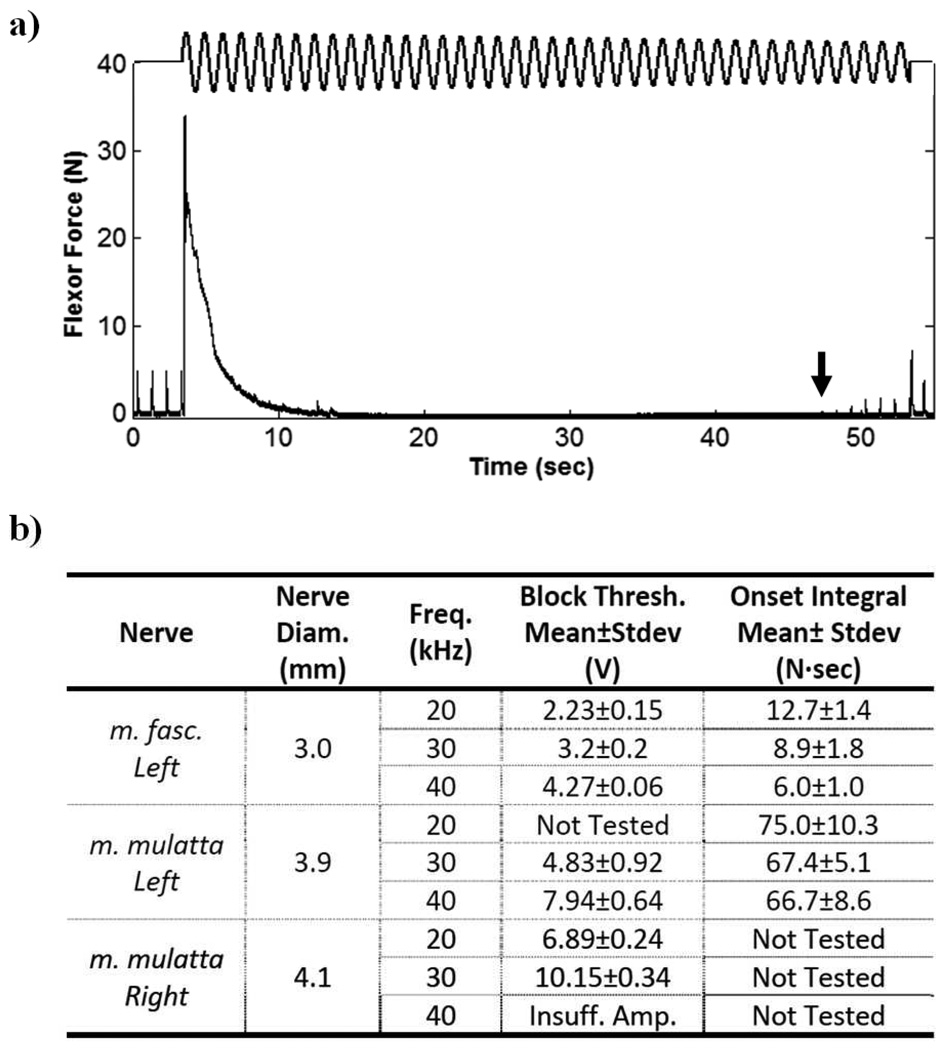
a) Finger flexor force during HFAC block threshold trial on the left median nerve in the m. mulatta monkey at a frequency of 30 kHz. Relative HFAC amplitude is indicated diagrammatically. HFAC amplitude started at 15.0 V, and threshold was measured to be 10.6 V (the arrow indicates the first twitch resulting from partial conduction block). b) Table summarizing the results of the randomized block threshold and onset response trials for each of the three nerves tested. The waveform generator was unable to produce sufficient amplitude to produce a complete conduction block at 40 kHz for the 4.1 mm nerve.
References
-
- Rosenblueth A, Reboul J. The Blocking and Deblocking Effects of Alternating Currents on Nerve. Am J Physiol. 1939;125(2):251–264.
-
- Kilgore K, Bhadra N. Nerve conduction block utilizing high-frequency alternating current. Medical and Biological Engineering and Computing. 2004;42(3):394–406. - PubMed
-
- Foldes E, Ackermann D, Bhadra N, Kilgore K. Counted Cycles Method to Quantify the Onset Activity in High-Frequency Peripheral Nerve Block. Proceedings of International Conf of the IEEE EMBS; 2009. pp. 614–617. - PubMed
Publication types
MeSH terms
Grants and funding
LinkOut - more resources
Full Text Sources
Other Literature Sources
Medical
