


Genetics of age-related macular degeneration: current concepts, future directions
- PMID: 21609220
- PMCID: PMC4242505
- DOI: 10.3109/08820538.2011.577129
Genetics of age-related macular degeneration: current concepts, future directions
Abstract
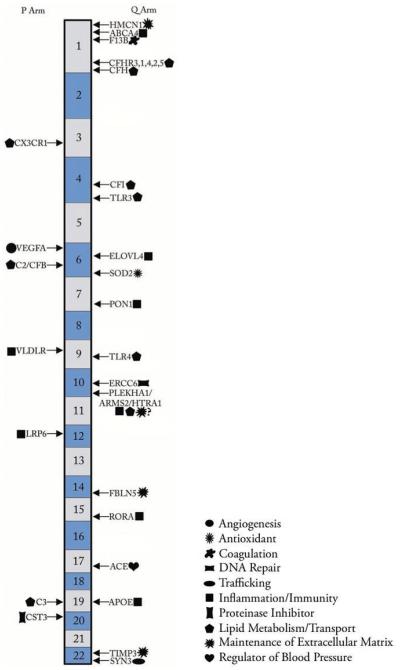
Age-related macular degeneration (AMD) is a progressive degenerative disease which leads to blindness, affecting the quality of life of millions of Americans. More than 1.75 million individuals in the United States are affected by the advanced form of AMD. The etiological pathway of AMD is not yet fully understood, but there is a clear genetic influence on disease risk. To date, the 1q32 (CFH) and 10q26 (PLEKHA1/ARMS2/HTRA1) loci are the most strongly associated with disease; however, the variation in these genomic regions alone is unable to predict disease development with high accuracy. Therefore, current genetic studies are aimed at identifying new genes associated with AMD and their modifiers, with the goal of discovering diagnostic or prognostic biomarkers. Moreover, these studies provide the foundation for further investigation into the pathophysiology of AMD by utilizing a systems-biology-based approach to elucidate underlying mechanistic pathways.
Figures
References
-
- Silvestri G, Johnston PB, Hughes AE. Is genetic predisposition an important risk factor in age-related macular degeneration? Eye (Lond) 1994;8(Pt 5):564–568. - PubMed
-
- Seddon JM, Ajani UA, Mitchell BD. Familial aggregation of age-related maculopathy. Am. J. Ophthalmol. 1997;123(2):199–206. - PubMed
-
- Klaver CC, Wolfs RC, Assink JJ, et al. Genetic risk of age-related maculopathy. Population-based familial aggregation study. Arch. Ophthalmol. 1998;116(12):1646–1651. - PubMed
-
- Swaroop A, Branham KE, Chen W, Abecasis G. Genetic susceptibility to age-related macular degeneration: A paradigm for dissecting complex disease traits. Hum. Mol. Genet. 2007;16(Spec No. 2):R174–182. - PubMed
-
- Hammond CJ, Webster AR, Snieder H, et al. Genetic influence on early age-related maculopathy: A twin study. Ophthalmology. 2002;109(4):730–736. - PubMed
Publication types
MeSH terms
Substances
Grants and funding
LinkOut - more resources
Full Text Sources
Other Literature Sources
Medical
Miscellaneous
