


Designing payment for Collaborative Care for Depression in primary care
- PMID: 21609327
- PMCID: PMC3168701
- DOI: 10.1111/j.1475-6773.2011.01272.x
Designing payment for Collaborative Care for Depression in primary care
Abstract
Objective: To design a bundled case rate for Collaborative Care for Depression (CCD) that aligns incentives with evidence-based depression care in primary care.
Data sources: A clinical information system used by all care managers in a randomized controlled trial of CCD for older primary care patients.
Study design: We conducted an empirical investigation of factors accounting for variation in CCD resource use over time and across patients. CCD resource use at the patient-episode and patient-month levels was measured by number of care manager contacts and direct patient contact time and analyzed with count data (Poisson or negative binomial) models.
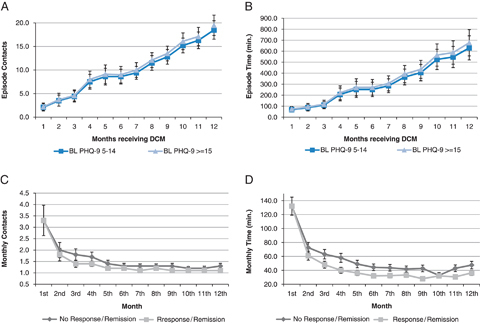
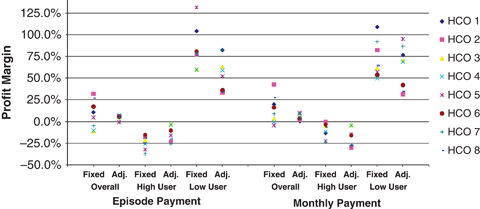
Principal findings: Episode-level resource use varies substantially with patient's time in the program. Monthly use declines sharply in the first 6 months regardless of treatment response or remission status, but it remains stable afterwards. An adjusted episode or monthly case rate design better matches payment with variation in resource use compared with a fixed design.
Conclusions: Our findings lend support to an episode payment adjusted by number of months receiving CCD and a monthly payment adjusted by the ordinal month. Nonpayment tools including program certification and performance evaluation and reward systems are needed to fully align incentives.
© Health Research and Educational Trust.
Figures
References
-
- Bachman J, Pincus HA, Houtsinger JK, Unützer J. Funding Mechanisms for Depression Care Management: Opportunities and Challenges. General Hospital Psychiatry. 2006;28(4):278–88. - PubMed
-
- Berenson RA, Horvath J. Confronting the Barriers to Chronic Care Management in Medicare. Health Affairs. 2003 W3: 37–53 [online] - PubMed
-
- Gilbody S, Bower P, Fletcher J, Richards D, Sutton AJ. Collaborative Care for Depression: A Cumulative Meta-Analysis and Review of Longer-Term Outcomes. Archives of Internal Medicine. 2006;166(21):2314–21. - PubMed
-
- Harpole LH, Stechuchak KM, Saur CD, Steffens DC, Unützer J, Oddone E. Implementing a Disease Management Intervention for Depression in Primary Care: A Random Work Sampling Study. General Hospital Psychiatry. 2003;25(4):238–45. - PubMed
-
- Institute for Clinical Systems Improvement. The DIAMOND Initiative: Depression Improvement Across Minnesota, Offering a New Direction. Bloomington, MN: Institute for Clinical Systems Improvement; 2008.
Publication types
MeSH terms
Grants and funding
LinkOut - more resources
Full Text Sources
Medical
