. 2011 Jun 14;108(24):10010-5.
doi: 10.1073/pnas.1017386108. Epub 2011 May 24.

Cross-linking, ligation, and sequencing of hybrids reveals RNA-RNA interactions in yeast

Affiliations

Cross-linking, ligation, and sequencing of hybrids reveals RNA-RNA interactions in yeast

Grzegorz Kudla et al. Proc Natl Acad Sci U S A. .

Abstract

Many protein-protein and protein-nucleic acid interactions have been experimentally characterized, whereas RNA-RNA interactions have generally only been predicted computationally. Here, we describe a high-throughput method to identify intramolecular and intermolecular RNA-RNA interactions experimentally by cross-linking, ligation, and sequencing of hybrids (CLASH). As validation, we identified 39 known target sites for box C/D modification-guide small nucleolar RNAs (snoRNAs) on the yeast pre-rRNA. Novel snoRNA-rRNA hybrids were recovered between snR4-5S and U14-25S. These are supported by native electrophoresis and consistent with previously unexplained data. The U3 snoRNA was found to be associated with sequences close to the 3' side of the central pseudoknot in 18S rRNA, supporting a role in formation of this structure. Applying CLASH to the yeast U2 spliceosomal snRNA led to a revised predicted secondary structure, featuring alternative folding of the 3' domain and long-range contacts between the 3' and 5' domains. CLASH should allow transcriptome-wide analyses of RNA-RNA interactions in many organisms.


Conflict of interest statement

The authors declare no conflict of interest.

Figures
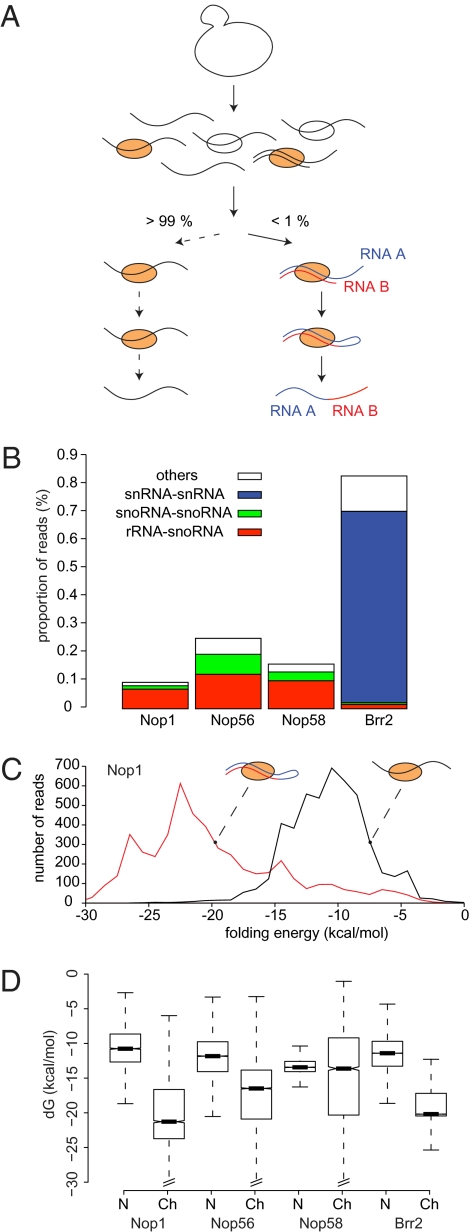
Fig. 1.
Fig. 1.
CLASH identifies RNA–RNA duplexes. (A) Schematic representation of the CLASH protocol. Following UV cross-linking, RNA–protein complexes were affinity-purified, RNA–RNA hybrids were ligated and sequenced, and chimeric reads were identified bioinformatically. (B) Classification of chimeric reads recovered with the snoRNP proteins Nop1, Nop56, and Nop58 and with the splicing factor Brr2. (C) Predicted minimum folding energies of chimeric reads (red trace) and nonchimeric reads (black trace) recovered with Nop1. (D) Distribution of minimum folding energies of nonchimeric and chimeric reads in all experiments. Dark bars, boxes, and whiskers represent the median, the first through third quartile ranges, and 1.5-fold the interquartile range, respectively. Ch, chimeric; N, nonchimeric; dG, mimimal free energy upon folding.
Fig. 2.
Fig. 2.
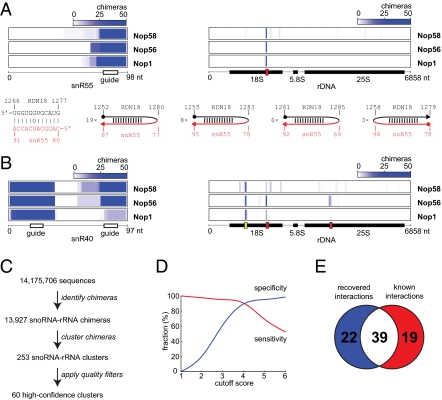
Identification of box C/D snoRNA-rRNA interactions. (A) Analysis of snR55-rRNA interaction. (Upper) Density of snR55-rRNA chimeras along snR55 (Left) and along rRNA (Right). The red box represents the known snR55 target site in 18S rRNA. (Lower Left) Known base-pairing interaction between snR55 and rRNA. (Lower Right) Examples of chimeras supporting the snR55-rRNA interaction and numbers of times each chimera was found. Filled circles represent starts of reads, and arrowheads indicate ends of reads. (B) Density of snR40-rRNA chimeras along snR40 (Left) and along rRNA (Right). Red boxes indicate known snR40 target sites in 18S and 25S rRNA. The yellow box indicates the predicted novel site. (C) Numbers of reads, chimeric reads, chimeric read clusters, and high-confidence clusters in the combined Nop1, Nop56, and Nop58 datasets. (D) Scoring snoRNA-rRNA clusters. For each cutoff score N, the red line (“sensitivity,” or true-positive rate) represents the number of known targets with a score ≥N, divided by the total number of known targets, and the blue line (“specificity,” or true-negative rate) is the number of previously unknown targets with a score <N, divided by the total number of previously unknown targets. Only targets with corresponding clusters were used in the calculation. (E) Venn diagram showing the overlap between the set of previously identified interactions, and the set of called interactions at a cutoff score of 4.
Fig. 3.
Fig. 3.
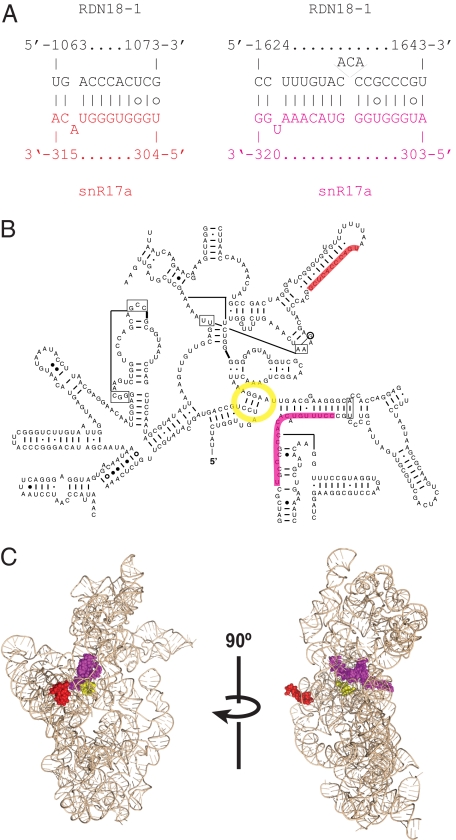
Novel U3-rRNA interaction site close to the small subunit central pseudoknot. (A) Predicted U3-rRNA base-pairing. (B) Predicted interaction sites mapped onto the secondary structure of yeast 18S rRNA. (C) Predicted interaction sites mapped onto the Thermus thermophilus mature small ribosomal subunit structure. Central pseudoknot is shown in yellow, and interaction sites are shown in red and magenta.
Fig. 4.
Fig. 4.
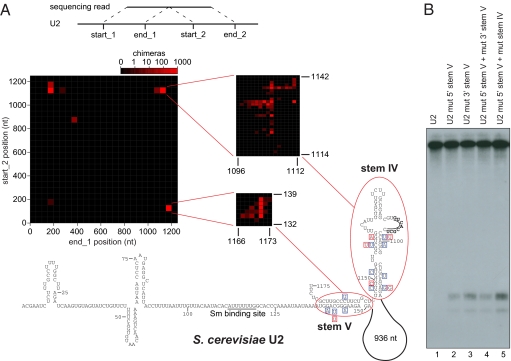
Structure analysis of yeast U2. (A) (Top) Line diagram indicating the positions of fragments found in chimeras. (Middle) Heat-map representation of intramolecular chimeras within U2. The x axis represents the position in U2 where the first fragment of the chimera was mapped, and the y axis shows the position of the second fragment. The red color intensity increases with the number of chimeric reads. The insets show the major peaks at higher resolution. The peaks in the lower right and upper left corners correspond to the same stem ligated at the opposite ends. (Bottom) Secondary structure of U2 inferred from the chimeras. The boxed nucleotides represent compensatory base-changes in S. mikatae (blue boxes) and S. kudriavzevii (red boxes). The conserved nucleotides in the internal bulge of stem IV are in bold and underlined. (B) Northern blot analysis of U2 carrying mutations in stem IV or V (details of mutations are provided in Fig. S6B).

References

    1. Licatalosi DD, Darnell RB. RNA processing and its regulation: Global insights into biological networks. Nat Rev Genet. 2010;11:75–87. - PMC - PubMed
    1. Granneman S, Kudla G, Petfalski E, Tollervey D. Identification of protein binding sites on U3 snoRNA and pre-rRNA by UV cross-linking and high-throughput analysis of cDNAs. Proc Natl Acad Sci USA. 2009;106:9613–9618. - PMC - PubMed
    1. Kiss-László Z, Henry Y, Bachellerie J-P, Caizergues-Ferrer M, Kiss T. Site-specific ribose methylation of preribosomal RNA: A novel function for small nucleolar RNAs. Cell. 1996;85:1077–1088. - PubMed
    1. Tollervey D, Kiss T. Function and synthesis of small nucleolar RNAs. Curr Opin Cell Biol. 1997;9:337–342. - PubMed
    1. Kiss T. Small nucleolar RNAs: An abundant group of noncoding RNAs with diverse cellular functions. Cell. 2002;109:145–148. - PubMed

Publication types

MeSH terms