. 2011 Oct;19(10):1813-20.
doi: 10.1038/mt.2011.92. Epub 2011 May 24.

Envelope-chimeric entry-targeted measles virus escapes neutralization and achieves oncolysis

Affiliations

Envelope-chimeric entry-targeted measles virus escapes neutralization and achieves oncolysis

Tanner S Miest et al. Mol Ther. 2011 Oct.

Abstract

Measles virus (MV) is a promising vector for cancer therapy and multivalent vaccination, but high prevalence of pre-existing neutralizing antibodies may reduce therapeutic efficacy, particularly following systemic administration. MV has only one serotype, but here we show that its envelope glycoproteins can be exchanged with those of the closely related canine distemper virus (CDV), generating a chimeric virus capable of escaping neutralization. To target its entry, we displayed on the CDV attachment protein a single-chain antibody specific for a designated receptor. To enhance oncolytic efficacy we armed the virus with a prodrug convertase gene capable of locally activating chemotherapeutic prodrugs. The new virus achieved high titers, was genetically stable, and was resistant to neutralization by sera from both MV-immunized mice and MV-immune humans. The new virus targeted syngeneic murine tumor cells expressing the designated receptor implanted in immunocompetent mice, and synergized with a chemotherapeutic prodrug in a model of oncolysis. Importantly, the chimeric MV remained oncolytic when administered systemically even in the presence of anti-MV antibodies capable of abrogating the therapeutic efficacy of the parental, nonshielded MV. This work shows that targeting, arming, and shielding can be combined to generate a tumor-specific, neutralization-resistant virus that can synergize with chemotherapeutics.


Figures
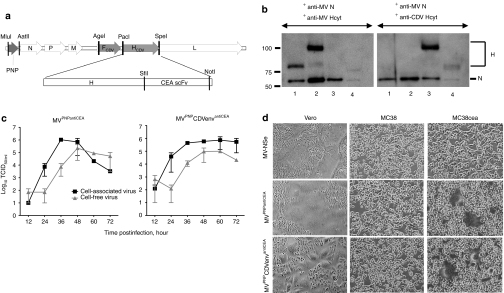
Figure 1
Figure 1
Generation and characterization of an armed and targeted MV-based vector with a foreign envelope. (a) Schematic diagram of the genome of a chimeric MV, with gray genome segments representing foreign genes (PNP or FCDV, HCDV). The CDV-H coding region is continuous with an antiCEA single-chain antibody (scFv) coding region. Restriction enzymes used for plasmid construction are indicated above the genome. CEA, carcinoembryonic antigen; F, fusion; H, hemagglutinin; L, large/polymerase; M, matrix; N, nucleocapsid; P, phosphoprotein; PNP, purine nucleoside phosphorylase; scFV, single-chain antibody. (b) Immunoblot analysis of protein incorporation in ~5,000 infectious particles of MV-NSe (lane 1), MVPNPantiCEA (lane 2), MVPNPCDVenvantiCEA (lane 3), and CDV (lane 4). The H-protein was detected using antibodies against the cytoplasmic tail of either MV-H (left panel) or CDV-H (right panel). CDV, canine distemper virus; Hcyt, hemagglutinin cytoplasmic tail; MV, measles virus. (c) Growth kinetics of MVPNPantiCEA (left panel) and MVPNPCDVenvantiCEA (right panel). Vero cells were infected at an multiplicity of infection (MOI) of 0.1 and cell-associated or released virus titrated on Vero cells to determine 50% tissue culture infective dose. Data points, mean of three independent experiments; bars, SD. (d) CEA-dependent cell fusion of MVPNPCDVenvantiCEA. Vero, MC38, or MC38CEA cells were infected at MOI 0.5 with vaccine-lineage MV (upper row), MVPNPantiCEA (middle row), or MVPNPCDVenvantiCEA (bottom row) and photographed 36 hours later.
Figure 2
Figure 2
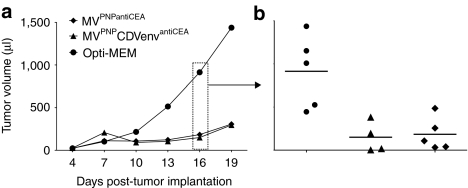
MVPNPCDVenvantiCEA is oncolytic after intratumoral administration. MC38CEA tumors were established using one million cells injected subcutaneously in C57BL/6 mice. (a) average tumor volume over time; (b) tumor volume for all mice on day 16. Circles: mock-infections with Opti-minimal essential medium. Triangles: MVPNPCDVenvantiCEA treatment. Diamonds: MVPNPantiCEA treatment. The defined endpoint was 1,500 µl tumor volume. CDV, canine distemper virus; CEA, carcinoembryonic antigen; MV, measles virus; PNP, purine nucleoside phosphorylase.
Figure 3
Figure 3
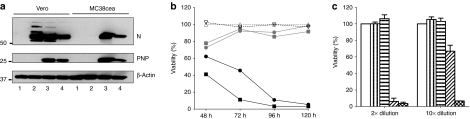
Synergistic cytotoxicity between vector and prodrug. (a) Characterization of PNP expression in infected cells. Cell lysates were collected 36–48 hours postinfection at multiplicity of infection (MOI) of 0.5. Lane 1: mock infection; lane 2: MV-NSe; lane 3: MVPNPantiCEA; lane 4: MVPNPCDVenvantiCEA. PNP, purine nucleoside phosphorylase; N, nucleocapsid. (b) Synergistic cytotoxicity between vector and 6-methylpurine 2'-deoxyriboside (MeP-dR) in MC38CEA cells. MC38CEA cells were infected with MVPNPCDVenvantiCEA at MOI of 1 (squares) or 0.1 (circles), or no virus (triangles, dashed lines) and after 24 hours 100 µmol/l of MeP-dR was added (black lines) or not (gray lines) to the culture before determining cell viability at indicated time points using 3-(4, 5-dimethyldiazoyl-2-yl)-2,5-diphenyltetrazolium bromide (MTT) assay. Mock-treated cells are used to define 100% viability. (c) Bystander killing by activated prodrug in the supernatant of infected cultures. Cells were mock infected (open bar), treated with MeP-dR only (vertical hatching), infected with MVPNPCDVenvantiCEA only (MOI 1, horizontal hatching), or treated with both virus for 36 hours and MeP-dR for 12 hours (MOI 0.1, diagonal hatching; MOI 1, x-hatching). Supernatant was removed and heat-inactivated to kill free virus, and then incubated on fresh cultures of MC38CEA cells at 2× (left) or 10× (right) dilutions for 72 hours. Cell viability was determined by MTT assay. Columns, mean of two independent experiments; bars, SD. CDV, canine distemper virus; CEA, carcinoembryonic antigen; MV, measles virus; PNP, purine nucleoside phosphorylase.
Figure 4
Figure 4
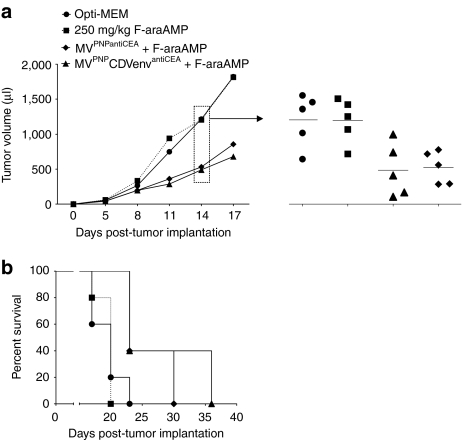
MVPNPCDVenvantiCEA synergizes with fludarabine in an animal model. Subcutaneous MC38CEA tumors were established in C57BL/6 mice with one million cells. Mice received four consecutive intravenous injections of MVPNPCDVenvantiCEA (triangles), MVPNPantiCEA (diamonds), or mock (squares), followed by 3 consecutive days of intraperitoneal injection of 250 mg/kg of fludarabine (F-araAMP). Control mice received neither virus nor F-araAMP (circles). (a) Left, average tumor volume over time; right, tumor volume for all mice on day 14. (b) Survival curves. The defined endpoint was 1,500 µl tumor volume. CDV, canine distemper virus; CEA, carcinoembryonic antigen; MV, measles virus; PNP, purine nucleoside phosphorylase.
Figure 5
Figure 5
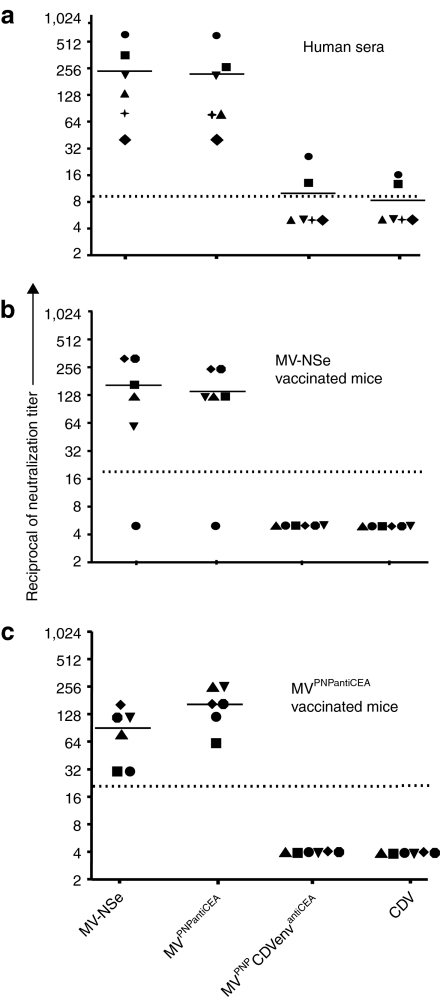
MVPNPCDVenvantiCEA escapes neutralization. Virus infectivity after mixing with (a) human sera or (b) sera from mice inoculated with a vaccine-lineage MV, (c) or sera from mice inoculated with a retargeted MV. Mice were immunized twice (days 1 and 7) with 106 plaque forming units of either (b) MV-NSe or (c) MVPNPantiCEA. CDV, canine distemper virus; CEA, carcinoembryonic antigen; MV, measles virus; PNP, purine nucleoside phosphorylase. Different shapes represent independent samples.
Figure 6
Figure 6
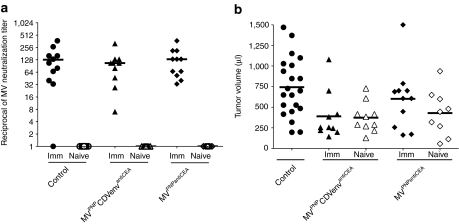
Envelope-chimeric virus remains oncolytic after systemic administration to MV-immune mice. Subcutaneous MC38CEA tumors were established in C57BL/6 mice with one million cells. Mice received intravenous injections every other day for three days of MVPNPCDVenvantiCEA (triangles), MVPNPantiCEA (diamonds), or mock (circles). (a) Neutralizing anti-MV titers on day 34 after immunization. All mice were seronegative for MV on day 0. (b) Tumor volume for all mice on day 14 post-tumor implantation. CDV, canine distemper virus; CEA, carcinoembryonic antigen; Imm, MV-immunized (filled symbols); Naive, MV-naive (open symbols); MV, measles virus; PNP, purine nucleoside phosphorylase.

References

    1. Liu TC, Galanis E., and, Kirn D. Clinical trial results with oncolytic virotherapy: a century of promise, a decade of progress. Nat Clin Pract Oncol. 2007;4:101–117. - PubMed
    1. Kumar S, Gao L, Yeagy B., and, Reid T. Virus combinations and chemotherapy for the treatment of human cancers. Curr Opin Mol Ther. 2008;10:371–379. - PubMed
    1. Ottolino-Perry K, Diallo JS, Lichty BD, Bell JC., and, McCart JA. Intelligent design: combination therapy with oncolytic viruses. Mol Ther. 2010;18:251–263. - PMC - PubMed
    1. Cattaneo R, Miest T, Shashkova EV., and, Barry MA. Reprogrammed viruses as cancer therapeutics: targeted, armed and shielded. Nat Rev Microbiol. 2008;6:529–540. - PMC - PubMed
    1. Russell SJ., and, Peng KW. Measles virus for cancer therapy. Curr Top Microbiol Immunol. 2009;330:213–241. - PMC - PubMed

Publication types

LinkOut - more resources