Review
. 2011 Jun;68(12):2013-37.
doi: 10.1007/s00018-011-0673-y. Epub 2011 Apr 6.

Regulation of flowering time: all roads lead to Rome

Affiliations
Review

Regulation of flowering time: all roads lead to Rome

Anusha Srikanth et al. Cell Mol Life Sci. 2011 Jun.

Abstract

Plants undergo a major physiological change as they transition from vegetative growth to reproductive development. This transition is a result of responses to various endogenous and exogenous signals that later integrate to result in flowering. Five genetically defined pathways have been identified that control flowering. The vernalization pathway refers to the acceleration of flowering on exposure to a long period of cold. The photoperiod pathway refers to regulation of flowering in response to day length and quality of light perceived. The gibberellin pathway refers to the requirement of gibberellic acid for normal flowering patterns. The autonomous pathway refers to endogenous regulators that are independent of the photoperiod and gibberellin pathways. Most recently, an endogenous pathway that adds plant age to the control of flowering time has been described. The molecular mechanisms of these pathways have been studied extensively in Arabidopsis thaliana and several other flowering plants.


Figures

Fig. 1
Fig. 1
a, b Regulation of CONSTANS at a transcriptional and protein level. a In short days, FKF1 and GI proteins peak at different times and hence are not able to efficiently repress CDF1, a transcriptional inhibitor of CO. CO protein levels are very low to start with in SD as indicated by the graph. PHYB plays a vital role in maintaining this low level of CO in the early hours of the day. Another protein, DNF, is important for maintaining low levels of CO between 4 and 7 h after dawn. Active CRY protein represses COP1, a ubiquitin ligase that marks CO for degradation. In the dark, the inactive CRY is no longer able to repress COP1 resulting in almost no CO protein being present. b In long days, both FKF1 and GI peak at approximately 13 h after dawn, resulting in active repression of CDF1, and thereby, CO transcription. The protein levels are regulated by PHYB in the early morning hours, while active CRY and PHYA repress PHYB during the rest of the day. Active CRY protein also binds to and inhibits transport of COP1 into the nucleus, hence preventing it from efficiently ubiquitinating the CO protein. Genes are represented in green, and proteins in orange. Dull colors represent inactive genes/proteins, while bold colors indicate active genes/proteins. Dashed box shows weak complex formation, and the grey box shows efficient complex formation. The clock is a 24 h clock. The graph represents expression of CO protein through the day (SD/LD), with the day length represented on the x-axis
Fig. 2
Fig. 2
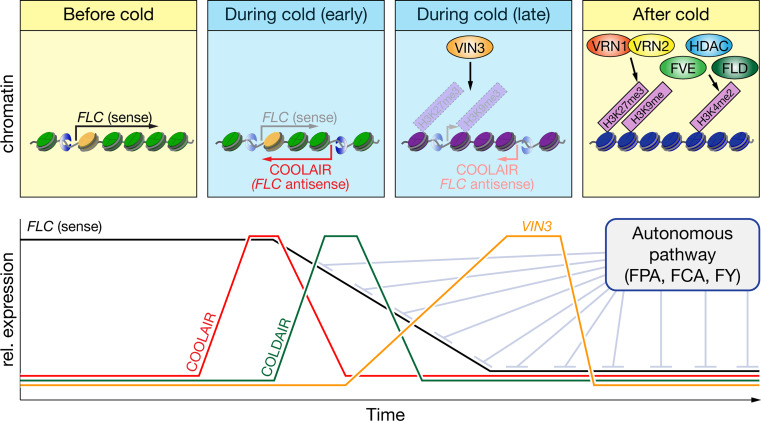
Regulation of FLC. In plants requiring vernalization, FLC chromatin is acetylated in a nonvernalized state, resulting in active transcription. The first step to negate the effects of FLC is the transcriptional repression of its RNA by COOLAIR, the antisense transcript of FLC during early exposure to cold. Another noncoding RNA called COLDAIR is transcribed from the first intron of FLC and also plays a major role in downregulating FLC transcript levels. Upon initiation of vernalization (late cold), VIN3 methylates lysine residues of histone H3. This vernalized state is maintained by VRN1 and VRN2 upon vernalization, even after the temperatures become warmer. The autonomous pathway regulators FLD and FVE also function by controlling methylation of lysine residues of histone H3. The RNA binding elements Cst64 and Cst77 and the autonomous pathway regulators FPA, FCA, and FY all regulate FLC transcript levels. Levels of FLC RNA (black) are plotted against different stages of cold and compared to levels of COOLAIR RNA (red), COLDAIR RNA (green), and VIN3 protein (orange)
Fig. 3
Fig. 3
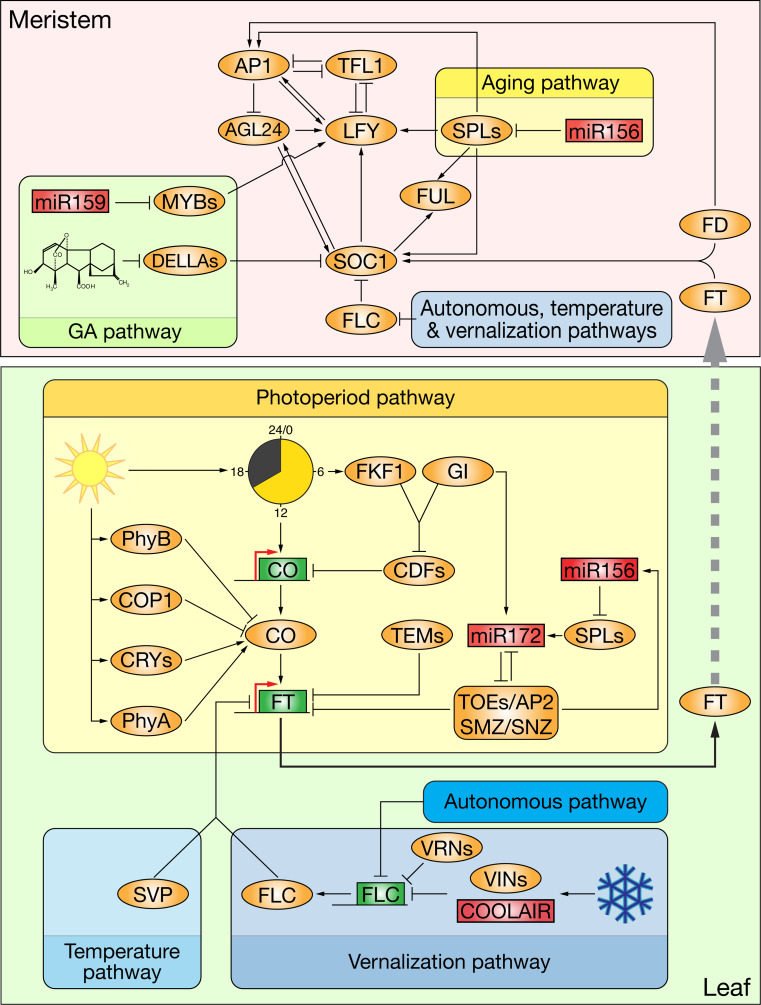
Integration of flowering time pathways. Light is perceived in the leaves, where it is perceived by photoreceptors such as PHYA, PHYB, CRY1, and CRY2 and regulates expression of genes such as GI, FKF1, and CDF1, all of which have direct or indirect effects on CO expression. CO is a transcriptional activator of FT. miR172 is regulated both by the circadian clock as well as SPLs, which are in turn regulated by miR156. miR172 targets the AP2 family of transcription factors, which play an important role in transcriptional repression of FT in the leaf. The different autonomous pathway genes regulate FLC, a suppressor of FT and SOC1. Another major environmental factor that affects FLC is temperature. FRI activates FLC, while the histone modification proteins VIN3 and VRN1/2 repress it, thereby promoting flowering. Ambient temperatures affect expression of yet another transcriptional repressor of FT, SVP. As the florigen, FT protein moves from the leaf to the apex, where, with the bZIP transcription factor FD, it activates AP1 and SOC1. In the GA pathway, GA regulates levels of the DELLA proteins, which in turn repress miRNA159, a repressor of MYB. MYBs positively control LFY levels in the meristem. Thus the signals from different pathways integrate at LFY, FT, and/or SOC1. SOC1 and AGL24 regulate each other and act together to activate LFY transcription. TFL1 and LFY repress each other. SOC1 activates FUL, which is also a target of the SPL proteins. Activation of SPLs by miR156 forms a novel pathway for regulation of flowering called the aging pathway. SPL proteins upregulate LFY, AP1, FUL, and SOC1. Hence, the different integrators directly or indirectly activate AP1, which marks the beginning of floral organ formation. All genes are represented in green, microRNAs in red, and proteins in orange

References

    1. Kobayashi Y, Weigel D. Move on up, it’s time for change—mobile signals controlling photoperiod-dependent flowering. Genes Dev. 2007;21:2371–2384. - PubMed
    1. Pittendrigh CS. Circadian rhythms and the circadian organization of living systems. Cold Spring Harb Symp Quant Biol. 1960;25:159–184. - PubMed
    1. Pittendrigh C. Circadian surfaces and the diversity of possible roles of circadian organization in photoperiodic induction. Proc Natl Acad Sci USA. 1972;69:2734–2737. - PMC - PubMed
    1. Knott J. Effect of a localized photoperiod on spinach. Proc Soc Hortic Sci. 1934;31:152–154.
    1. Evans LT. Flower induction and the florigen concept. Annu Rev Plant Physiol. 1971;22:365–394.

Publication types

MeSH terms

LinkOut - more resources