


Review
doi: 10.1016/j.dnarep.2011.04.026.
Epub 2011 May 25.
Physiological consequences of defects in ERCC1-XPF DNA repair endonuclease
Affiliations
- PMID: 21612988
- PMCID: PMC3139823
- DOI: 10.1016/j.dnarep.2011.04.026
Item in Clipboard
Review
Physiological consequences of defects in ERCC1-XPF DNA repair endonuclease
DNA Repair (Amst).
.
Abstract
ERCC1-XPF is a structure-specific endonuclease required for nucleotide excision repair, interstrand crosslink repair, and the repair of some double-strand breaks. Mutations in ERCC1 or XPF cause xeroderma pigmentosum, XFE progeroid syndrome or cerebro-oculo-facio-skeletal syndrome, characterized by increased risk of cancer, accelerated aging and severe developmental abnormalities, respectively. This review provides a comprehensive overview of the health impact of ERCC1-XPF deficiency, based on these rare diseases and mouse models of them. This offers an understanding of the tremendous health impact of DNA damage derived from environmental and endogenous sources.
Copyright © 2011 Elsevier B.V. All rights reserved.
Figures
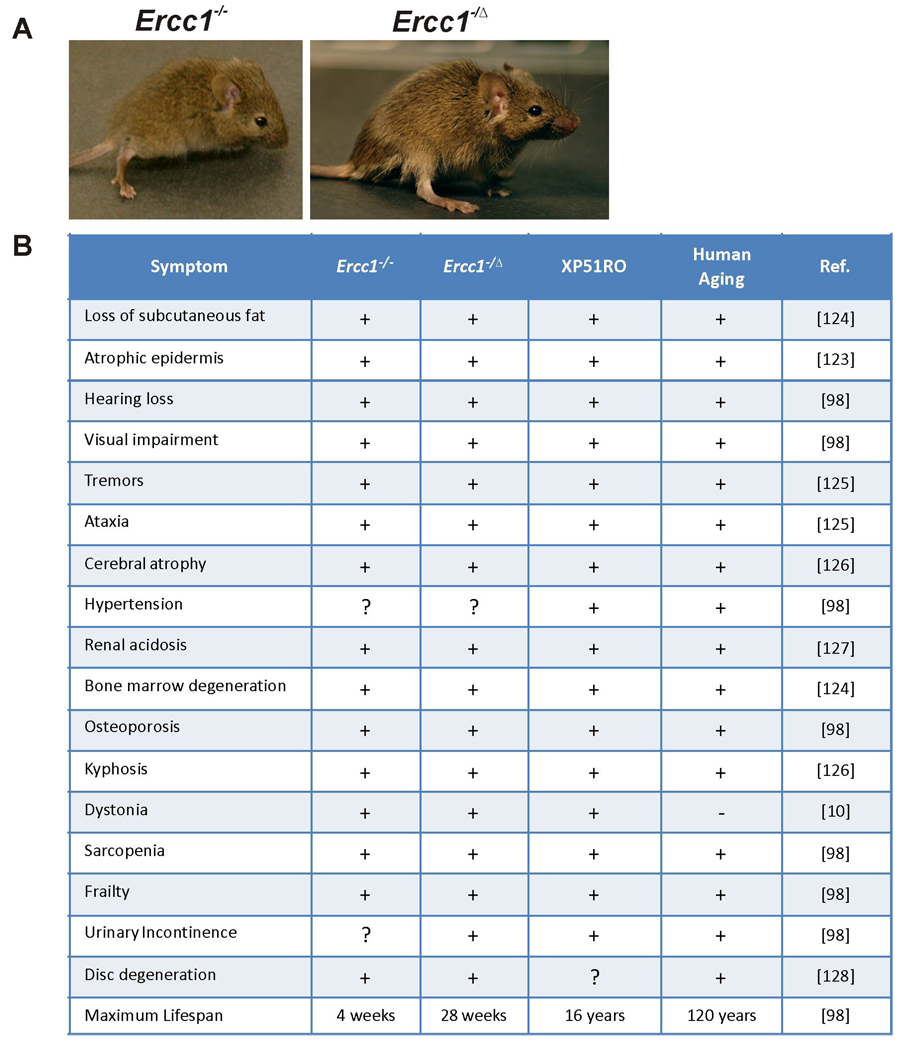
(A) Representative images of Ercc1−/− (left; 3 wks of age) and Ercc1−/Δ (right; 18 wks of age) mice. (B) Table listing the symptoms of aging observed in Ercc1−/− mice, Ercc1−/Δ mice, and patient XP51RO who had a progeroid syndrome (or disease of accelerated aging) due to a homozygous mutation in XPF. Symptoms are compared to normal human aging. (+) indicates presence and (−) indicates absence of the symptom. References are listed in the righthand column. Also indicated are whether or not the same symptoms are associated with old age in humans and (+) or (−) indicates presence or absence in the Ercc1−/− mice, Ercc1−/Δ mice, or progeroid patient XP51RO.
References
-
- Petit C, Sancar A. Nucleotide excision repair: from E. coli to man. Biochimie. 1999;81:15–25. - PubMed
-
- Kuraoka I, Kobertz WR, Ariza RR, Biggerstaff M, Essigmann JM, Wood RD. Repair of an interstrand DNA cross-link initiated by ERCC1-XPF repair/recombination nuclease. J Biol Chem. 2000;275:26632–26636. - PubMed
-
- Schlake C, Ostermann K, Schmidt H, Gutz H. Analysis of DNA repair pathways of Schizosaccharomyces pombe by means of swi-rad double mutants. Mutat Res. 1993;294:59–67. - PubMed
Publication types
MeSH terms
Substances
Grants and funding
LinkOut - more resources
Full Text Sources
