. 2011 Jul;18(7):1083-90.
doi: 10.1128/CVI.05075-11. Epub 2011 May 25.

Cross-protection of chicken immunoglobulin Y antibodies against H5N1 and H1N1 viruses passively administered in mice

Affiliations

Cross-protection of chicken immunoglobulin Y antibodies against H5N1 and H1N1 viruses passively administered in mice

Michael G Wallach et al. Clin Vaccine Immunol. 2011 Jul.

Abstract

Influenza viruses remain a major threat to global health due to their ability to undergo change through antigenic drift and antigenic shift. We postulated that avian IgY antibodies represent a low-cost, effective, and well-tolerated approach that can easily be scaled up to produce enormous quantities of protective antibodies. These IgY antibodies can be administered passively in humans (orally and intranasally) and can be used quickly and safely to help in the fight against an influenza pandemic. In this study, we raised IgY antibodies against H1N1, H3N2, and H5N1 influenza viruses. We demonstrated that, using whole inactivated viruses alone and in combination to immunize hens, we were able to induce a high level of anti-influenza virus IgY in the sera and eggs, which lasted for at least 2 months after two immunizations. Furthermore, we found that by use of in vitro assays to test for the ability of IgY to inhibit hemagglutination (HI test) and virus infectivity (serum neutralization test), IgYs inhibited the homologous as well as in some cases heterologous clades and strains of viruses. Using an in vivo mouse model system, we found that, when administered intranasally 1 h prior to infection, IgY to H5N1 protected 100% of the mice against lethal challenge with H5N1. Of particular interest was the finding that IgY to H5N1 cross-protected against A/Puerto Rico/8/34 (H1N1) both in vitro and in vivo. Based on our results, we conclude that anti-influenza virus IgY can be used to help prevent influenza virus infection.


Figures
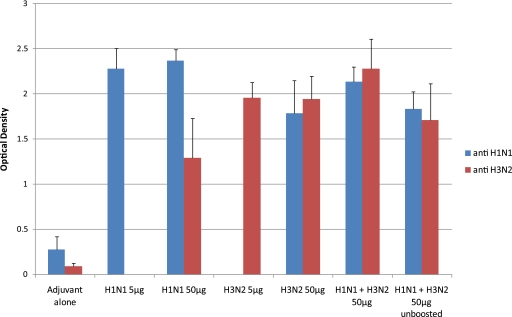
Fig. 1.
Fig. 1.
Serology on serum samples taken from hens immunized with H1N1 and H3N2 influenza viruses. This graph shows the ELISA results measured as the average OD405 ± standard deviation of individual hen serum samples from the groups immunized with a single viral strain, taken 2 weeks after the second immunization. The graph also shows the ELISA results from the groups immunized with H1N1 and H3N2 viruses in combination, using serum samples taken after 2 immunizations (H1N1 + H3N2 50 μg) or those taken after one immunization (H1N1 + H3N2 50 μg unboosted). The number of samples for each group was as follows: negative-control adjuvant alone, 16 serum samples; H1N1 5 μg and 50 μg, 15 serum samples each; H3N2 5 μg, 9 serum samples; H3N2 50 μg, 12 serum samples; H1N1 + H3N2 50 μg, 10 to 12 serum samples; H1N1 + H3N2 50 μg unboosted, 4 serum samples.
Fig. 2.
Fig. 2.
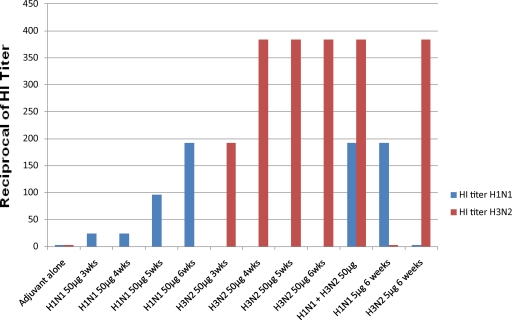
Hemagglutinin inhibition titers in eggs from hens immunized with H1N1 and H3N2 viruses. This graph shows the HI titers of egg yolks (pools of 5 egg yolks per group) from the various vaccinated groups of hens. The first 8 groups of egg yolks were from eggs taken at various times after the first immunization. The rest of the groups were from eggs taken at 6 weeks after the first immunization. The results are plotted as the reciprocal of the HI titer.
Fig. 3.
Fig. 3.
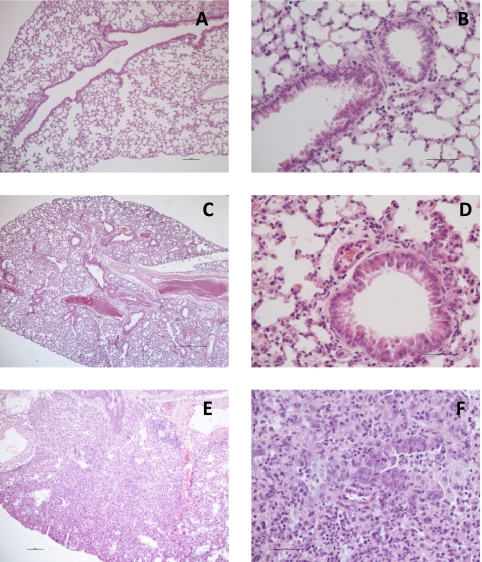
Histopathology on different mouse strains challenged with H1N1 PR8 virus with or without pretreatment with IgY to H5N1. (A and B) C.B-17 uninfected control; normal lungs. (C and D) C.B-17 mouse treated with IgY against H5N1 and challenged with 104 TCID50 PR8. (A and C) The lungs do not show any inflammatory lesions. (B and D) Intact bronchiolar mucosa and alveoli are visible. (E and F) C.B-17 mouse treated with control IgY and challenged with 104 TCID50 PR8. (E) Severe pulmonary inflammation. (F) The bronchiolar mucosa is damaged and infiltrated with leukocytes, predominantly polymorphs and macrophages. Leukocytes in the lumen and the peribronchial tissues are also visible. Magnifications, ×60 (A), ×240 (B), ×24 (C), ×240 (D), ×60 (E), and ×240 (F).
Fig. 4.
Fig. 4.
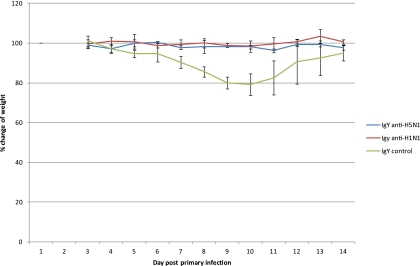
Studies on mice immunized intranasally with IgY to H1N1 or H5N1 and challenged with a sublethal dose of H1N1 virus. This graph shows the average percent weight gain or loss ± standard deviation in BALB/c mice treated with IgY to either H1N1 or H5N1 virus and challenged with 104 TCID50 of the H1N1 PR8 virus over a period of 14 days postinfection. All of the points shown for the IgY control group between 6 and 11 days corresponded with a significant level of weight loss (P < 0.05 or P < 0.01).

References

    1. Carlander D., Stalberg J., Larsson A. 1999. Chicken antibodies a clinical chemistry perspective. Uppsala J. Med. Sci. 104:179–189 - PubMed
    1. De Jong M. D., et al. 2005. Oseltamivir resistance during treatment of influenza A (H5N1) infection. N. Engl. J. Med. 353:2667–2672 - PubMed
    1. Gerhard W., Mozdzanowska K., Zharikova D. 2006. Prospects for universal influenza virus vaccine. Emerg. Infect. Dis. 12:569–574 - PMC - PubMed
    1. Hoffmann E., Lipatov A. S., Webby R. J., Govorkova E. A., Webster R. G. 2005. Role of specific hemagglutinin amino acids in the immunogenicity and protection of H5N1 influenza virus vaccines. Proc. Natl. Acad. Sci. U. S. A. 102:12915–12920 - PMC - PubMed
    1. Karlsson M., Kollberg H., Larsson A. 2004. Chicken IgY: utilizing the evolutionary advantage. Worlds Poult. Sci. J. 60:341–347

Publication types