


Review
doi: 10.1038/nature10108.
Catalysis for fluorination and trifluoromethylation
Affiliations
- PMID: 21614074
- PMCID: PMC3119199
- DOI: 10.1038/nature10108
Item in Clipboard
Review
Catalysis for fluorination and trifluoromethylation
Nature.
.
Abstract
Recent advances in catalysis have made the incorporation of fluorine into complex organic molecules easier than ever before, but selective, general and practical fluorination reactions remain sought after. Fluorination of molecules often imparts desirable properties, such as metabolic and thermal stability, and fluorinated molecules are therefore frequently used as pharmaceuticals or materials. But the formation of carbon-fluorine bonds in complex molecules is a significant challenge. Here we discuss reactions to make organofluorides that have emerged within the past few years and which exemplify how to overcome some of the intricate challenges associated with fluorination.
Figures
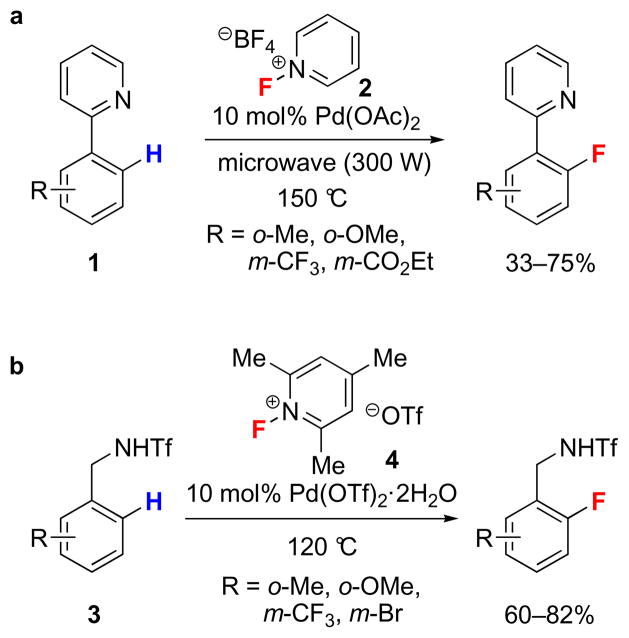
a, The first palladium-catalyzed fluorination of organic molecules. Phenylpyridine derivatives (1) were fluorinated in the presence of 10 mol% of Pd(OAc)2 and the electrophilic fluorination reagent N-fluoropyridinium tetrafluoroborate (2) under microwave irradiation. b, A palladium-catalyzed directed electrophilic fluorination of C–H bonds of N-benzyltriflamide derivatives (3) with the catalyst Pd(OTf)2·2H2O and the electrophilic fluorination reagent N-fluoro-2,4,6-trimethylpyridinium triflate (4). (Ac: acetyl, Me: methyl, Et: ethyl, Tf: trifluoromethanesulfonyl).
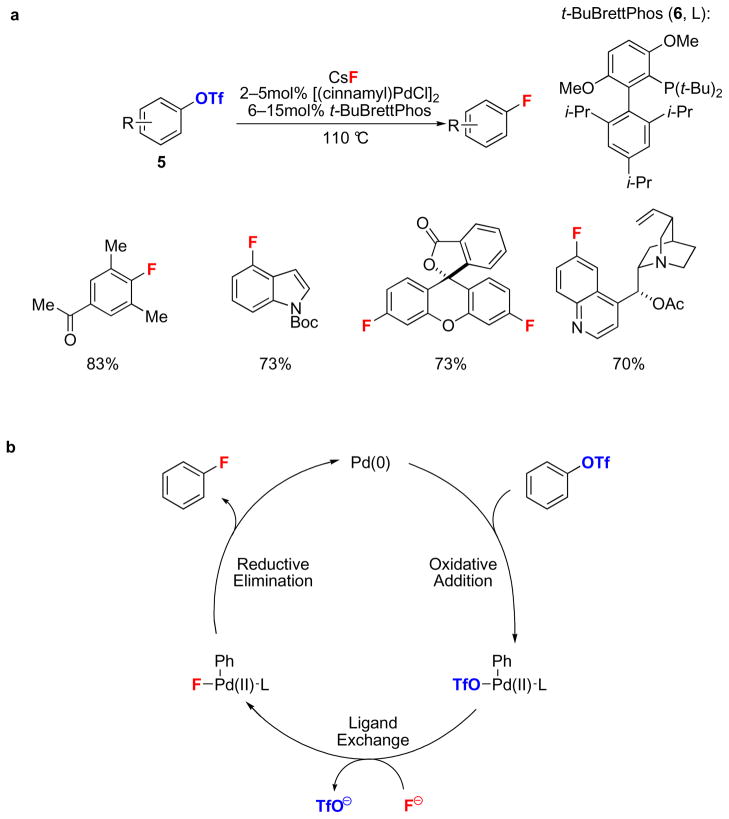
a, The first nucleophilic palladium-catalyzed Ar–F bond-forming reaction of aryl triflates (5) with CsF as the fluorine source, the palladium(0) catalyst precursor [(cinnamyl)PdCl]2, and the sterically demanding ligand t-BuBrettPhos (6). b, The proposed mechanism for the Pd-catalyzed nucleophilic Ar–F bond-forming reaction is comprised of three elementary steps: oxidative addition, ligand exchange, and C–F reductive elimination. (L: ligand, t-Bu: tert-butyl, i-Pr: iso-propyl, Boc: tert-butoxylcarbonyl, Ph: phenyl).
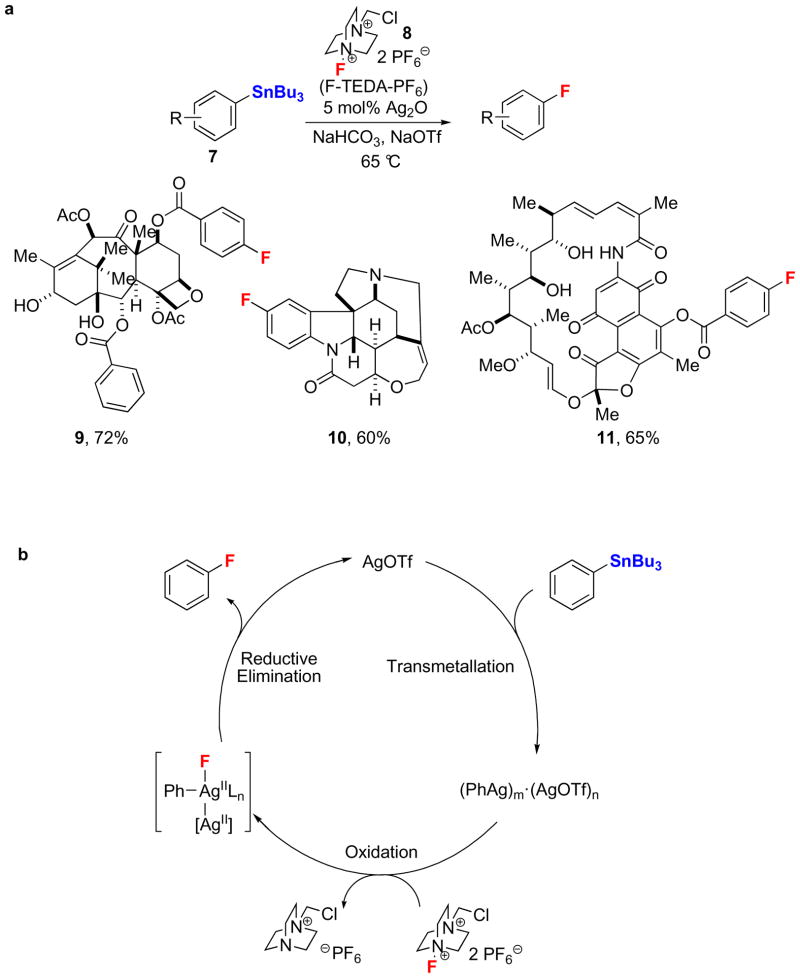
a, The first silver-catalyzed Ar–F bond-forming reaction. Aryl stannane derivatives (7) were fluorinated using 5 mol% of Ag2O as catalyst and the electrophilic fluorination reagent F-TEDA-PF6 (8). The reaction was applied to late-stage fluorination of complex small molecules, including taxol (9), strychnine (10), and rifamycin (11) derivatives. b, The proposed mechanism of the silver-catalyzed electrophilic fluorination includes three elementary steps: transmetallation, oxidation by an electrophilic fluorination reagent, and C–F reductive elimination. (Bu: butyl).
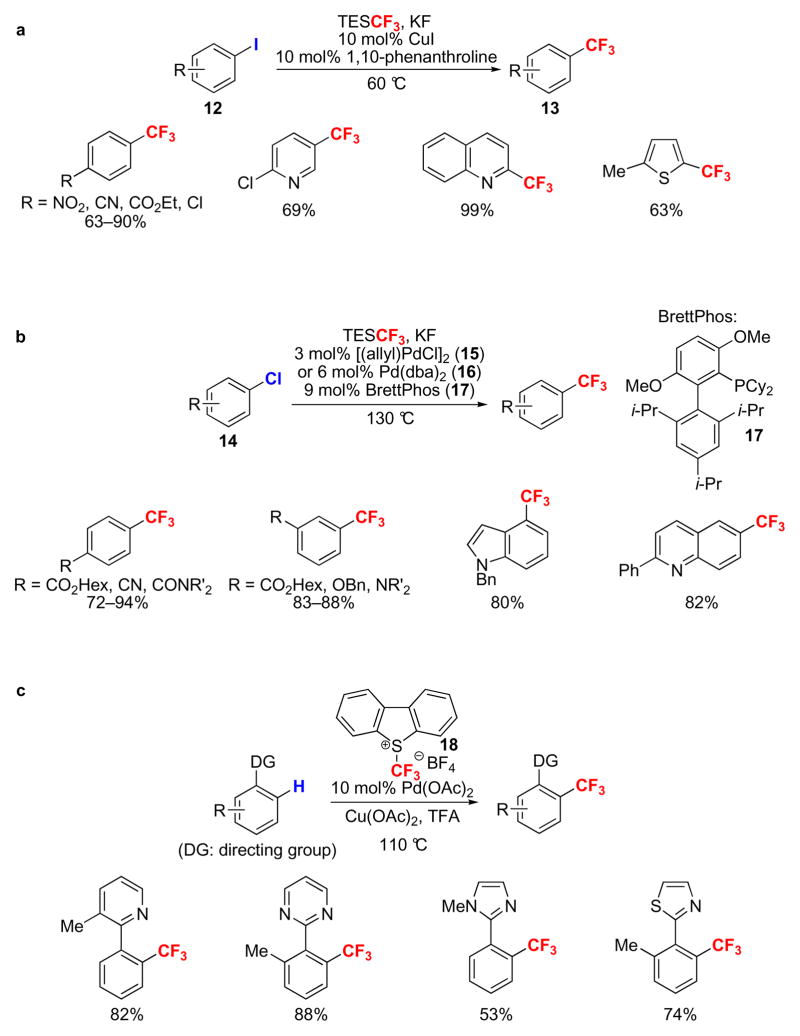
a, The first copper-catalyzed Ar–CF3 bond-forming reaction of aryl iodides (12) with 10 mol% of CuI and 1,10-phenanthroline. b, The first palladium-catalyzed nucleophilic Ar–CF3 bond-forming reaction of aryl chlorides (14) with TESCF3 as the CF3 source, 6 mol% of a palladium(0) precursor complex (15 or 16), 9 mol% of the sterically demanding ligand BrettPhos (17), and KF. c, The first palladium-catalyzed directed electrophilic Ar–CF3 bond-forming reaction with 10 mol% of Pd(OAc)2 and the electrophilic trifluoromethylation reagent S-(trifluoromethyl)dibenzothiophenium tetrafluoroborate (18). (TES: triethylsilyl, dba:dibenzylideneacetone, Hex: hexyl, Bn, benzyl, TFA: trifluoroacetic acid).
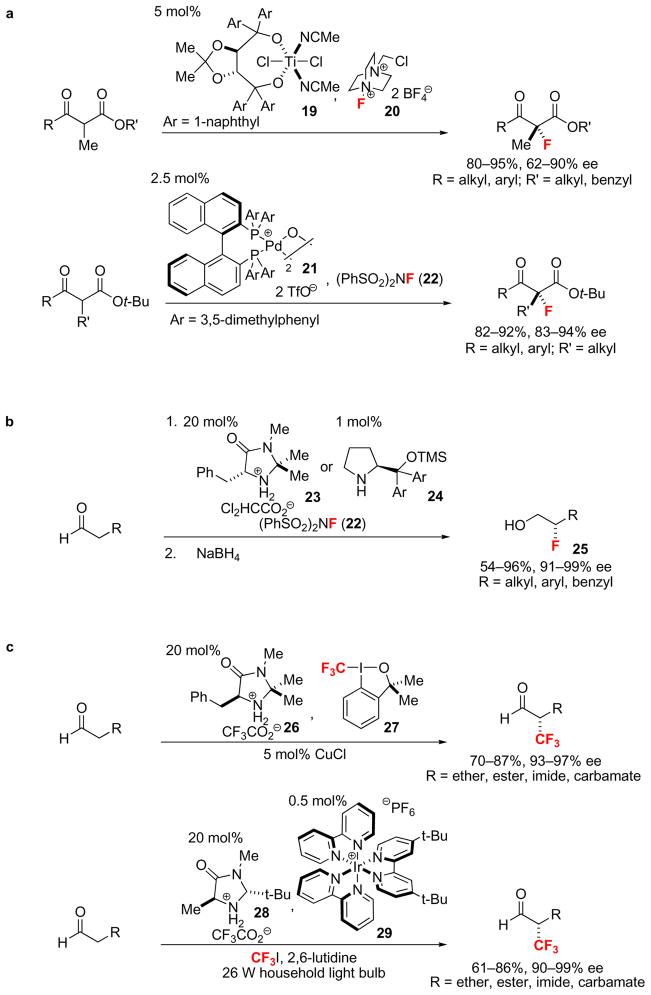
a, Metal-catalyzed enantioselective Csp3–F bond-forming reactions. Branched β-ketoesters were fluorinated using 5 mol% of a Ti-TADDOL catalyst (19) and Selectfluor® (20) or 2.5 mol% of μ-hydroxo-palladium-BINAP complex (21) and N-fluorobenzenesulfonimide (22). b, Examples of organocatalytic enantioselective Csp3–F bond-forming reactions. Amino acid-derived organocatalysts (23 and 24) and N-fluorobenzenesulfonimide (22) were utilized to fluorinate α-unbranched aldehydes. Due to the potentially facile racemization of α-fluoroaldehydes, the corresponding fluorohydrins (25) were isolated after reduction with NaBH4 in 54–96% yield and 91–99% ee. c, Enantioselective Csp3–CF3 bond-forming reactions. The mechanism of the two presented reactions differ conceptually, but both afford α-trifluoromethylated aldehydes in good yield and high enantioselectivity either using hypervalent iodine 27 as the CF3 source and amine catalyst 26 or using trifluoroiodomethane as the CF3 source, 20 mol% amine catalyst 28, 0.5 mol% Ir catalyst 29 and light. (TMS: trimethylsilyl).
References
-
- Müller K, Faeh C, Diederich F. Fluorine in pharmaceuticals: Looking beyond intuition. Science. 2007;317:1881–1886. - PubMed
-
- Purser S, Moore PR, Swallow S, Gouverneur V. Fluorine in medicinal chemistry. Chem Soc Rev. 2008;37:320–330. - PubMed
-
- Jeschke P. The unique role of fluorine in the design of active ingredients for modern crop production. ChemBioChem. 2004;5:570–589. - PubMed
-
- Hung MH, Farnham WB, Feiring AE, Rozen S. Functional Fluoromonomers and Fluoropolymers. In: Hougham G, Cassidy PE, Johns K, Davidson T, editors. Fluoropolymers: Synthesis. Vol. 1. Plenum Publishing Co; 1999. pp. 51–66.
-
- Ametamey SM, Honer M, Schubiger PA. Molecular imaging with PET. Chem Rev. 2008;108:1501–1516. - PubMed
Publication types
MeSH terms
Substances
Grants and funding
LinkOut - more resources
Full Text Sources
Other Literature Sources
Miscellaneous
