Review
. 2011 Aug;130(2):237-45.
doi: 10.1007/s00439-011-1011-z. Epub 2011 May 26.

Genes that escape from X inactivation

Affiliations
Review

Genes that escape from X inactivation

Joel B Berletch et al. Hum Genet. 2011 Aug.

Abstract

To achieve a balanced gene expression dosage between males (XY) and females (XX), mammals have evolved a compensatory mechanism to randomly inactivate one of the female X chromosomes. Despite this chromosome-wide silencing, a number of genes escape X inactivation: in women about 15% of X-linked genes are bi-allelically expressed and in mice, about 3%. Expression from the inactive X allele varies from a few percent of that from the active allele to near equal expression. While most genes have a stable inactivation pattern, a subset of genes exhibit tissue-specific differences in escape from X inactivation. Escape genes appear to be protected from the repressive chromatin modifications associated with X inactivation. Differences in the identity and distribution of escape genes between species and tissues suggest a role for these genes in the evolution of sex differences in specific phenotypes. The higher expression of escape genes in females than in males implies that they may have female-specific roles and may be responsible for some of the phenotypes observed in X aneuploidy.


Conflict of interest statement

Conflict of interest The authors declare that they have no conflict of interest.

Figures

Fig. 1
Fig. 1
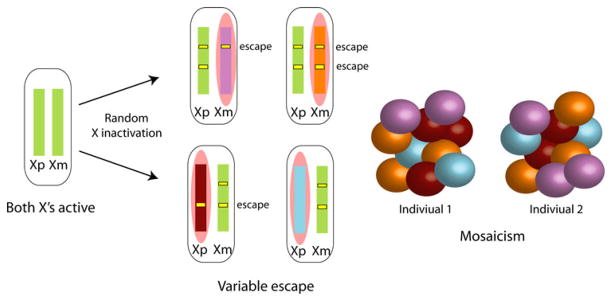
X inactivation and escape patterns. Before differentiation, the paternal X (Xp) and the maternal X (Xm) chromosomes are active. As cells differentiate, random X inactivation is initiated by coating one X chromosome with Xist RNA (pink cloud). This will become the inactive X, while the other X remains active (green chromosome). Since the process is random, either the Xp or the Xm is inactivated in a given cell, resulting in mosaicism in females. Some genes escape X inactivation, i.e., are expressed from both the Xi and the Xa (yellow bars) in all cells. Other genes escape from X inactivation in a subset of cells in a given tissue resulting in mosaicism of escape patterns. An additional layer of variability in escape patterns results from differences between individuals (Carrel and Willard 2005; Yang et al. 2010)
Fig. 2
Fig. 2
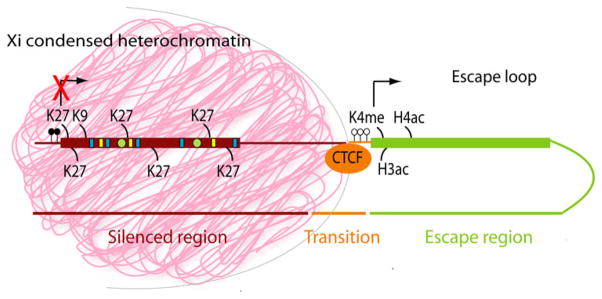
Molecular characteristics of escape and inactivated X-linked genes. This model shows that silenced regions on the inactive X are coated with the non-coding Xist RNA (pink cloud). Nucleosomes in the inactive X territory contain histones decorated with modifications associated with transcriptional repression and chromatin condensation, for example, H3K27me3 and H3K9me3, as well as the variant histone macroH2A (green circles). In addition, the CpG islands at the 5′ end of inactivated genes are methylated (solid black circles). Silenced chromatin also harbors specific DNA motifs (e.g., LINE-1 elements and AT-rich motifs) (yellow and blue boxes, respectively) to facilitate Xist RNA binding as well as binding of specific proteins such as SATB1. In contrast, genes that escape X inactivation are not coated with Xist, contain nucleosomes with modifications associated with active transcription, for example, H3 and H4 acetylation and H3K4me3, and their CpG islands are unmethylated (open circles). Chromatin between inactivated and escape genes may be bound by the chromatin insulator CTCF preventing the spread of heterochromatin into the escape regions or, vice versa, the spread of euchromatin into the silenced regions (Filippova et al. 2005)

References

    1. Abidi F, Holloway L, Moore CA, Weaver DD, Simensen RJ, Stevenson RE, Rogers RC, et al. Novel human pathological mutations. Gene symbol: JARID1C. Disease: mental retardation, X-linked. Hum Genet. 2009;125(3):345. - PubMed
    1. Adegbola A, Gao H, Sommer S, Browning M. A novel mutation in JARID1C/SMCX in a patient with autism spectrum disorder (ASD) Am J Med Genet A. 2008;146A(4):505–511. doi: 10.1002/ajmg.a.32142. - DOI - PubMed
    1. Agger K, Cloos PA, Christensen J, Pasini D, Rose S, Rappsilber J, Issaeva I, et al. UTX and JMJD3 are histone H3K27 demethylases involved in HOX gene regulation and development. Nature. 2007;449(7163):731–734. doi: 10.1038/nature06145. - DOI - PubMed
    1. Agrelo R, Souabni A, Novatchkova M, Haslinger C, Leeb M, Komnenovic V, Kishimoto H, et al. SATB1 defines the developmental context for gene silencing by Xist in lymphoma and embryonic cells. Dev Cell. 2009;16(4):507–516. doi: 10.1016/j.devcel.2009.03.006. - DOI - PMC - PubMed
    1. Al Nadaf S, Waters PD, Koina E, Deakin JE, Jordan KS, Graves JA. Activity map of the tammar X chromosome shows that marsupial X inactivation is incomplete and escape is stochastic. Genome Biol. 2010;11 (12):R122. doi: 10.1186/gb-2010-11-12-r122. - DOI - PMC - PubMed

Publication types

LinkOut - more resources