Review
. 2011 Jun 15;436(3):527-36.
doi: 10.1042/BJ20102162.

ATR signalling: more than meeting at the fork

Affiliations
Review

ATR signalling: more than meeting at the fork

Edward A Nam et al. Biochem J. .

Abstract

Preservation of genome integrity via the DNA-damage response is critical to prevent disease. ATR (ataxia telangiectasia mutated- and Rad3-related) is essential for life and functions as a master regulator of the DNA-damage response, especially during DNA replication. ATR controls and co-ordinates DNA replication origin firing, replication fork stability, cell cycle checkpoints and DNA repair. Since its identification 15 years ago, a model of ATR activation and signalling has emerged that involves localization to sites of DNA damage and activation through protein-protein interactions. Recent research has added an increasingly detailed understanding of the canonical ATR pathway, and an appreciation that the canonical model does not fully capture the complexity of ATR regulation. In the present article, we review the ATR signalling process, focusing on mechanistic findings garnered from the identification of new ATR-interacting proteins and substrates. We discuss how to incorporate these new insights into a model of ATR regulation and point out the significant gaps in our understanding of this essential genome-maintenance pathway.


Figures
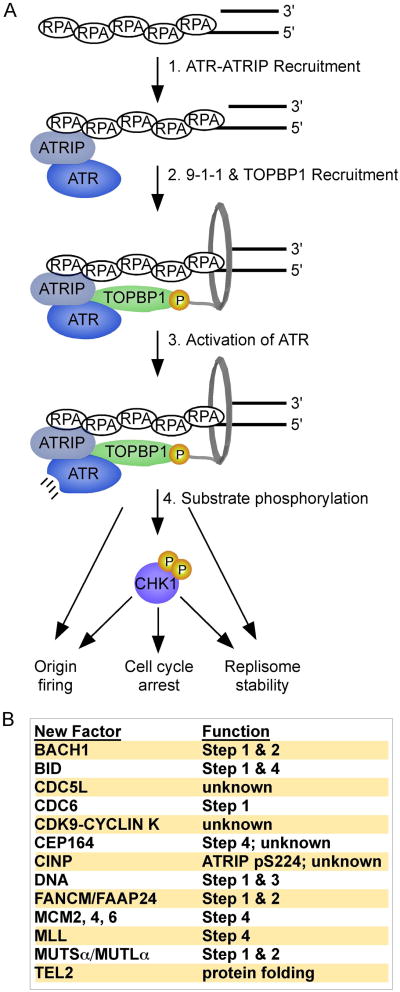
Figure 1
Figure 1
Canonical ATR signaling pathway and functions of newly identified regulators. (A) ATR signaling is activated in response to single-stranded DNA gaps in the genome. Independent recruitment of several checkpoint proteins leads to TOPBP1-dependent activation of the kinase and phosphorylation of numerous substrates including CHK1 to regulate cellular responses to DNA damage and replication stress. (B) The table lists newly identified regulators of this pathway and, when known, describes their position in the pathway. See text for details.
Figure 2
Figure 2
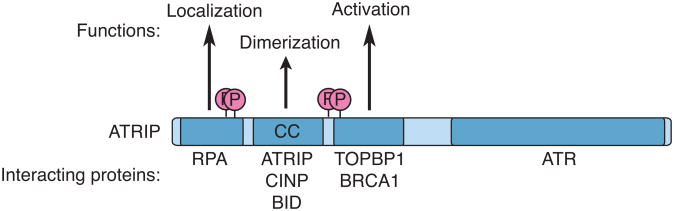
Functions of ATRIP in ATR regulation. ATRIP has several functional domains that regulate localization, stability, dimerization, and activation of ATR. These include an N-terminal RPA binding domain, a coiled-coil domain (CC), and a C-terminal domain that interacts with TOPBP1 and ATR.
Figure 3
Figure 3
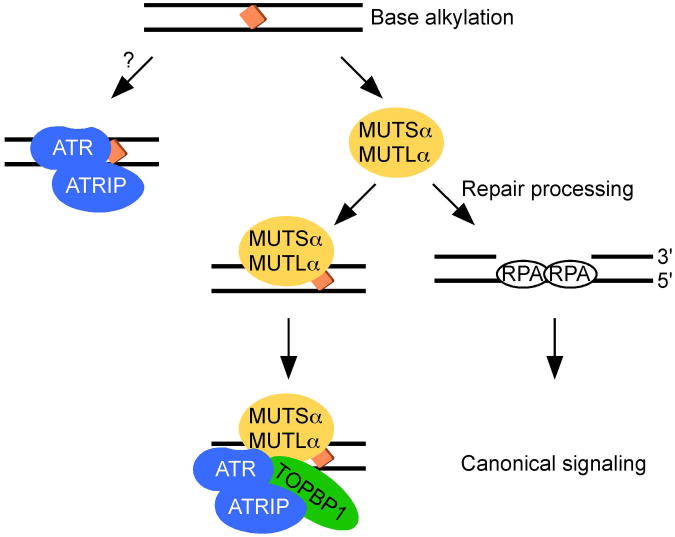
ATR recruitment to some DNA base lesions proceeds through a mismatch repair-dependent mechanism. Mismatch repair proteins may contribute directly and indirectly to ATR recognition of some times of DNA damage. Direct interactions between the ATR-ATRIP complex and MUTSα and MUTLα proteins may promote activation of ATR independently of RPA and single-stranded DNA. Alternatively, mismatch repair-dependent DNA processing may promote the RPA-dependent canonical ATR signaling pathway.
Figure 4
Figure 4
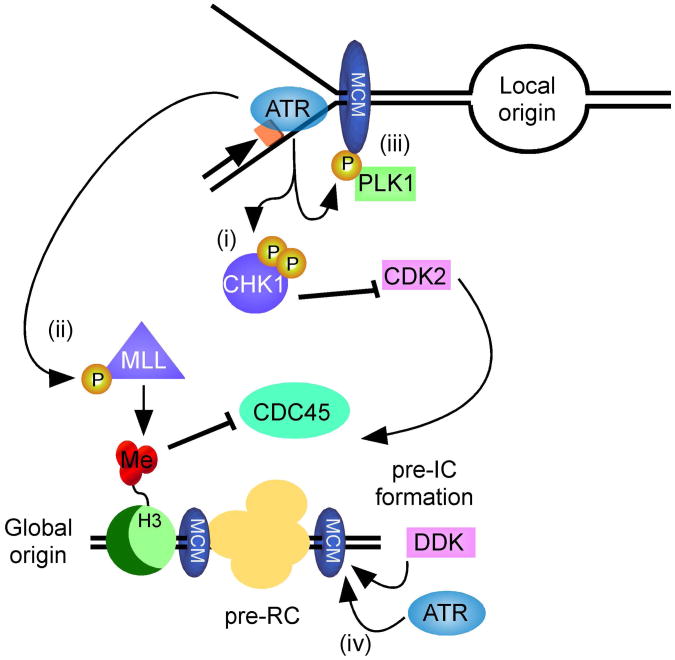
ATR signaling at stalled forks regulates origin firing through multiple mechanisms. ATR negatively regulates origin firing by regulating S-phase kinases via CHK1 activation (i) and histone methylation (ii). These activities prevent pre-initiation complex (pre-IC) formation. ATR also positively promotes local origin firing via MCM2 phosphorylation and recruitment of PLK1 (iii). Finally, at least in budding yeast, it can also act as a priming kinase for DDK-dependent MCM phosphorylation (iv). See text for details.

References

    1. Mordes DA, Cortez D. Activation of ATR and related PIKKs. Cell Cycle. 2008;7:2809–2812. - PMC - PubMed
    1. Lempiainen H, Halazonetis TD. Emerging common themes in regulation of PIKKs and PI3Ks. The EMBO journal. 2009;28:3067–3073. - PMC - PubMed
    1. Lovejoy CA, Cortez D. Common mechanisms of PIKK regulation. DNA Repair (Amst) 2009;8:1004–1008. - PMC - PubMed
    1. Cimprich KA, Cortez D. ATR: an essential regulator of genome integrity. Nat Rev Mol Cell Biol. 2008;9:616–627. - PMC - PubMed
    1. Cortez D, Wang Y, Qin J, Elledge SJ. Science. Vol. 286. New York, N.Y.: 1999. Requirement of ATM-dependent phosphorylation of brca1 in the DNA damage response to double-strand breaks; pp. 1162–1166. - PubMed

Publication types

MeSH terms

Substances