. 2011 May 26:6:28.
doi: 10.1186/1745-6150-6-28.

Interplay of recombination and selection in the genomes of Chlamydia trachomatis

Affiliations

Interplay of recombination and selection in the genomes of Chlamydia trachomatis

Sandeep J Joseph et al. Biol Direct. .

Abstract

Background: Chlamydia trachomatis is an obligate intracellular bacterial parasite, which causes several severe and debilitating diseases in humans. This study uses comparative genomic analyses of 12 complete published C. trachomatis genomes to assess the contribution of recombination and selection in this pathogen and to understand the major evolutionary forces acting on the genome of this bacterium.

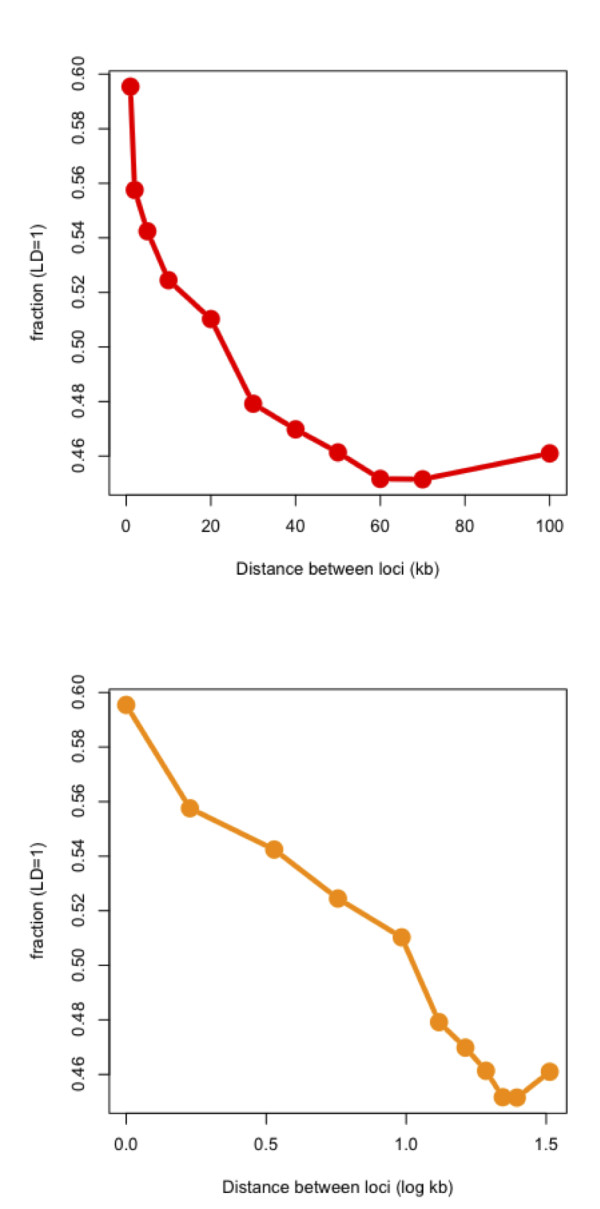
Results: The conserved core genes of C. trachomatis are a large proportion of the pan-genome: we identified 836 core genes in C. trachomatis out of a range of 874-927 total genes in each genome. The ratio of recombination events compared to mutation (ρ/θ) was 0.07 based on ancestral reconstructions using the ClonalFrame tool, but recombination had a significant effect on genetic diversification (r/m=0.71). The distance-dependent decay of linkage disequilibrium also indicated that C. trachomatis populations behaved intermediately between sexual and clonal extremes. Fifty-five genes were identified as having a history of recombination and 92 were under positive selection based on statistical tests. Twenty-three genes showed evidence of being under both positive selection and recombination, which included genes with a known role in virulence and pathogencity (e.g., ompA, pmps, tarp). Analysis of inter-clade recombination flux indicated non-uniform currents of recombination between clades, which suggests the possibility of spatial population structure in C. trachomatis infections.

Conclusions: C. trachomatis is the archetype of a bacterial species where recombination is relatively frequent yet gene gains by horizontal gene transfer (HGT) and losses (by deletion) are rare. Gene conversion occurs at sites across the whole C. trachomatis genome but may be more often fixed in genes that are under diversifying selection. Furthermore, genome sequencing will reveal patterns of serotype specific gene exchange and selection that will generate important research questions for understanding C. trachomatis pathogenesis.

Reviewers: This article was reviewed by Dr. Jeremy Selengut, Dr. Lee S. Katz (nominated by Dr. I. King Jordan) and Dr. Arcady Mushegian.


Figures

Figure 1
Figure 1
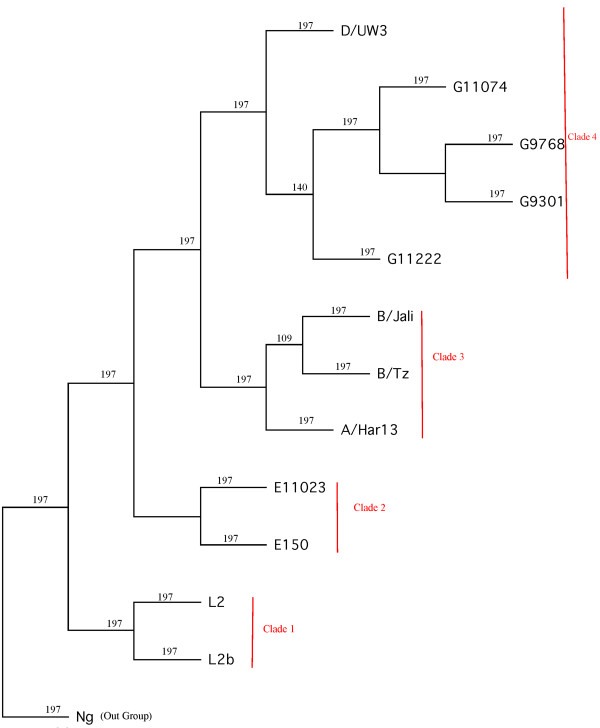
Phylogeny of Chlamydia trachomatis. Twelve C. trachomatis strains along with one C. muridarum (out-group) are represented in this tree. The phylogeny was constructed based on the concatenated alignment of all individual core genes (286,496 amino acid sites) by both NJ and MP procedures. Both NJ and MP analysis inferred the same tree. The numbers represent bootstrap values.
Figure 2
Figure 2
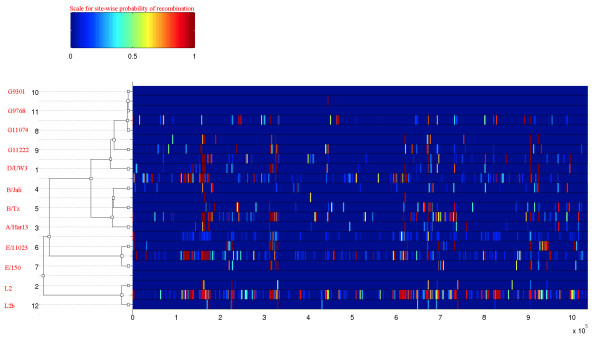
Results of the ClonalFrame analysis on an alignment of the 12 C. trachomatis genomes. The inferred clonal genealogy is shown on the left. To each branch of this tree corresponds a row of the heat map, which is vertically aligned with it. Each row of the heat map shows the posterior probability of recombination estimated by ClonalFrame on the corresponding branch (Y-axis) and along the positions of the alignment (X-axis). These probabilities are color-coded according to the legend shown at the top.
Figure 3
Figure 3
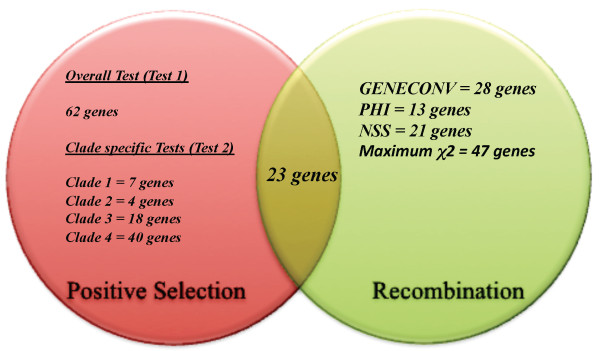
Venn diagram showing the number of genes under positive selection and recombination. These genes were identified to be under positive selection based on test 1 (overall test) and test 2 (clade-specific test) along with the number of genes identified as undergone recombination by each of the four-recombination methods implemented. Twenty-three genes were identified to be both under recombination and positive selection.
Figure 4
Figure 4
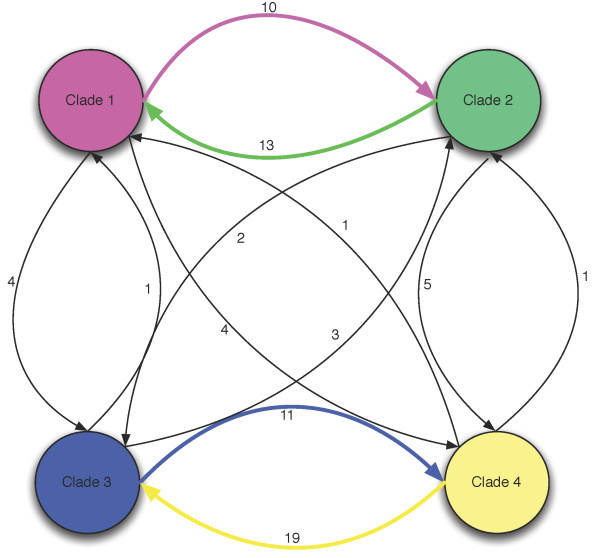
Inter-clade recombination flux. Genetic flow between clades. Each arrow is labeled with the number of genetic imports that were inferred from the given origin to the given clade of destination. Clade 1 contained L2 and L2b (LGV strains), clade 2 contained E/11023 and E/150 (non-invasive prevalent sexually transmitted strains), clade 3 contained B/Tz, B/Jali and A/HAR13 (trachoma strains) and clade 4 contained D/UW3, G11074, G11222, G/9301 and G9768.
Figure 5
Figure 5
Illustration of distance-dependent decay in C. trachomatis core genome. A) For pairs of loci separated by increasing genetic distance on a linear scale, the proportion of pairs in full linkage (number of pairs with DA' = 1 ÷ total number of pairs in that distance bin) is plotted on the y-axis. B) The same plot as in figure 5(A) but the distance between loci is shown on a log scale (log kb).

References

    1. Lefebure T, Stanhope MJ. Evolution of the core and pan-genome of Streptococcus: positive selection, recombination, and genome composition. Genome Biol. 2007;8(5):R71. doi: 10.1186/gb-2007-8-5-r71. - DOI - PMC - PubMed
    1. Didelot X, Maiden MCJ. Impact of recombination on bacterial evolution. Trends in Microbiology. 2010;18(7):315–322. doi: 10.1016/j.tim.2010.04.002. - DOI - PMC - PubMed
    1. Vos M. Why do bacteria engage in homologous recombination? Trends in Microbiology. 2009;17(6):226–232. doi: 10.1016/j.tim.2009.03.001. - DOI - PubMed
    1. Narra HP, Ochman H. Of what use is sex to Bacteria? Current Biology. 2006;5(17):R705–710. - PubMed
    1. Basic-Hammer N, Vogel V, Basset P, Blanc DS. Impact of recombination on genetic variability within Staphylococcus aureus clonal complexes. Infection Genetics and Evolution. 2010;10(7):1117–1123. doi: 10.1016/j.meegid.2010.07.013. - DOI - PubMed

Publication types

LinkOut - more resources