. 2011 Jul 15;51(2):530-8.
doi: 10.1016/j.freeradbiomed.2011.05.005. Epub 2011 May 13.

Distinct role of Hsp70 in Drosophila hemocytes during severe hypoxia

Affiliations

Distinct role of Hsp70 in Drosophila hemocytes during severe hypoxia

Priti Azad et al. Free Radic Biol Med. .

Abstract

Severe hypoxia can lead to injury and mortality in vertebrate or invertebrate organisms. Our research is focused on understanding the molecular mechanisms that lead to injury or adaptation to hypoxic stress using Drosophila as a model system. In this study, we employed the UAS-Gal4 system to dissect the protective role of Hsp70 in specific tissues in vivo under severe hypoxia. In contrast to overexpression in tissues such as muscles, heart, and brain, we found that overexpression of Hsp70 in hemocytes of flies provides a remarkable survival benefit to flies exposed to severe hypoxia for days. Furthermore, these flies were tolerant not only to severe hypoxia but also to other stresses such as oxidant stress (e.g., paraquat feeding or hyperoxia). Interestingly we observed that the better survival with Hsp70 overexpression in hemocytes under hypoxia or oxidant stress is causally linked to reactive oxygen species (ROS) reduction in whole flies. We also show that hemocytes are a major source of ROS generation, leading to injury during hypoxia, and their elimination results in a better survival under hypoxia. Hence, our study identified a protective role for Hsp70 in Drosophila hemocytes, which is linked to ROS reduction in the whole flies and thus helps in their remarkable survival during oxidant or hypoxic stress.


Figures

Figure 1
Figure 1
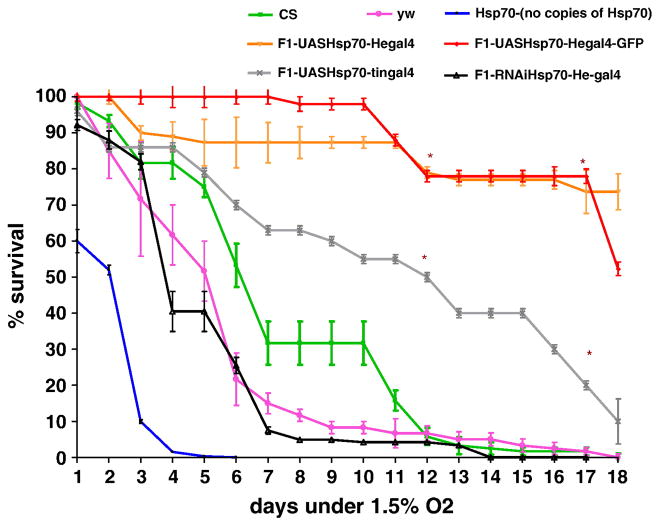
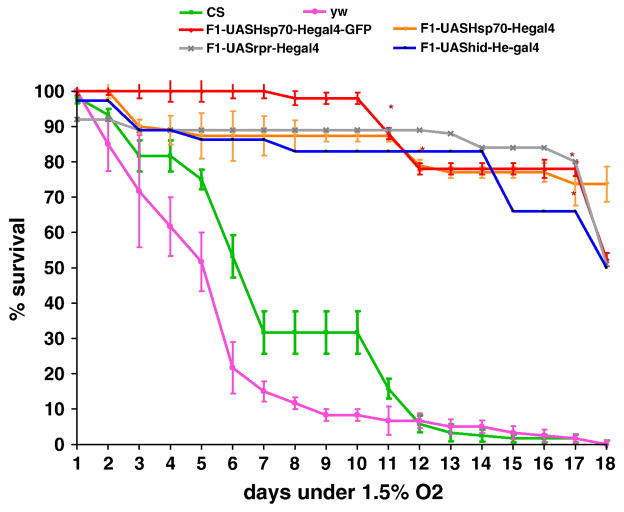
Survival of adult flies exposed to severe hypoxia (1.5% O2). Over-expression of Hsp70 in hemocytes significantly increased survival as compared to controls. Each point represents the average of at least three tests for each line and error bars represent the standard errors. * with unpaired t-test P<0.05 with controls vs. the genotype.
Figure 2
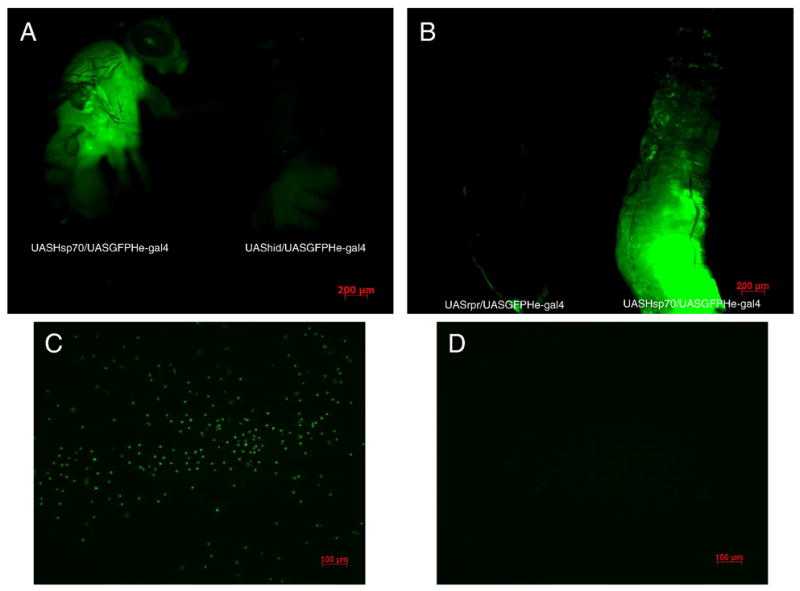
Figure 2. Visualization of hemocytes through GFP hemese marker and comparison among phenotypes
A - F1 progeny adults in which Hsp70 is over-expressed (UAS-Hsp70/He-Gal4GFP) in hemocytes GFP signal confirms the presence of hemocytes whereas expression of apoptotic gene hid gives rise to adults (F1-UAShid/heGal4GFP) devoid of GFP signal suggesting hemocytes are eliminated, image taken with both flies on the same field at 4x magnification. B - F1 progeny larvae in which Hsp70 is over-expressed (UAS-Hsp70/He-Gal4GFP) in hemocytes GFP signal confirms the presence of hemocytes whereas expression of apoptotic gene rpr gives rise to larvae (F1-UASrpr/heGal4GFP) devoid of GFP signal suggesting hemocytes are eliminated, image taken with both larvae on the same field at 4x magnification. C - GFP tagged hemocytes when larvae of F1- UAS-Hsp70/He-Gal4GFP are bled on the slide, taken at 10x magnification at same GFP exposure time and intensity between groups. D - Shows lack of GFP signal and hence hemocytes when larvae of F1-UAShid/heGal4GFP are bled on the slide suggesting that these are devoid of mature hemocytes taken at 10x magnification at same GFP exposure time and intensity between groups.
Figure 3
Figure 3
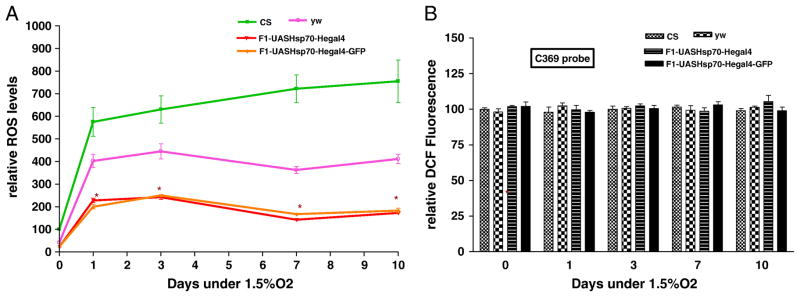
Figure 3a – Relative ROS levels after 1.5% O2. Up regulation of Hsp70 in hemocytes reduced the ROS levels significantly. Each point represents the average of at least three tests for each line and error bars represent the standard errors. * with unpaired t-test P<0.05 with controls vs. the genotype. Figure 3b- Measurement of Fluorescence with oxidation-insensitive probe of DCFH (C369) as a control under 1.5% O2. Each bar represents the average of at least three tests for each line and error bars represent the standard errors.
Figure 4
Figure 4
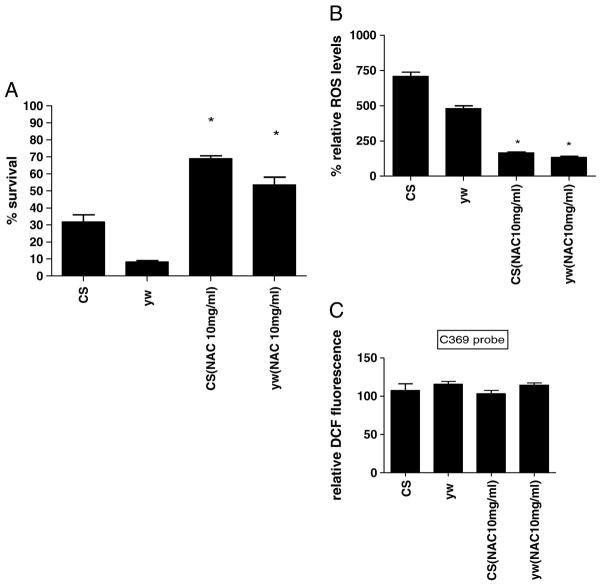
Effect of feeding an ROS inhibitor NAC to CS and yw control flies under severe hypoxia (1.5% O2). Figure 4a - Survival of adult flies after 9 days exposure to 1.5% O2. Flies that were fed NAC survived more than twice when compared to flies fed control food. * with unpaired t-test P<0.05 between the NAC fed food and regular food fed flies. Figure 4b - Relative ROS levels after 1.5% O2. Each bar represents the average of at least three tests for each line and error bars represent the standard errors. * with unpaired t-test P<0.05 between the NAC fed food vs. regular food fed flies. Figure 4c - Measurement of Fluorescence with oxidation-insensitive probe of DCFH (C369) as a control under 1.5% O2. Each bar represents the average of at least three tests for each line and error bars represent the standard errors.
Figure 5
Figure 5
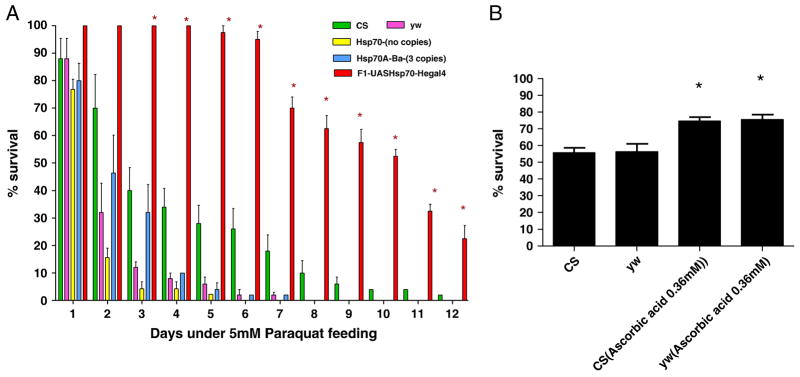
Figure 5a - Survival of adult flies exposed to 5mM Paraquat. Over-expression of Hsp70 in hemocytes significantly increased survival as compared to controls. Each bar represents the average of at least three tests for each line and error bars represent the standard errors. * With unpaired t-test P<0.05 with controls vs. the genotype. Figure 5b - Effect of feeding flies ascorbic acid under paraquat treatment. Survival of adult flies exposed to 20mM Paraquat. Each bar represents the average of at least three tests for each line and error bars represent the standard errors. * With unpaired t-test P<0.05 with control food fed flies vs.ascorbic acid fed flies.
Figure 6
Figure 6
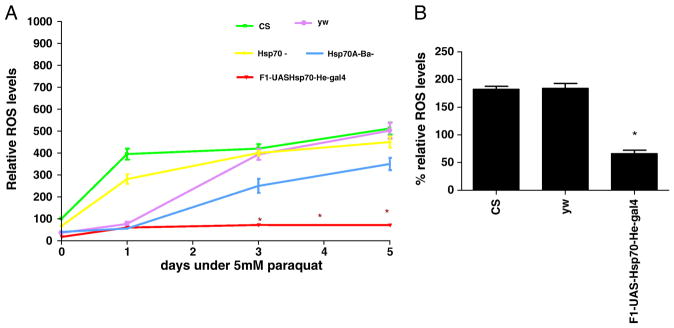
Figure 6a - Relative ROS levels after 5mM paraquat treatment. Upregulation of Hsp70 in hemocytes reduced the ROS levels significantly. Each point represents the average of at least three tests for each line and error bars represent the standard errors. * With unpaired t-test P<0.05 with controls vs. the genotype. Figure 6b - % relative ROS levels after 24 hours 20mM Paraquat treatment of larvae. Hemocytes isolated from Hsp70 over-expression generated significantly less ROS as compared to controls. Each bar represents the average of at least three tests for each line and error bars represent the standard errors. * With unpaired t-test P<0.05 with controls vs. the genotype.
Figure 7
Figure 7
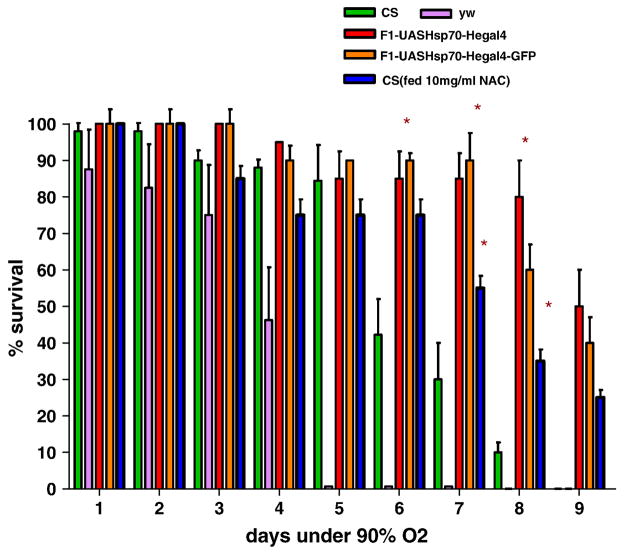
Survival of adult flies exposed to hyperoxia (90%O2) for 7 days. Over-expression of Hsp70 in hemocytes significantly increased survival as compared to controls. Each bar represents the average of at least three tests for each line and error bars represent the standard errors. * With unpaired t-test P<0.05 with controls vs. the genotype.
Figure 8
Figure 8
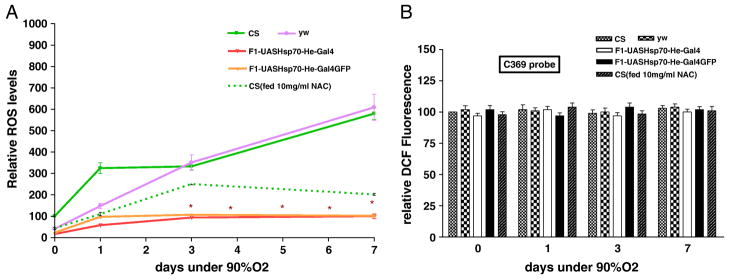
Figure 8a- Relative ROS levels after hyperoxia treatment. Upregulation of Hsp70 in hemocytes reduced the ROS levels significantly. Each point represents the average of at least three tests for each line and error bars represent the standard errors. * With unpaired t-test P<0.05 with controls vs. the genotype. Figure 8b-Measurement of Fluorescence with oxidation-insensitive probe of DCFH (C369) as a control under 90% O2. . Each bar represents the average of at least three tests for each line and error bars represent the standard errors
Figure 9
Figure 9
Survival of adult flies exposed to hypoxia (1.5% O2). Flies in which hemocytes are depleted by crossing either hid or reaper have similar increased survival as Hsp70 over-expression lines in hemocytes. Each point represents the average of at least three tests for each line and error bars represent the standard errors. * With unpaired t-test P<0.05 with controls vs. the genotype.
Figure 10
Figure 10
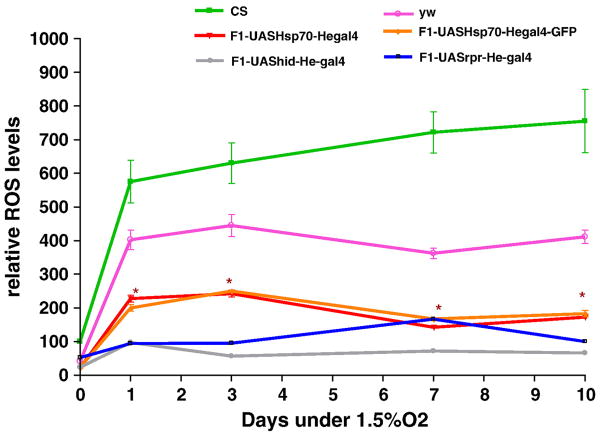
Relative ROS levels under 1.5% O2.Flies in which hemocytes are killed by reaper or hid have lower ROS levels than controls. Each point represents the average of at least three tests for each line and error bars represent the standard errors. * With unpaired t-test P<0.05 with controls vs. the genotype.

References

    1. Douglas RM, Miyasaka N, Takahashi K, Latuszek-Barrantes A, Haddad GG, Hetherington HP. Chronic intermittent but not constant hypoxia decreases NAA/Cr ratios in neonatal mouse hippocampus and thalamus. Am J Physiol Regul Integr Comp Physiol. 2007;292:R1254–1259. - PubMed
    1. Fan C, Iacobas DA, Zhou D, Chen Q, Lai JK, Gavrialov O, Haddad GG. Gene expression and phenotypic characterization of mouse heart after chronic constant or intermittent hypoxia. Physiol Genomics. 2005;22:292–307. - PMC - PubMed
    1. Gu XQ, Haddad GG. Decreased neuronal excitability in hippocampal neurons of mice exposed to cyclic hypoxia. J Appl Physiol. 2001;91:1245–1250. - PubMed
    1. Wang H, Zhu HF, Xia R, Zhou ZN, Zhu PH. Effect of intermittent and continuous hypoxia on ryanodine receptors of rat heart. Life Sci. 2003;73:2151–2160. - PubMed
    1. Zhou D, Wang J, Zapala MA, Xue J, Schork NJ, Haddad GG. Gene expression in mouse brain following chronic hypoxia: role of sarcospan in glial cell death. Physiol Genomics. 2008;32:370–379. - PubMed

Publication types

Substances

LinkOut - more resources