


Mass spectrometry accelerates membrane protein analysis
- PMID: 21616670
- PMCID: PMC3222592
- DOI: 10.1016/j.tibs.2011.04.005
Mass spectrometry accelerates membrane protein analysis
Abstract
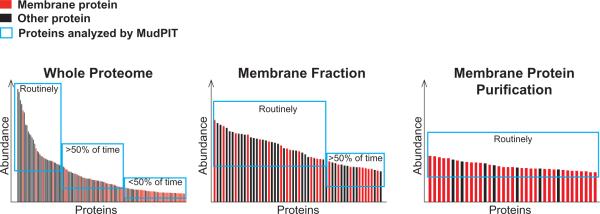
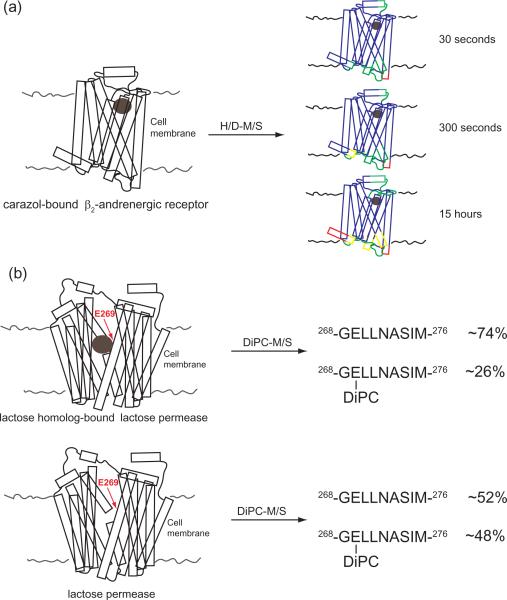
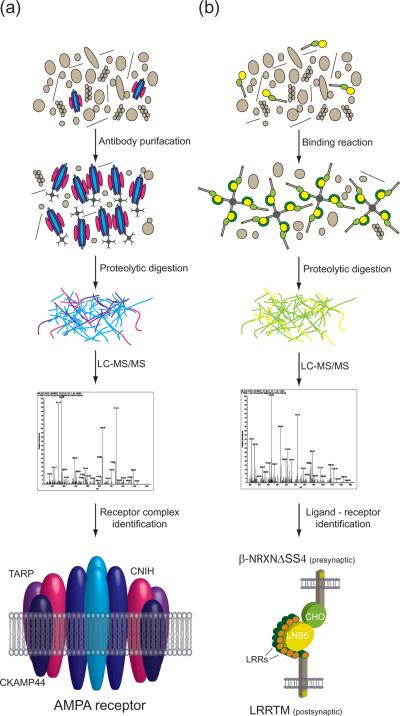
Cellular membranes are composed of proteins and glyco- and phospholipids and play an indispensible role in maintaining cellular integrity and homeostasis, by physically restricting biochemical processes within cells and providing protection. Membrane proteins perform many essential functions, which include operating as transporters, adhesion-anchors, receptors, and enzymes. Recent advancements in proteomic mass spectrometry have resulted in substantial progress towards the determination of the plasma membrane (PM) proteome, resolution of membrane protein topology, establishment of numerous receptor protein complexes, identification of ligand-receptor pairs, and the elucidation of signaling networks originating at the PM. Here, we discuss the recent accelerated success of discovery-based proteomic pipelines for the establishment of a complete membrane proteome.
2011 Elsevier Ltd. All rights reserved.
Figures
References
-
- Eichacker LA, et al. Hiding behind hydrophobicity. Transmembrane segments in mass spectrometry. J Biol Chem. 2004;279(49):50915–50922. Translated from eng. in eng. - PubMed
-
- Speers AE, Wu CC. Proteomics of integral membrane proteins--theory and application. Chem Rev. 2007;107(8):3687–3714. Translated from eng. in eng. - PubMed
-
- Hopkins AL, Groom CR. The druggable genome. Nat Rev Drug Discov. 2002;1(9):727–730. Translated from eng. in eng. - PubMed
-
- Weinglass AB, Whitelegge JP, Kaback HR. Integrating mass spectrometry into membrane protein drug discovery. Curr Opin Drug Discov Devel. 2004;7(5):589–599. Translated from eng. in eng. - PubMed
-
- Wu CC, Yates JR., 3rd The application of mass spectrometry to membrane proteomics. Nat Biotechnol. 2003;21(3):262–267. Translated from eng. in eng. - PubMed
Publication types
MeSH terms
Substances
Grants and funding
LinkOut - more resources
Full Text Sources
