. 2011 Jun 14;108(24):9827-32.
doi: 10.1073/pnas.1105714108. Epub 2011 May 26.

Converting structural information into an allosteric-energy-based picture for elongation factor Tu activation by the ribosome

Affiliations

Converting structural information into an allosteric-energy-based picture for elongation factor Tu activation by the ribosome

Andrew J Adamczyk et al. Proc Natl Acad Sci U S A. .

Abstract

The crucial process of aminoacyl-tRNA delivery to the ribosome is energized by the GTPase reaction of the elongation factor Tu (EF-Tu). Advances in the elucidation of the structure of the EF-Tu/ribosome complex provide the rare opportunity of gaining a detailed understanding of the activation process of this system. Here, we use quantitative simulation approaches and reproduce the energetics of the GTPase reaction of EF-Tu with and without the ribosome and with several key mutants. Our study provides a novel insight into the activation process. It is found that the critical H84 residue is not likely to behave as a general base but rather contributes to an allosteric effect, which includes a major transition state stabilization by the electrostatic effect of the P loop and other regions of the protein. Our findings have general relevance to GTPase activation, including the processes that control signal transduction.


Conflict of interest statement

The authors declare no conflict of interest.

Figures
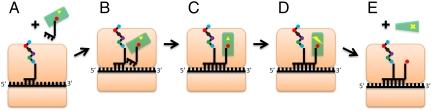
Fig. 1.
Fig. 1.
Schematic representation of the role of EF-Tu during the elongation process. The prokaryotic ribosome is shown (in orange) reading a messenger RNA (mRNA) sequence while in the early stage of elongating a polypeptide with an amino acid bound to an incoming ternary complex comprised of a GTP-bound EF-Tu and aa-tRNA. (A) EF-Tu:GTP:aa-tRNA (ternary complex) and the ribosome with mRNA. (B) Initial binding of ternary complex to the ribosome with mRNA. (C) Codon–anticodon recognition and conformational change of ternary complex on the ribosome with mRNA. (D) Hydrolysis of GTP to GDP on the ribosome with mRNA. (E) EF-Tu:GDP dssociation and aa-tRNA accommodation on the ribosome with mRNA. The small circles represent amino acids, the yellow triangle represents GTP, the yellow lightning bolt represents a chemical transformation (i.e., GTP hydrolysis to GDP), and the yellow cross represents GDP.
Fig. 2.
Fig. 2.
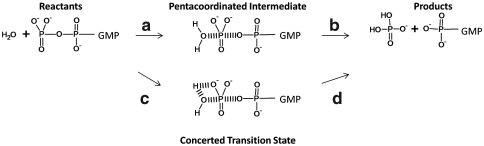
Schematic representation of the GTPase reaction mechanism. The reaction is considered as a two-step (steps a and b) or concerted process (steps c and d). Step a of the two-step process involves an attack of a water molecule on GTP and a formation of a pentacoordinated intermediate, whereas step b of the two-step process involves a cleavage of the Pβ-O bond and the generation of a leaving phosphate group and the GDP.
Fig. 3.
Fig. 3.
Energetics of the GTPase reaction (with the stepwise mechanism). The average free-energy profiles (kcal mol-1), calculated using the EVB FEP/umbrella sampling procedure, for the GTPase reaction in (A) water, EF-Tu, and EF-Tu’/ribosome complex, and (B) H84A, H84Q, and H84HNP mutants. The free energies are given relative to the free energies of the reactants. The notation NP (nonpolar) indicates that all the residual charges of the given residue are set to zero. The number of points in each profile does not correspond to the total number of frames employed in the FEP mapping of the respective GTPase reaction.
Fig. 4.
Fig. 4.
The average activation barriers (kcal mol-1) for the reacting systems in this study. For water, EF-Tu, EF-Tu′/rib, and the H84A mutant (EF-Tu′), the experimental data was taken from Table 1. Calculated activation barriers for the Ras and RasGAP systems are provided for the sake of comparison. kcat = 4.7 × 10-4 s-1 at 37 °C for Ras and kcat = 19.1 s-1 at 25 ºC for RasGAP were taken from ref. , and the experimental activation barriers were calculated analogously to the method described in Table 1. The notation NP indicates that all the residual charges of the given residue or set of residues are set to zero. The notation K = 0.2 indicates that the simulation was performed with a force constraint using a force constant of K = 0.2 kcal mol-1 -2 on the EF-Tu residues. The notation “rib” indicates the presence of the ribosome in the simulations.
Fig. 5.
Fig. 5.
Comparing the structures of the active site in both the EF-Tu (gray, from PDB ID code 1EFT) and EF-Tu′/ribosome (yellow, from PDB ID code 2XQD) that were used as starting points of our simulations (PyMOL software was used for the structural alignment). Critical regions (P loop, switch I, and switch II) are labeled. GTP and water are included in the RS configuration of EF-Tu′/ribosome. The Mg2+, aa-tRNA, and ribosome are not shown for the sake of clarity in this diagram. Note that, although the superposition can be subjective, the actual calculated group contributions (see SI Text) are independent of the relative initial orientation on the structures.
Fig. 6.
Fig. 6.
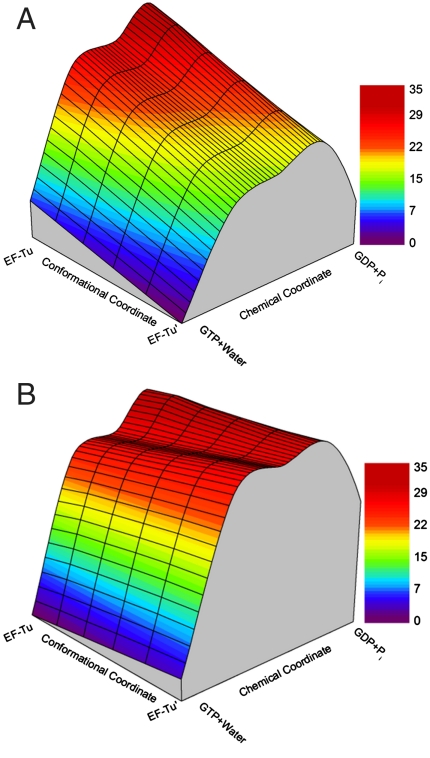
An approximate catalytic free-energy landscape (kcal mol-1) for the coupling between the chemical coordinate (i.e., the movement from the RS to the PS) and the conformational coordinate that connects the EF-Tu and EF-Tu′ conformations in the (A) native and (B) H84A mutant systems.

References

    1. Daviter T, Wieden HJ, Rodnina MV. Essential role of histidine 84 in elongation factor Tu for the chemical step of GTP hydrolysis on the ribosome. J Mol Biol. 2003;332:689–699. - PubMed
    1. Liljas A. Structural Aspects of Protein Synthesis. Singapore: World Scientific; 2004.
    1. Agirrezabala X, Frank J. Elongation in translation as a dynamic interaction among the ribosome, tRNA, and elongation factors EF-G and EF-Tu. Q Rev Biophys. 2009;42:159–200. - PMC - PubMed
    1. Yonath A. Polar bears, antibiotics, and the evolving ribosome (Nobel lecture) Angew Chem Int Ed Engl. 2010;49:4340–4354. - PubMed
    1. Ogle JM, et al. Recognition of cognate transfer RNA by the 30S ribosomal subunit. Science. 2001;292:897–902. - PubMed

Publication types

MeSH terms

Substances

LinkOut - more resources