Review
. 2011 Jun 1;16(7):2598-621.
doi: 10.2741/3875.

Biomineralization of bone: a fresh view of the roles of non-collagenous proteins

Affiliations
Review

Biomineralization of bone: a fresh view of the roles of non-collagenous proteins

Jeffrey Paul Gorski. Front Biosci (Landmark Ed). .

Abstract

The impact of genetics has dramatically affected our understanding of the functions of non-collagenous proteins. Specifically, mutations and knockouts have defined their cellular spectrum of actions. However, the biochemical mechanisms mediated by non-collagenous proteins in biomineralization remain elusive. It is likely that this understanding will require more focused functional testing at the protein, cell, and tissue level. Although initially viewed as rather redundant and static acidic calcium binding proteins, it is now clear that non-collagenous proteins in mineralizing tissues represent diverse entities capable of forming multiple protein-protein interactions which act in positive and negative ways to regulate the process of bone mineralization. Several new examples from the author's laboratory are provided which illustrate this theme including an apparent activating effect of hydroxyapatite crystals on metalloproteinases. This review emphasizes the view that secreted non-collagenous proteins in mineralizing bone actively participate in the mineralization process and ultimately control where and how much mineral crystal is deposited, as well as determining the quality and biomechanical properties of the mineralized matrix produced.


Figures
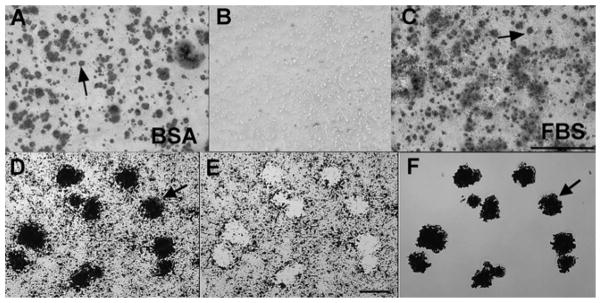
Figure 1
Figure 1
Biomineralization foci can be isolated from total cell layers by laser capture microscopy. A and B, UMR-106-01 osteoblastic cells were cultured in serum-depleted conditions (BSA), or C, the presence of serum (FBS). Cultures were stained with Alizarin red S to detect hydroxyapatite crystals. B, both conditions failed to mineralize in the absence of BGP. Arrows point to mineralized BMF (A and C). Scale bar: 500 μm. D–F, laser capture microscopy of Alizarin red S stained BMF from UMR-106-01 culture. Arrows refer to the same BMF structures in all panels. D, microscopic view of field to be laser-captured. E, appearance of the residual cell layer left behind after laser dissection of mineralized BMF. F, purified BMF temporarily affixed to the “cap” used for laser capture. Scale bar: 25 μm. (Reproduced with permission of the J. of Biological Chemistry).
Figure 2
Figure 2
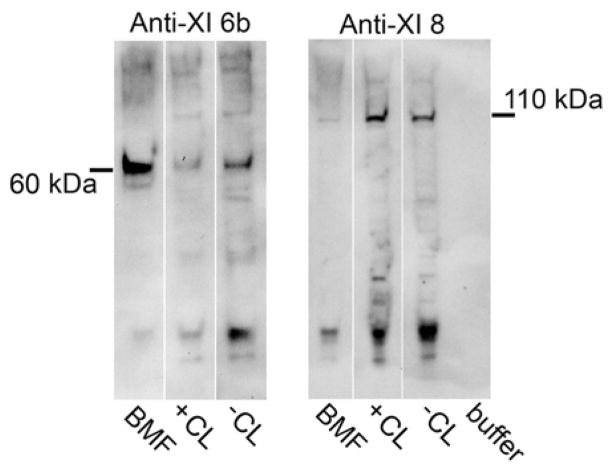
Type XI collagen 6b splice variant is enriched in biomineralization foci. Fractions from osteoblastic cultures in Figure 1 were extracted and solubilized and subjected to Western blotting. A 60 kDa N-terminal 6b immunoreactive fragment of the COL11A1 chain was enriched in mineralized BMF (see F, Figure 1) compared to that from the total cell layer from mineralized (see D, Figure 1) or un-mineralized cultures (see B, Figure 1). In contrast, immunoreactive splice variant 8 was not enriched in BMF. KEY:BMF, extract of laser micro dissected biomineralization foci; +CL, extract from cell layer from mineralized culture; −CL, extract from cell layer from un-mineralized culture. Antibodies kindly provided by Dr. J. T. Oxford.
Figure 3
Figure 3
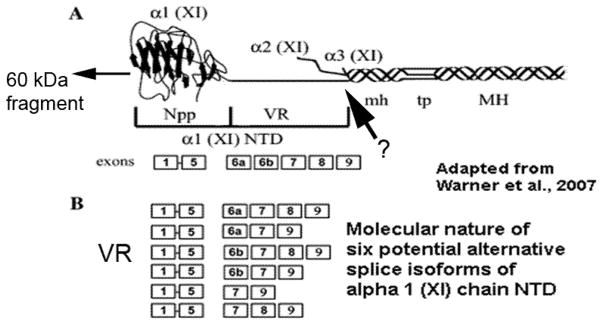
Model of type XI collagen structure [adapted from Warner et al. (58)]. A, Proposed trimeric structure showing large non-helical N-terminal domain for alpha 1 chain. Arrow demarks approximate position of proteolytic cleavage by unknown protease which generates 60 kDa N-terminal fragment found enriched within biomineralization foci (see Figure 2). B, Description of the composition of six different possible splice variant sequences for the N-terminal domain. KEY: VR, variable region; NTD, N-terminal domain; Npp, N-terminal propeptide.
Figure 4
Figure 4
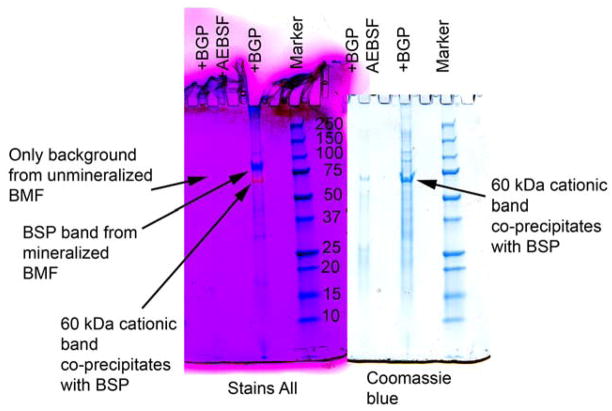
Bone sialoprotein is immunoprecipitated together with 60 kDa cationic type XI N-terminal fragment only from mineralized osteoblastic cultures. Extracts of mineralized and un-mineralized osteoblastic cultures were immunoprecipitated with anti-bone sialoprotein antibodies. Immunoprecipitates were subjected to SDS-PAGE and the same gel was stained sequentially with Stains All (left) and then with Coomassie blue dye (right). KEY: +BGP +AEBSF, extract from culture where mineralization was inhibited by 4-(2-aminoethyl)-benzenesulfonyl fluoride hydrochloride; +BGP, extract from mineralized culture; marker, molecular weight standards.
Figure 5
Figure 5
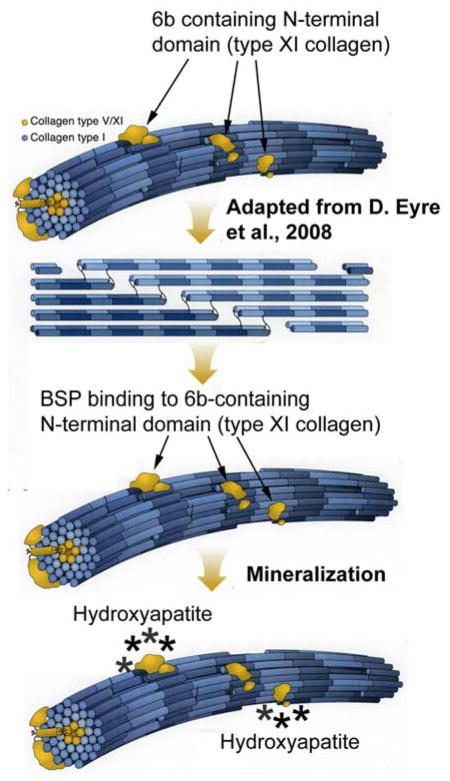
Model for mineralization of collagen fibrils involving 6b splice variant containing type XI collagen and phosphoprotein BSP. Adapted from image by D. Eyre et al. (61), cationic 6b containing N-terminal domains are positioned on the surface of type I fibrils where they can bind mineralization nucleator BSP. We propose this mechanism may fulfill the 1964 phosphoprotein-collagen hypothesis of Glimcher, and, Veis and Schleuter.
Figure 6
Figure 6
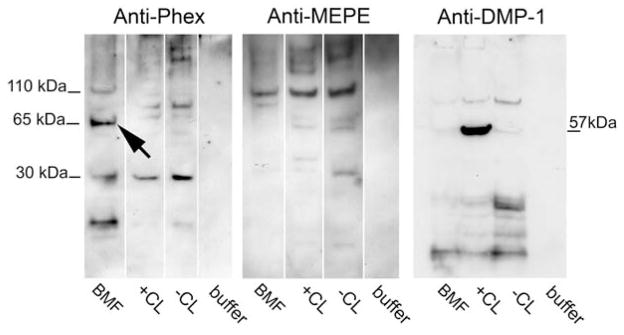
Immunoblotting shows that a 60 kDa fragment of PHEX is specifically enriched in biomineralization foci whereas MEPE and DMP1 are not. BMF were isolated from Alizarin red stained cell layers using laser micro dissection (see Figure 1), and along with total cell layer fractions, were extracted as described by Huffman et al. (11). Six micrograms of total protein were applied to each lane and Western blotted with monospecific antibodies using chemiluminescent detection. Large arrow denotes band specifically enriched in purified BMF. KEY: BMF, extract of laser micro dissected biomineralization foci; +CL, extract from cell layer from mineralized culture; −CL, extract from cell; and, buffer alone, extraction buffer only. Antibodies were kindly provided by Drs. P.S. Rowe and L.D. Bonewald. referred to the publication by Yadav et al. (8) for a more complete description of their “unified model of mineralization”.
Figure 7
Figure 7
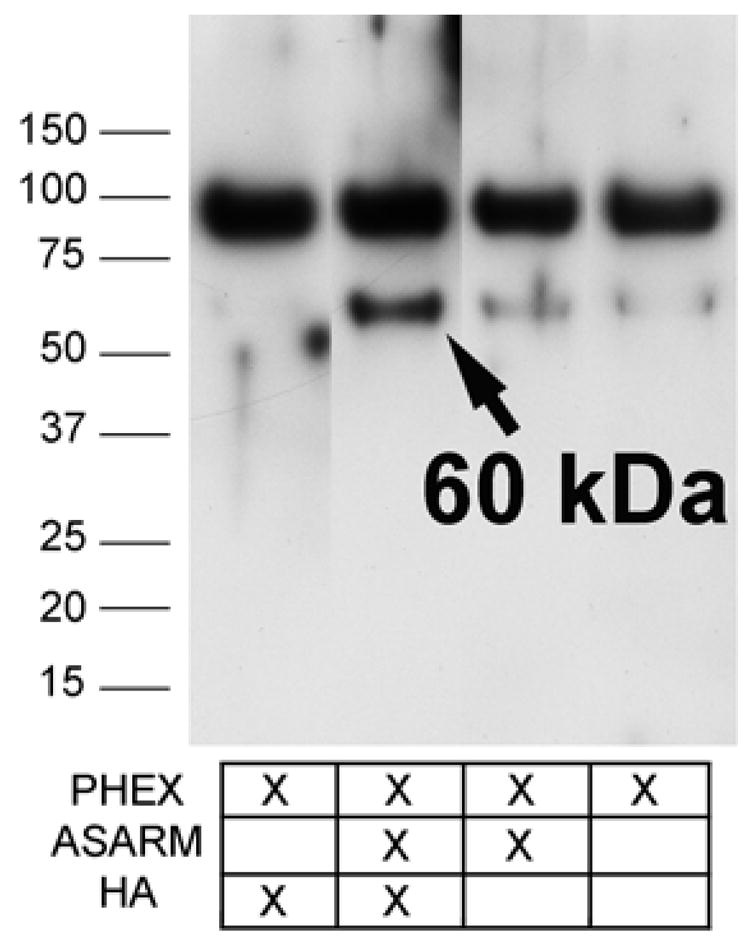
Hydroxyapatite induces autolytic cleavage of PHEX in presence of ASARM peptide. KEY: PHEX, recombinant 98 kDa secPHEX; ASARM, ASARM peptide; and HA, hydroxyapatite crystals. Proteins were kindly provided by Dr. Peter S. Rowe.
Figure 8
Figure 8
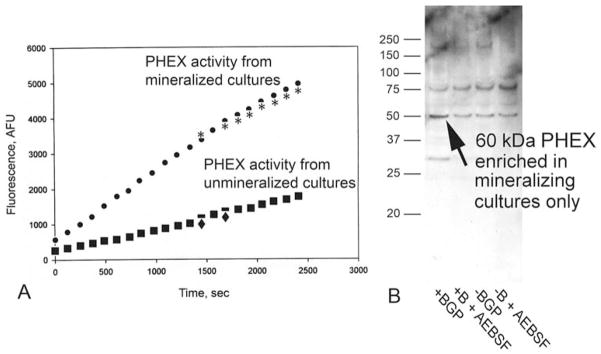
PHEX endoprotease activity and 60 kDa PHEX fragment content are higher in membranes from mineralized osteoblastic cultures versus un-mineralized controls. A, Crude membranes were isolated and assayed for PHEX endopeptidase activity with a specific fluorescent substrate assay as previously described (147). Cultures assayed were either mineralized by addition of BGP (● and *) or treated with AEBSF to block mineralization (■ and ◆) (188). Individual symbols on the graph represent duplicate analyses. Activity was normalized based on the protein content of membrane preparations. (Data obtained in collaboration with Drs. S. Liu and D. Quarles). B, Crude membranes from mineralizing cultures are enriched in the 60 kDa PHEX band. Comparing the data in Figures 8A and 8B leads to the conclusion that the 60 kDa PHEX band is catalytically active. KEY: +BGP, mineralized; +B + AEBSF, mineralization blocked with AEBSF; −BGP, unmineralized (without BGP); −BGP + AEBSF (without BGP but with AEBSF). (Data obtained in collaboration with Drs. S. Liu and D. Quarles.)

References

    1. Olsen Bjorn R. Bone Embryology. In: Favus Murry J., editor. Primer on the Metabolic Bone Diseases and Disorders of Mineral Metabolism. American Society for Bone and Mineral Research; Washington, DC: 2006.
    1. Turner Charles H, Woltman TA, Belongia DA. Structural changes in rat bone subjected to long-term, in vivo mechanical loading. Bone. 1992;13:417–422. - PubMed
    1. Gorski Jeffrey P. Is all bone the same? Distinctive distributions and properties of non-collagenous matrix proteins in lamellar vs. woven bone imply the existence of different underlying osteogenic mechanisms. Crit Rev Oral Biol Med. 1998;9:201–223. - PubMed
    1. Simmons Edward D, Jr, Pritzker Kenneth P, Grynpas Marc D. Age-related changes in the human femoral cortex. J Orthop Res. 1991;9:155–167. - PubMed
    1. Bonucci Ermanno. Comments on the ultrastructural morphology of the calcification process: an attempt to reconcile matrix vesicles, collagen fibrils, and crystal ghosts. Bone and Mineral. 1992;17:219–222. - PubMed

Publication types

LinkOut - more resources